Pittsburgh's coldest days are getting warmer


Add Axios as your preferred source to
see more of our stories on Google.
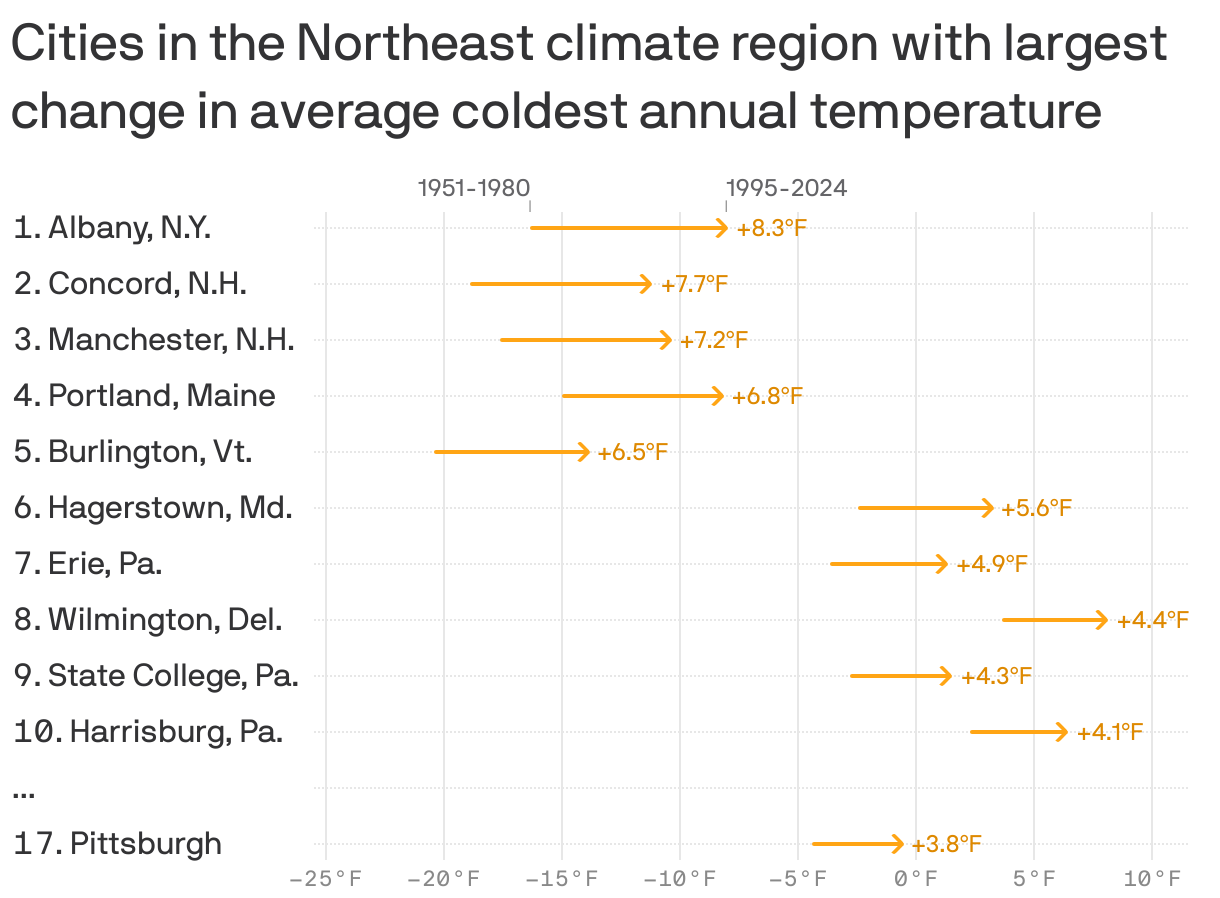
Thirty-year average coldest temperatures are rising almost universally nationwide, including in Pittsburgh, a new analysis found.
Why it matters: Such a shift can affect us in a variety of ways — changing which plants and insects thrive in our neighborhoods, for example, amid other impacts of climate change.
Driving the news: The 30-year average coldest temperature for 1995-2024 compared to 1951-1980 was higher in 97% of the 243 locations analyzed by Climate Central, a research and communications group.
- Among the locations with an increase, the coldest annual temperature was 3.7°F higher on average.
- The group's analysis is based on data from NOAA's Regional Climate Centers.
Zoom in: Pittsburgh saw a +3.8°F increase in average coldest temperature between the two 30-year periods.
- Erie, just two hours north of Pittsburgh, saw the biggest change in Pennsylvania at +4.9°F.
State of play: Pittsburgh's springs are also getting warmer, and last year was the region's hottest on record.
Zoom out: Reno, Nevada (+9.7°F), had the biggest increase in average coldest temperature between the two 30-year periods.
- Watertown, New York (-4.0°F), saw the biggest decrease.
What they're saying: "Although such shifts could expand growing ranges for high-value crops such as almonds, oranges, and kiwis, they could also expand ranges for harmful weeds and pests," Climate Central says, citing the invasive kudzu vine and the brown marmorated stink bug.
What's next: The group also used climate modeling and NASA data to project future change between the 30-year period of 1995-2024 and the 2036-2065 period.
- It predicts that the 30-year average coldest temperature will rise in every one of the 243 locations analyzed between those periods, with an average gain of 5.6°F.