How Allegheny County rates in health outcomes

Add Axios as your preferred source to
see more of our stories on Google.
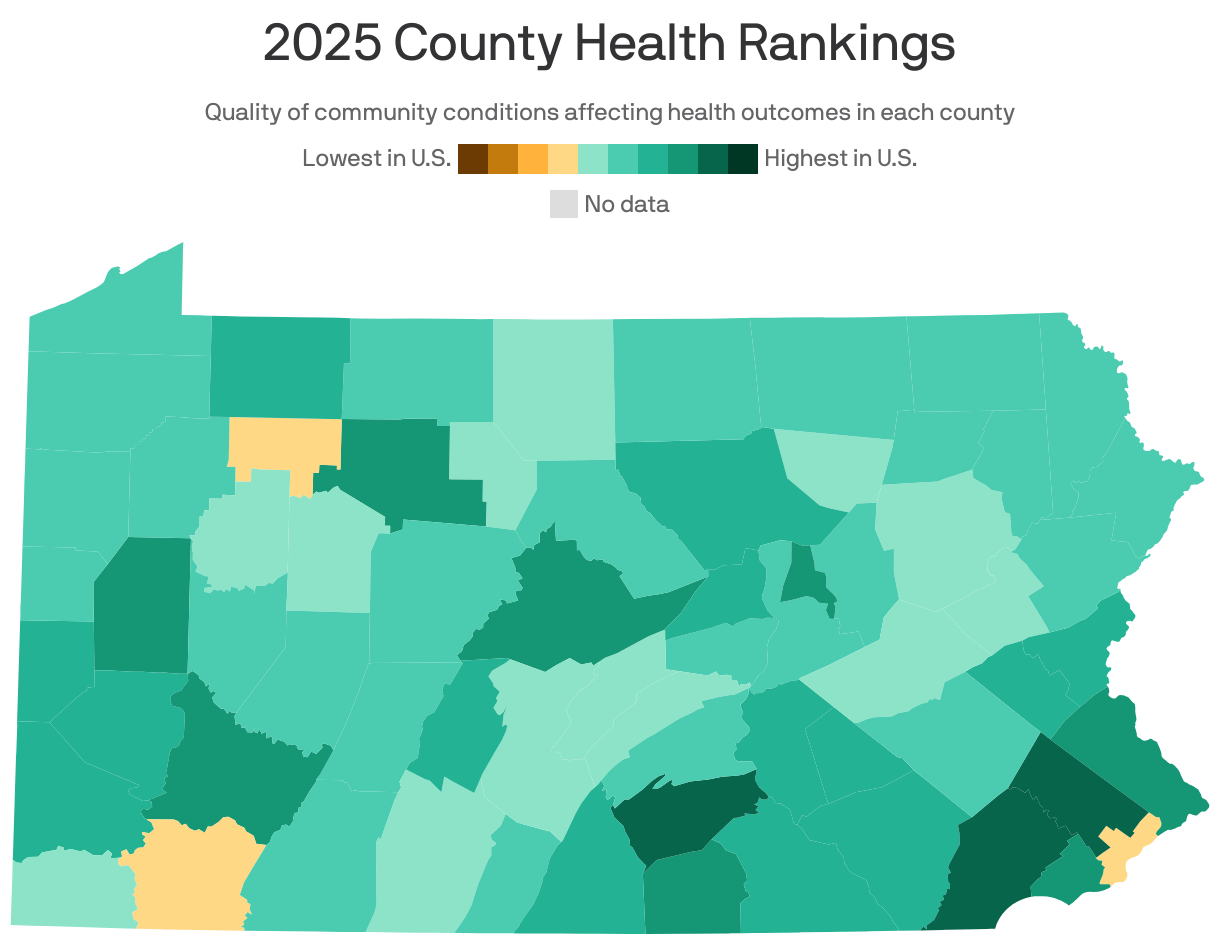
Pittsburgh's strong "eds and meds" economy is contributing to better overall health outcomes for Allegheny County residents compared with the average Pennsylvania county, a new report suggests, but there's still room for improvement.
Why it matters: Allegheny County residents are faring slightly better than the state average, partly thanks to greater access to primary and mental health care providers and a higher percentage of residents completing high school and some college, according to County Health Rankings & Roadmaps.
Driving the news: The report, published annually by the University of Wisconsin Population Health Institute, looks at dozens of measures including life expectancy, unemployment, uninsured adults, mental health, obesity rates, education and environmental issues.
By the numbers: There is one primary care physician for every 920 residents in the county — better than the state average of one for every 1,260 people. Mental health care is more readily available, too, with one provider for every 210 residents in the county, compared with one for every 350 people statewide.
- 81% of adults in Allegheny County have completed some post-secondary education, including vocational/technical schools, junior colleges or four-year colleges, compared with 68% in Pennsylvania.
- The county has slightly lower rates of adult obesity, diabetes, food insecurity, teen births, unemployment, and uninsured adults and children than state and national averages.
Yes, but: The county has slightly higher rates of child mortality, injury deaths, poor mental health days, excessive drinking, drug overdose deaths and air pollution.
- Although air quality in Pittsburgh is improving, the region still has some of the worst in the nation, according to the American Lung Association.
- Significant health disparities persist for people of color in Allegheny County. Black residents have a life expectancy of just 68.9 years — far lower than the county average of 76.9, the report says.
- According to a 2019 report from Pittsburgh's Gender Equity Commission, Black women in the city rank among the lowest in the country for overall livability. This includes higher rates of maternal mortality, infant mortality, and overall death rates compared with other groups.
The big picture: Appalachia, the Deep South and Tribal regions were more likely to have community conditions that contribute to poorer health in the report.
What they're saying: "As we work toward a world where everyone has what they need to thrive, we must continue to uncover and challenge the power and rules that shape health and well-being," the authors of the report wrote.