Entering final year as governor, DeSantis takes victory lap on education

Add Axios as your preferred source to
see more of our stories on Google.
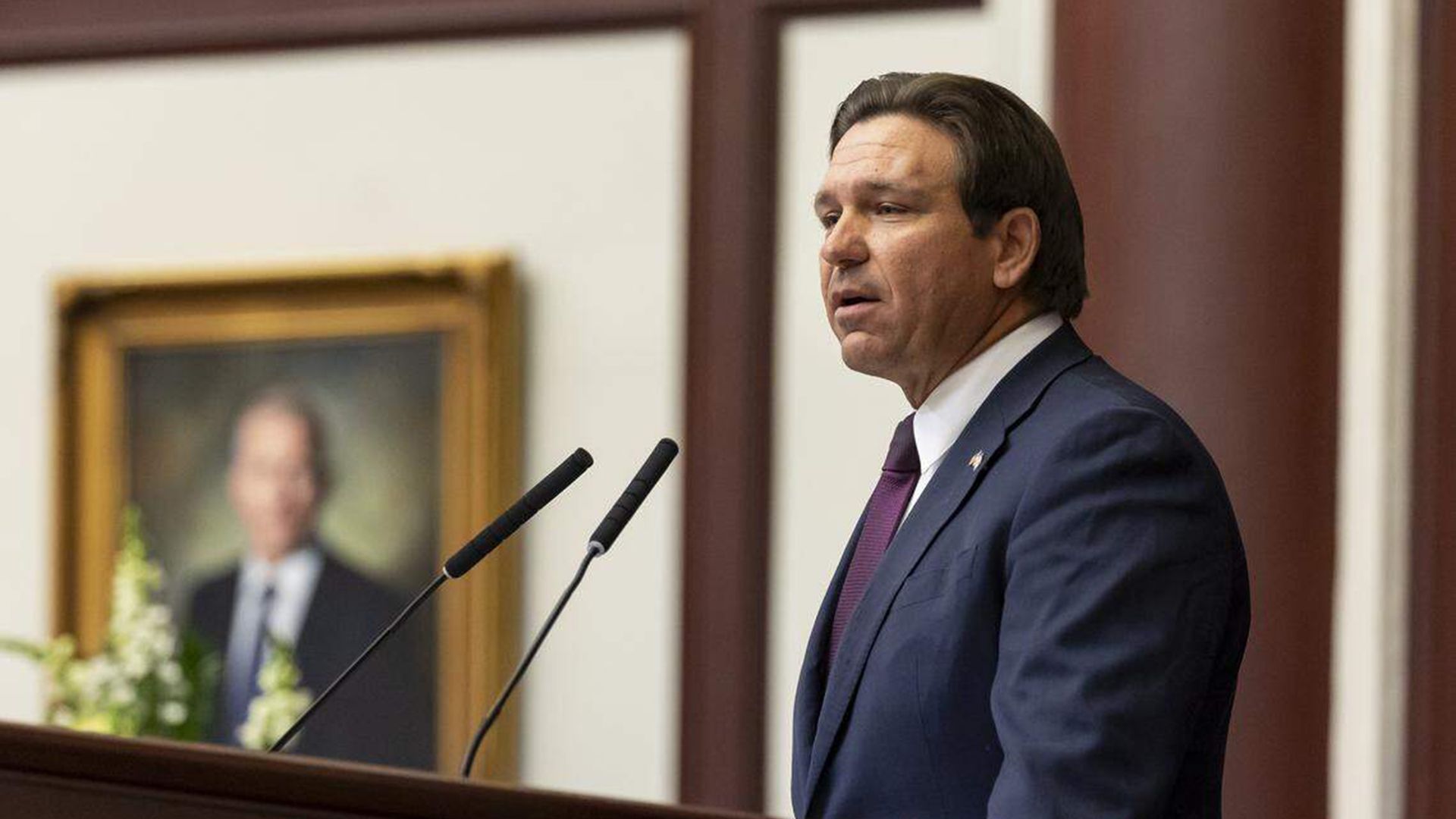
Gov. Ron DeSantis touted his education reforms during his State of the State address in Tallahassee. Photo: Matias J. Ocner/Miami Herald/Tribune News Service via Getty Images
Entering his final year in office, Gov. Ron DeSantis, who built his national profile on overhauling public education, is celebrating his achievements rather than pushing for one final round of reforms.
Why it matters: The governor's education policies have provided a blueprint for conservative reforms nationwide, with Florida during his tenure often serving as a test kitchen for boundary-testing policies.
- But many public education advocates say the governor will leave office having gutted the state's public school system, to the detriment of teachers and families.
State of play: In his final State of the State speech this month, DeSantis took a victory lap, touting the state's expanded school-choice options and efforts to boost teacher salaries.
- He claimed his administration has "ensured schools have a right to educate, not a right to indoctrinate."
Zoom in: Throughout his tenure, DeSantis has pointed to the teacher salary increases he signed into law in 2020, which boosted the minimum salary to $47,500, as a signature achievement.
- He said his administration "provided a record of $6 billion to better compensate our teachers" and touted that Florida "has the highest minimum salary in the southeast region."
Reality check: Last year, the National Education Association ranked Florida 50th in the nation for average teacher salary for the second year in a row. (The administration has dismissed the reports, calling them "bogus.")
- Educators say that's because DeSantis' reforms prioritized starting teacher salaries, leaving many veteran teachers making similar pay or less than their first- or second-year counterparts.
Zoom out: One of DeSantis' pivotal pieces of education legislation came in 2023, when he signed into law one of the nation's largest school-choice programs.
- Advocates for the expansion, including DeSantis, argue the move has given parents more freedom and control over their children's education.
- Opponents say it has rerouted money from already underfunded public schools to private institutions.
Case in point: Miami-Dade County Public Schools has seen a direct correlation between the voucher expansion and district enrollment, leading to budgetary constraints and the repurposing of underpopulated schools.
What they're saying: "What we've seen under this governor, as a way to incentivize charters and vouchers, is an all-out public assault on public schools, defaming and impugning public schools," Andrew Spar, president of the Florida Education Association, told Axios.
- Spar pointed to DeSantis' culture-war focus on curriculum overhauls and book bans. As Florida's schools have been politicized, he said, threats against public school workers have become "commonplace."
Between the lines: DeSantis has also had a heavy hand in local school boards, backing numerous candidates across the state.
- In Miami-Dade, he backed two successful candidates and appointed two others, reshaping the board with a conservative lean.
What we're watching: GOP Rep. Alex Rizo, a former charter-school principal and public school administrator, is seen as a contender to replace retiring Miami-Dade Schools Superintendent Jose Dotres, per the Miami Herald.
The bottom line: Even though legislators don't have much education policy on their plate this session, Florida's status as a conservative model appears likely to endure beyond DeSantis' tenure.