Business Brief
World Cup could boost Miami economy. But don't trust lofty projections, experts say

Add Axios as your preferred source to
see more of our stories on Google.
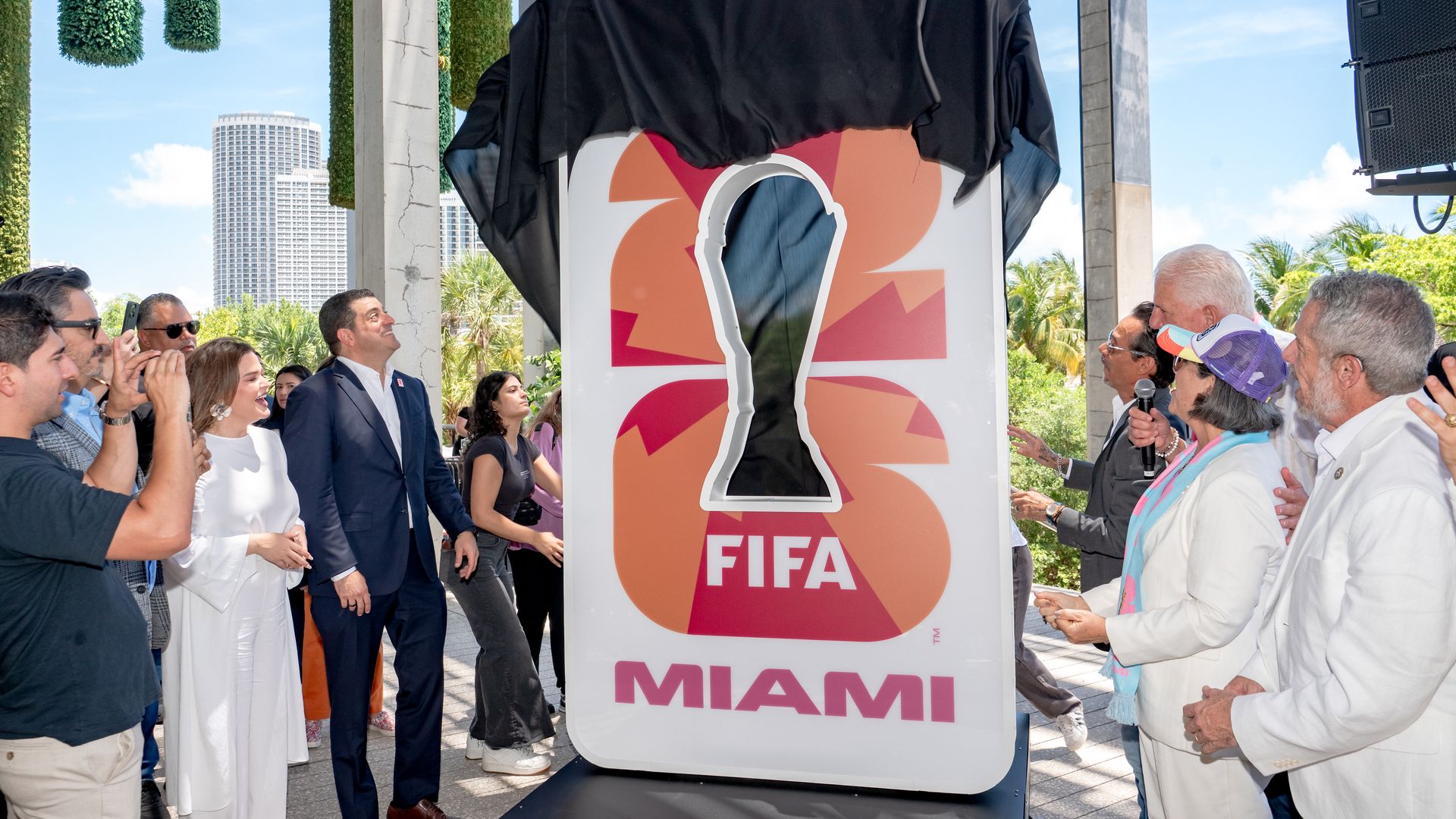
Celebrities and politicians gathered in Miami to mark the one-year countdown until the World Cup. Photo: Ivan Apfel/Getty Images
World Cup organizers say next year's tournament could be a huge win for the Miami economy, but economists say it's more complicated than that.
Why it matters: Miami-area governments are investing about $53 million to help fund the tournament, most of it coming from Miami-Dade County.
- That money will fund things like security, transportation and a free three-week fan festival in Bayfront Park that will stream the matches being played at Hard Rock Stadium, according to the Miami Herald.
State of play: The Miami host committee says the World Cup will drive "tourism, job creation, and global visibility for the region."
- A 2024 economic impact study commissioned by FIFA estimated that the Miami metro area could see between $920 million and $1.3 billion in economic output between June 2023 and August 2026.
Friction point: Economists have long been skeptical of similar studies published by tournament organizers, says Holy Cross professor Victor Matheson, an expert in sports economics.
- After reviewing a summary of the Miami report, Matheson told Axios that the estimates appear to be "wildly exaggerated" and "overlook a couple of huge issues."
The other side: FIFA declined to comment for this story.
- The Miami host committee did not respond to a request for comment.
Zoom in: A large percentage of attendees will be from the Miami area, so the hundreds they spend per ticket will go to FIFA instead of into the local economy, he argued.
- "Thus, any spending on tickets by local fans actually makes Miami poorer, not richer."
- He says some spending by visiting fans is also likely to "leak out of the economy," pointing to hotel room stays paid to large hotel chains.
Flashback: A 2004 study Matheson co-authored on the 1994 World Cup in the U.S. concluded that the $4 billion economic impact that organizers projected "probably did not materialize."
- Researchers concluded there might have been a negative impact overall.
Still, Matheson predicts Miami will likely see a positive economic impact since it doesn't have to build new stadiums or tourist infrastructure.
- And local governments collect resort taxes from hotels, which are likely to be busier than normal because the World Cup is happening during Miami's summer off-season.
Case in point: During the Club World Cup from June 14-July 1, hotel occupancy was about 72% in Miami-Dade County — up nearly 8% from the same period last year — according to the Greater Miami Convention & Visitors Bureau.
Andrew Zimbalist, a professor emeritus of economics at Smith College, tells Axios that Miami could see a boost in tourism, which he says is the main way host cities make money.
- Still, Zimbalist — who also reviewed FIFA's Miami report — says he doesn't "expect a massive increase" and says U.S. immigration policies could deter foreign visitors.
- Depending on the total operating costs, Zimbalist says, "it looks to me like in the best of circumstances it's a neutral economic impact. It's more likely to have a negative impact."
Dennis Coates — an economics professor at the University of Maryland, Baltimore County — notes that the FIFA study projects government revenues of up to $25 million.
- Compared to the $53 million governments are investing, Coates says: "That's not a good deal."
The bottom line: Both Coates and Matheson say there are benefits to hosting a World Cup, even if it doesn't make the government money.
- Local fans will get the chance to attend matches or go to watch parties, and local shops could see business boom, Coates says.
- But he said even if the projections are correct, Miami's windfall would represent a small fraction of its economy.
- "To say that this is going to be this huge driver of benefit for the community, probably not."