Controversial Florida parks plan touted access but missed the mark, experts say

Add Axios as your preferred source to
see more of our stories on Google.
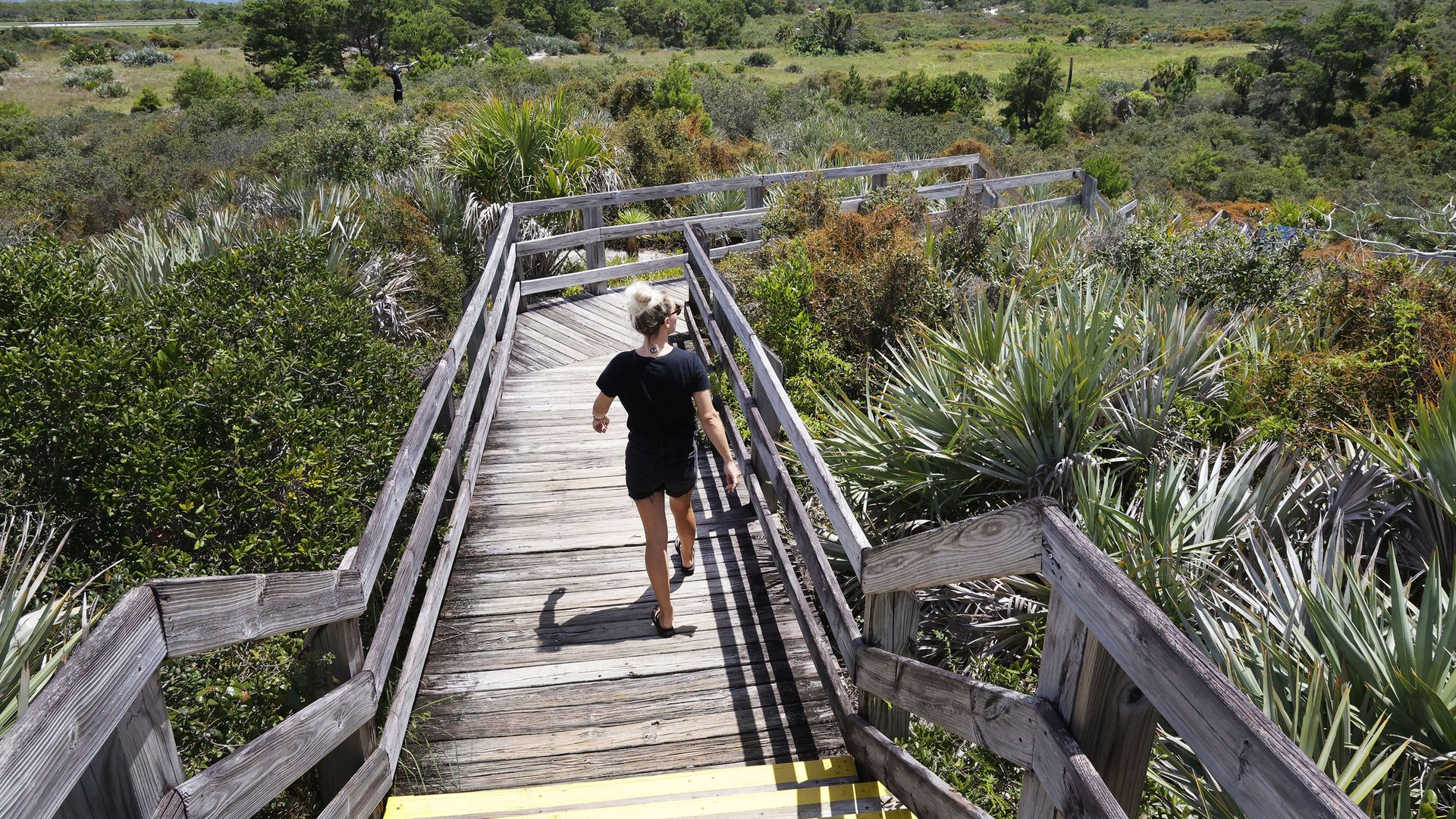
A woman leaves the Hobe Mountain Tower at Jonathan Dickinson State Park. Photo: Carline Jean/South Florida Sun Sentinel/Tribune News Service via Getty Images
The state agency that pitched adding sports amenities and lodging to Florida's state parks said its goal was to "expand public access" — an argument that didn't fly with environmentalists, conservation groups and many residents.
Why it matters: Advocates stress that meaningful ways to increase park accessibility for Floridians and the millions of visitors each year do exist — but golf courses and pickleball courts aren't among them.
- "Building high-end golf courses is the antithesis of accessibility [and] the argument never carried water with us," Eve Samples, executive director of Friends of the Everglades, told Axios.
- "That said, free admission or free admission days or weeks could be a valuable way to increase access" for residents, she said.
Catch up quick: Last month, the state's Department of Environmental Protections confirmed its plans to develop nine state parks.
- The plans were met with swift pushback from Floridians and elected officials on both sides of the political aisle who said development could threaten the parks' natural splendor and sensitive habitats.
- Following widespread criticism, Gov. Ron DeSantis withdrew the plans, which he said were "half-baked" and hadn't been approved. (His administration had earlier defended the plans on social media.)
What they're saying: Benji Studt, a conservation biologist, told Axios that Florida is "primed to really capture and become one of these ecotourism destinations," similar to how travelers think of Colorado or Utah.
- One way of doing that, he said, is investing in providing resource-based recreation, which the state defines as activities dependent on "natural or cultural environments that cannot be easily replicated or provided elsewhere." (Think hiking or kayaking.)
- The Department of Environmental Protection's pitch to revamp the parks called for boosting the state's outdoor recreation economy, but it didn't provide specifics.
Zoom in: The Hobe Mountain Observation Tower at Jonathan Dickinson State Park, one of the nine targeted parks, has been closed since April for improvements.
- The tower and the boardwalk that leads up to it aren't ADA accessible. Studt said changing that would be a "wonderful" improvement.
- The park's Trapper Nelson Interpretive Site is only accessible by canoe, small boat or the tour boat and is tide-dependent.
- A hiking trail with pedestrian bridges over creeks would increase access to a unique piece of Florida's history for all visitors, he said.
Zoom out: State parks have contracts with private businesses to provide amenities like kayaking or bike rentals.
- The businesses wouldn't offer the equipment for free, but it'd be "reasonable" for state funding to support the costs once or twice a year, Samples suggested.
Bottom line: "Accessibility is about connecting people to the land where we live [and] understanding our role within the environment," Studt said. "And it can be done in a way that can boost the economy."