Making sense of Miami's chaotic political moment

Add Axios as your preferred source to
see more of our stories on Google.
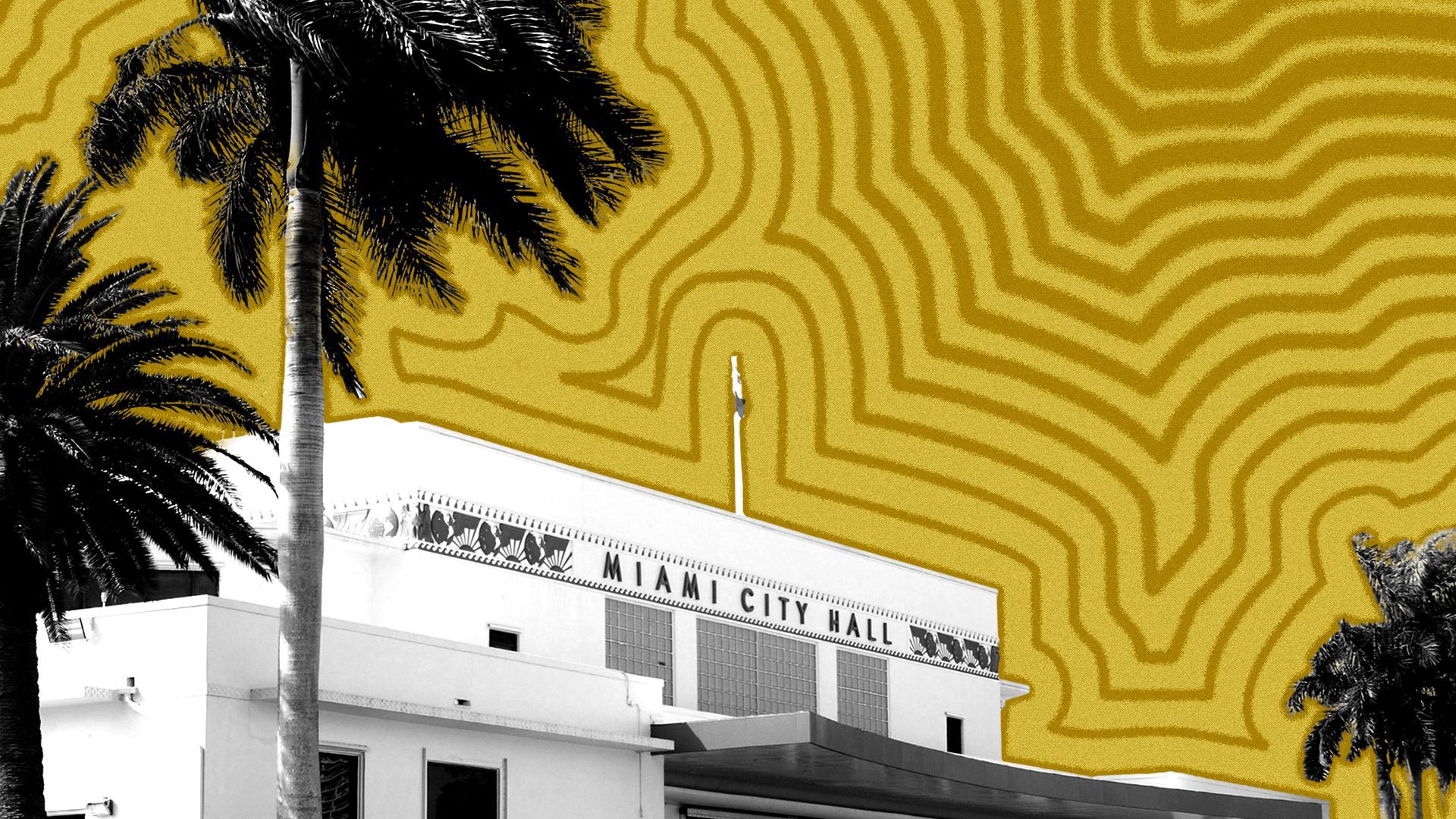
Photo illustration: Brendan Lynch/Axios. Photo: Joe Sohm/Visions of America/Universal Images Group via Getty Images
South Florida's 2024, so far: A former school board member arrested, Doral's city manager ousted, and three current and former Miami officials either removed from office or placed under investigation, all before Valentine's Day.
- This political turmoil comes against the backdrop of Miami's mayor facing a federal investigation for his outside work for a local developer.
- Meanwhile, a sitting commissioner might soon see his home go up for auction to pay a $63.5 million civil judgment. And a former commissioner is awaiting trial on corruption charges.
Why it matters: Political controversy is nothing new in Miami, but the chaos erupting across South Florida makes this a potentially game-changing moment in local politics.
- What remains to be seen: whether it will bring accountability, reckoning and reform or prompt a resurgence of Miami's notorious political vendettas.
Catch up fast: On Jan. 11, former Miami-Dade school board member Lubby Navarro was arrested for allegedly spending at least $100,000 of taxpayer money on personal items, the Miami Herald reported.
- Barbie Hernandez was removed as Doral city manager two weeks later, over what a sitting councilwoman claimed was a "clear conflict of interest" and the misuse of city resources.
- A Feb. 1 executive order made public an investigation into former Miami City Commissioner Sabina Covo for allegations including bribery, according to reporting by the Herald.
- Then, the Coral Gables City Commission fired City Manager Peter Iglesias, who was accused of insubordination by a newly elected commissioner.
- And just last week, Homestead City Manager Jerry Estrada was fired. In November, the mayor claimed he was more "concerned about taking care of staff, rather than doing the best possible job," according to the South Dade News Leader.
What they're saying: "What we're witnessing now is the cumulative effect of unserious and ego-driven people that have populated every aspect of local government," Fernand Amandi, Democratic pollster and lecturer in the department of political science at the University of Miami, tells Axios.
- "This is a generation of people who don't have the interest of the community in front of their own rivalries," he says. "It's something Miami-Dade has always struggled with, but it's happening now to an unprecedented and historic degree, and no area is unscathed."
Meanwhile, the city's economic and development boom has only brought out "the worst of the worst" behavior across local governments, David Marko, a business transaction lawyer and Miami native, tells Axios.
- "Miami has always had problems, but economics have changed things," he says. The city has become "much more economically attractive [in recent years, and] real money is on the line now."
Between the lines: The challenges and removals are often coming from fellow officials, not voters. (When Herndandez was removed, dozens of community members lauded her work as Doral's city manager and urged the council to reconsider.)
- Much of the chaos happening in the municipalities is "a war among themselves, so everything is personal," Amandi says. Coupled with the "intense political polarization" the county as a whole is grappling with, what's left is a perfect storm of infighting, he adds.
Yes, but: Former Miami Commissioner Ken Russell acknowledged that politicians have "become more brash and vindictive" and, as a result, removals have become more common. But he says the power to remove someone from office should not be weaponized.
- "I'm very optimistic to see the checks and balances kicking in."
Bottom line: This isn't normal.
- "What we're seeing are the signs of what a failed state starts to look like — when there's a total lack of trust and confidence in the people leading," Amandi tells Axios.
- There's always exceptions, he adds, but when the public "throws up their hands and say, 'Because Miami,' it means that place is becoming ungovernable."