The space defense impact of Auburn's Huntsville research lab

Add Axios as your preferred source to
see more of our stories on Google.
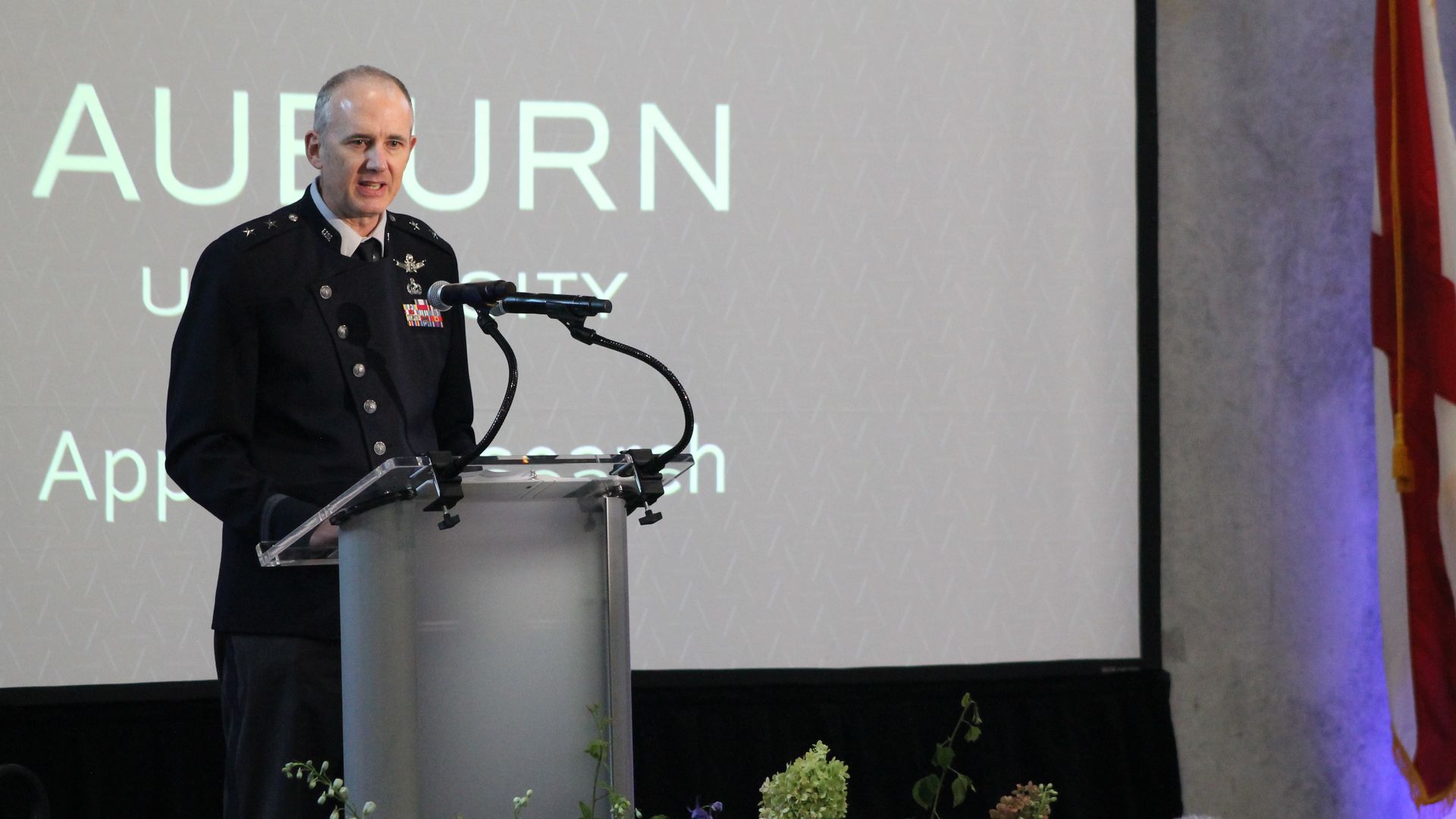
Maj. Gen. Jason Cothern, deputy director of the Missile Defense Agency, speaks Tuesday at the facility's ribbon cutting. Photo: Derek Lacey/Axios
Auburn University's Applied Research Institute in Cummings Research Park is officially up and running.
Why it matters: At a ribbon-cutting Tuesday, federal officials and Auburn leaders highlighted how impactful the rare research opportunities offered at the new facility will be.
Zoom in: The focus was on speed: supplying the technology and hardware the country needs on the front lines and in orbit.
Catch up quick: Auburn's Applied Research Institute (AUARI) is studying everything from space radiation's impact on electronics to 3D printing carbon fiber.
- It aims to serve as an impartial partner to help companies innovate faster, and to build a bank of technical data and a curriculum for advanced manufacturing and other areas.

What they're saying: "There's nothing like an August afternoon in Alabama to remind us of the effects of solar radiation," said Maj. Gen. Jason Cothern, deputy director of the Missile Defense Agency.
- MDA is the anchor customer for AUARI's marquee technology capability: a proton cyclotron used in testing electronics for space radiation resiliency, an effort MDA backed with $11.4 million.
"As a Space Force officer, I have spent my career understanding just how harsh the space radiation environment is and the absolute havoc it can wreak on electronics," Cothern said, also noting the growing threat of man-made radiation effects in space.
- "Right now, it's difficult to get radiation testing done in a timely manner," Cothern said. "There aren't that many facilities, they're scattered throughout the nation, and you have to share time with lots of other people."
- Now, he said, MDA has a "one-stop shop to do all the testing we need."
Driving the news: That capability, and others at the facility, will help "directly close capability gaps for our defense agencies," said Joseph Jewell, assistant secretary of war for science and technology.
AUARI brings a "powerful alliance between government, industry and academia," he said, to meet the complex and interconnected challenges faced in the world's rapidly evolving threat landscape.
- "Academia brings the brightest minds, the foundational research and the next generation of engineering talent," he said. "Industry … brings agility, scale and the ability to manufacture and commercialize at speed. And the government … provides the real-world operational challenges."
Go deeper: Auburn's new Huntsville research lab aims for speed and workforce impact