Business Brief
Auburn's new Huntsville research lab aims for speed and workforce impact

Add Axios as your preferred source to
see more of our stories on Google.

Auburn's Applied Research Institute aims to accelerate innovation in Huntsville's aerospace and advanced manufacturing ecosystem. Photo: Courtesy of Auburn University
Auburn's new Applied Research Institute in Huntsville is looking to be a catalyst for innovation and advanced manufacturing.
Why it matters: Auburn's lab space aims to fill a research niche in Huntsville's aerospace, defense and advanced manufacturing ecosystem.
Zoom in: AUARI aims to be an impartial research partner that's not competing against contractors in the market, but helping them get innovations to market faster, while supporting national space and defense efforts and creating a talent pipeline.
- “As an academic institution, we say our critical role in the supply chain is talent,” Jonathan Pettus, AUARI executive director, told Axios. “So we start there.”
- For academic institutions, Huntsville offers “rich opportunities … to expose their students and faculty to hard problems," Pettus said, "but hard problems associated with programs of national relevance.”
The latest: Leadership at AUARI gave Axios Huntsville a behind-the-scenes look earlier this month, showing how it aims to boost research, qualification and manufacturing in the Rocket City.
How it works: Lab spaces focus on radiation testing, additive manufacturing, space manufacturing, rapid prototyping and space operations.
What they're saying: Auburn saw the need in Huntsville for some "hardcore laboratory space," Pettus told Axios, as the federal government and defense industry focus on expediting delivery of capabilities and scaling production.
- AUARI already has active projects with multiple agencies, including NASA, the Missile Defense Agency (MDA) and Space and Missile Defense Command.
Context: The idea is "technical data banking," Larry Leopard, AUARI chief engineer, told Axios.
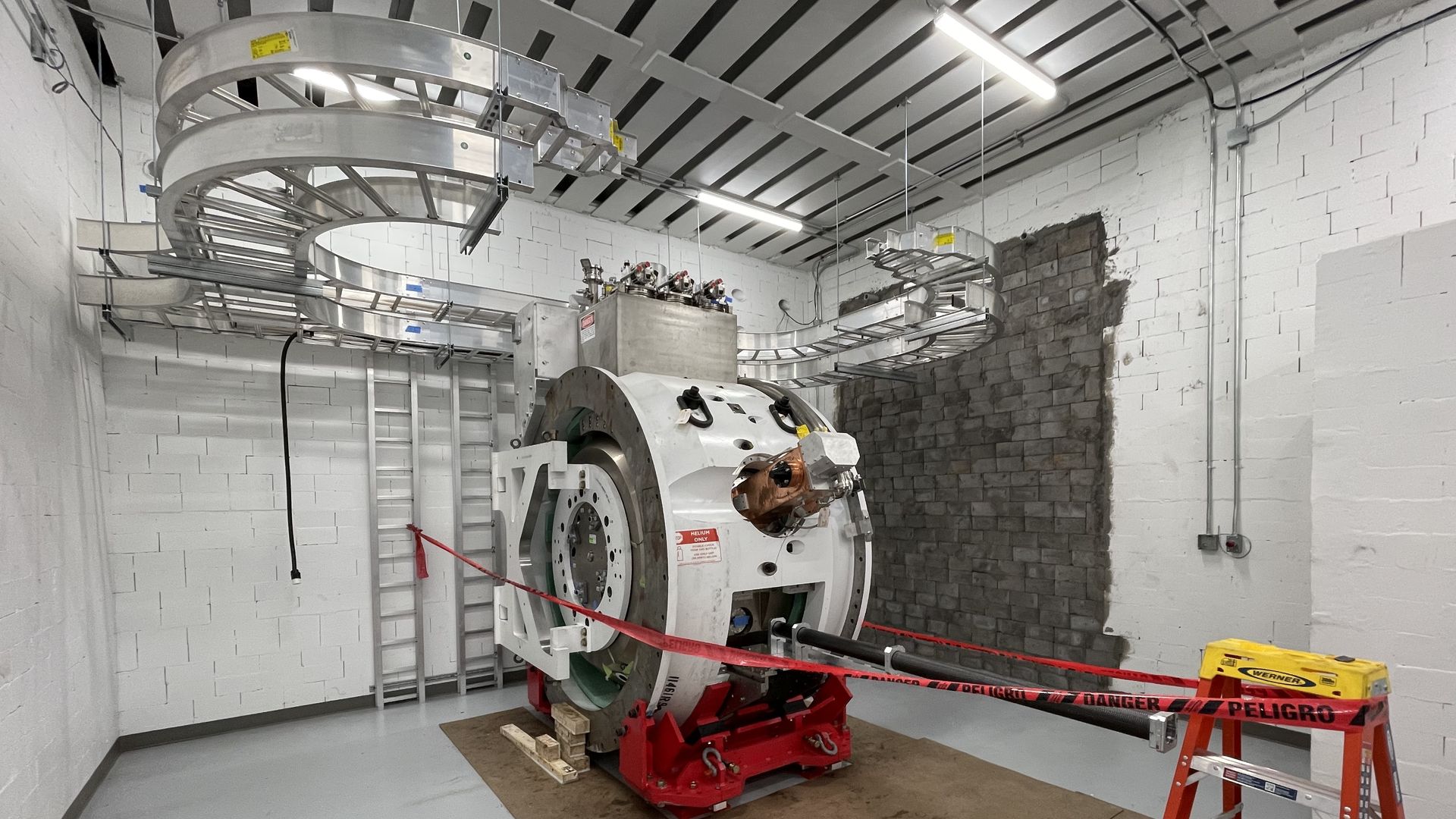
Case in point: The facility has research and testing capabilities including cutting-edge 3D printers and more, but a major component for the lab is a proton cyclotron, used to test how electronics will react to radiation in space, and how to harden them against that radiation.
- It's the only university-led facility in the nation to have one, backed by an $11.4-million Department of Defense contract through MDA.
- MDA is an anchor customer for the cyclotron, Pettus told Axios, saying that the demand for it is evident and he expects no problem filling up its 2,000 hours per year of availability.
Zoom out: The facility is about providing “infrastructure that supports rapid prototyping, rapid testing and qualification of new capabilities, particularly in areas where it’s difficult for companies to make the business case to invest,” said Pettus, who spent nearly 30 years at NASA before a stint at Dynetics (Leidos).
- That goes far beyond the cyclotron.
Driving the news: Military agencies are focusing on cost-effective and fast fulfillment, and advanced manufacturing research at AUARI is doing the same.
- On site are 3D printers experimenting with carbon fiber printing to expedite complex shapes like nose cones, and printers capable of on-demand component manufacturing in space.
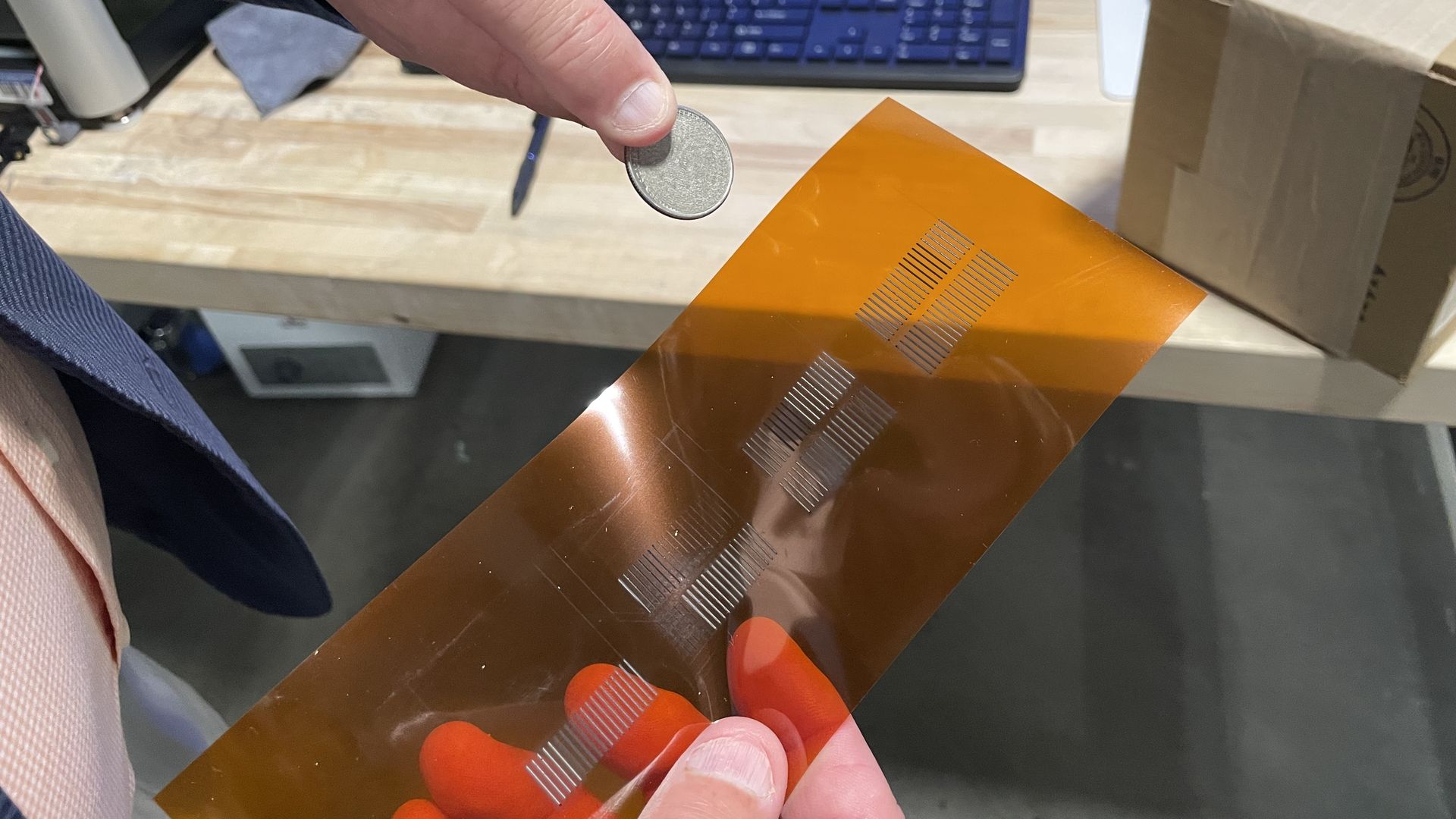
- Utilizing a "painter's palette" of separate metals, as Leopard described, the printer can essentially harvest, then print with, small particles of each metal.
- It could mean a future mission to space would only have to bring metals and this printer, rather than a large assortment of backup circuit boards or other components.
The bottom line: Ten years down the road, Pettus says, Auburn hopes to be a center of excellence in space hardware qualification, and that AUARI will have contributed to key aspects of Huntsville’s growing role with Space Command and Golden Dome.