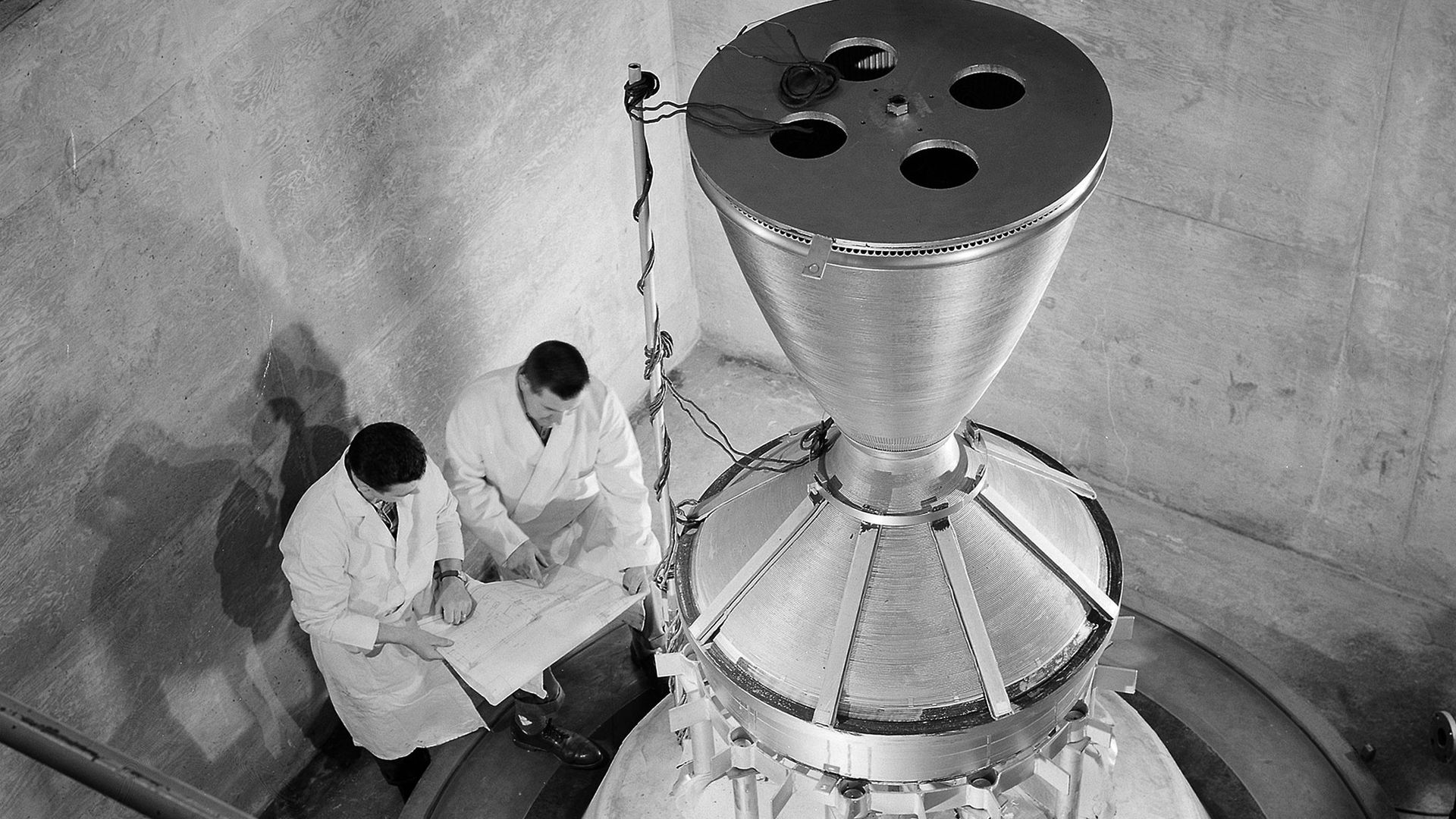
The Nuclear Engine for Rocket Vehicle Applications (NERVA) was a joint NASA and Atomic Energy Commission (AEC) project to develop a nuclear-powered rocket. Credit: Courtesy of NASA GRC
Nuclear propulsion is gaining new momentum.
Why it matters: A new partnership between the University of Alabama in Huntsville and NASA's Marshall Space Flight Center is advancing the propulsion technology that NASA says provides "comparatively unlimited energy."
The latest: UAH announced the partnership Monday, explaining that nuclear thermal propulsion (NTP) is widely viewed as among the most promising methods for advancing manned space travel into deep space.
What they're saying: NASA Administrator Jared Isaacman called nuclear propulsion "the next 'giant leap' technology" in a conversation with Axios last month, noting that the work is spearheaded at Marshall and saying, "we've got to scale that up big time."
How it works: A nuclear reactor is used as a heat source to superheat a lightweight propellant like hydrogen, that is then forced through a nozzle to produce thrust like a traditional rocket.
The key advantage is efficiency, per UAH, allowing for much higher temperatures and allowing more thrust per unit of propellant.
UAH will now partner with NASA to study where and how to use NTP most effectively.
Zoom out: Nuclear-powered space travel dates back to the 1950s and '60s, per Dale Thomas, eminent scholar of systems engineering at UAH and director of its Propulsion Research Center.
But, he says in the announcement, NASA's focus on the Space Shuttle after Apollo eliminated the need for that style of high-performance engine and the program was canceled.
"We have the designs and a treasure trove of ground-test data," Thomas said in the release. "We're not starting from zero."
What we're watching: The challenge now is testing amid concerns about radioactive contamination and a bottleneck in ground testing infrastructure, Thomas said in the release.
"If the infrastructure comes together, Huntsville could become a major center of the future of space nuclear propulsion," he said.