What it’s actually like to have ACL reconstruction surgery in Charlotte

This content was created in partnership with OrthoCarolina.
orthocarolina
OrthoCarolina patient John Canaday was playing basketball with his friends when he tore his ACL.
“I fell to the ground and felt a pop in my knee,” says John. “It’s a hard feeling to describe but I knew something wasn’t right.” After his day of basketball ended early, he hurried home to elevate his leg and ice it.
“I was able to walk and move but my left leg felt wobbly and unstable,” the 41-year-old recalls. Set to go on a ski trip in 5 days, he was hoping it was only a minor injury and went to have it checked out. “I had an MRI and it revealed I had a full ACL tear.”
If you’re an athlete or relatively active, hearing that you have an ACL tear is pretty devastating. But while it’s a serious injury to have, it’s actually one of the most common sports injuries, according to Dr. Dana Piasecki from OrthoCarolina.
Dr. Piasecki was John’s doctor for his ACL reconstruction surgery. John had the procedure in May 2020 and is still on the road to recovery.
I talked to both John and Dr. Piasecki about what it’s really like to tear your ACL and undergo reconstruction surgery – here’s what I found out.
What does ACL stand for and where even is it?
For those of you who don’t even really know where your ACL is (embarrassingly me), ACL stands for anterior cruciate ligament and it’s in your knee. The key ligament stabilizes your knee joint and connects your thigh bone to your shin bone.
How do you injure your ACL?
“The tear happens when you plant your foot and try to change directions quickly,” says Dr. Piasecki. “It commonly happens during high-risk activities like soccer, football, lacrosse, basketball, or volleyball.”
However, you don’t have to be playing a sport to tear your ACL. Dr. Piasecki explains it can happen any time you’re twisting that ligament or changing directions quickly.
How do I know if I need surgery?
John had his initial consultation with Dr. Piasecki over Zoom. Dr. Piasecki says there are two main considerations for deciding if someone is a candidate for ACL reconstruction surgery – 1) your activity level and 2) the health of the knee.
“Most of the time if a patient is active enough to injure their ACL, they can benefit from reconstruction,” he says. “However, we also have to consider the health of the knee because in some cases surgery could cause further damage.”
How serious is ACL reconstruction surgery?
“If you’re going to have an injury that needs surgery, this is one of the easier surgeries,” explains Dr. Piasecki. “The success rate is better than 90%.” Dr. Piasecki estimates that he performs around 150 ACL surgeries a year at OrthoCarolina.
The procedure does require that patients are under general anesthesia during the surgery, which can make anyone nervous. “That’s the part that made me a little anxious,” says John. “But Dr. Piasecki told me it’s basically the surgical equivalent of going to the dentist for a cleaning.” Ok, that’s not quite as scary sounding.
What does the actual surgery entail?
“It’s a full-day affair with 3 phases to the experience,” explains Dr. Piasecki. “You arrive early in the morning and get checked in and see the anesthesiologist. This is kind of the prep phase.”
John recalls being pretty nervous the morning of but says the team helped keep him calm. “The people around me were amazing and there was always someone there to comfort me.”
Then, it’s time for surgery which takes around 1.5-2 hours. “You basically have a really great nap,” says Dr. Piasecki. The reconstruction requires a graft, which is sometimes taken from the patient’s own body or from a cadaver. Ultimately, your surgeon will determine the graft type that will work best.
After surgery, they wheel you into the recovery room where you can slowly wake up. “The nurses give you water and a light dressing and brace on the knee,” he says. Then, it’s time to head home.

With Covid-19 safety protocols in place, you aren’t allowed to have a visitor with you. “My wife wasn’t allowed inside so she waited in the car during the surgery,” says John. “Dr. Piasecki called her afterward to let her know how everything went.”
What’s the recovery like?
John had his surgery on May 13, and when I talked to him in November, he said he was still on the road to recovery. “It’s not a very linear recovery,” explains John. “The swelling is pretty bad at first and it stays kind of swollen for the first few months. You also have to sleep in a knee brace for the first 6 weeks, which is pretty uncomfortable.”
“Once patients get to the 6-week mark, they can start exercise on a stationary bike,” says Dr. Piasecki. “Around the 3-month mark people are usually feeling good enough to be dangerous and I have to caution them. It can stress the ACL if you jump back in too quickly.”
Physical therapy is a big part of the recovery process. John says he’s been to 57 physical therapy sessions this year.
Chris Gabriel, a physical therapist at OrthoCarolina, says “physical therapy is really helpful in the early stages of recovery, especially for pain management and getting motion back.” Chris says in the first 3 months patients will come in for physical therapy about twice a week.
How long until you can be active again?
Dr. Piasecki says that the majority of patients can return to normal activity after 7-9 months.
Right now, John is currently in the process of returning to running, which was given the ok by Dr. Piasecki. “I’ve been running for 3 weeks now. It’s been nice to get back into it,” he says.
John says he’ll probably skip his annual ski trip this spring but will hopefully be back on the slopes in 2022. He does hope to return to activities like tennis and golf next year though.
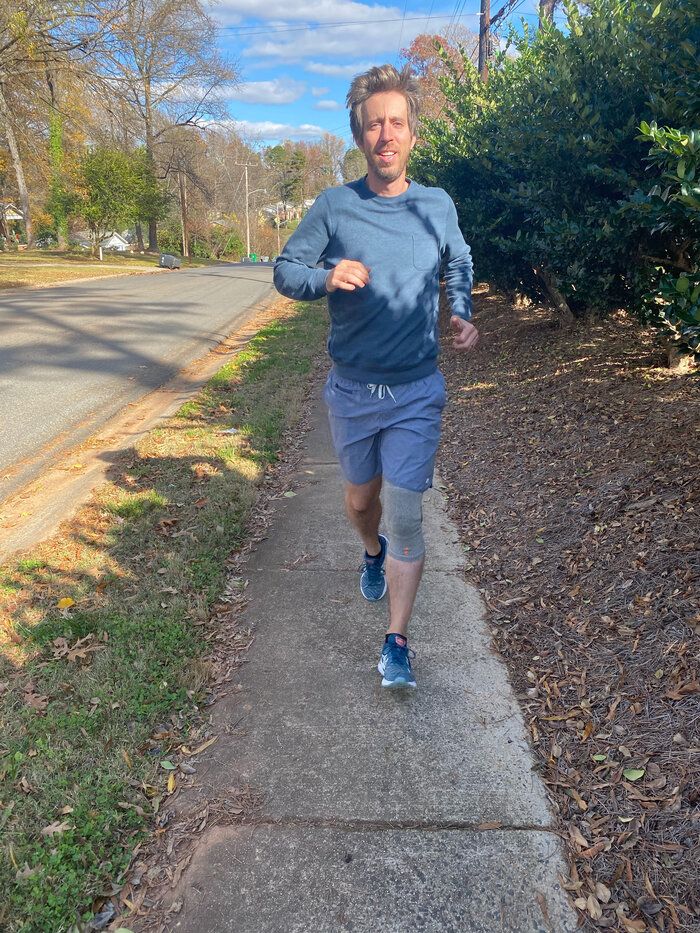
Before patients get the greenlight for all activities, there’s a physical therapy test, explains Chris. “We’ll do various strength testing, hop testing to get a symmetry score, various agility drills on the field, and film their mechanics to make sure their form is correct and safe.”
How can I prevent an ACL injury from happening to me?
“There’s actually some really good research on injury prevention programs,” says Chris. “There’s actually a study that found they can help reduce injury rates by 53%.” These programs are basically a series of exercises you can do before a game or practice.
He recommends this workout for knee injury prevention:
WARM-UP
- Jog line-to-line for 30 seconds
- Shuttle run for 60 seconds
- Backward running for 60 seconds
STRENGTHENING
- Squats – 2 sets of 12
- Walking lunges – 2 sets of 12
- Single leg toe raises – 2 sets of 15
- Russian hamstring curls – 3 sets of 15
PLYOMETRICS
- Forward/backward jumps over a line – repeat 20 times
- Lateral jumps over a line – repeat 20 times
- Vertical jumps – repeat 20 times
“The biggest thing is doing the prevention exercises while you’re healthy,” says Chris.
Learn more about ACL injuries and reconstruction here. Plus, check out how OrthoCarolina is helping patients get convenient care here.
This content was created in partnership with OrthoCarolina.