Why supermarkets keep flocking to rich Charlotte and avoid everyone else

Add Axios as your preferred source to
see more of our stories on Google.
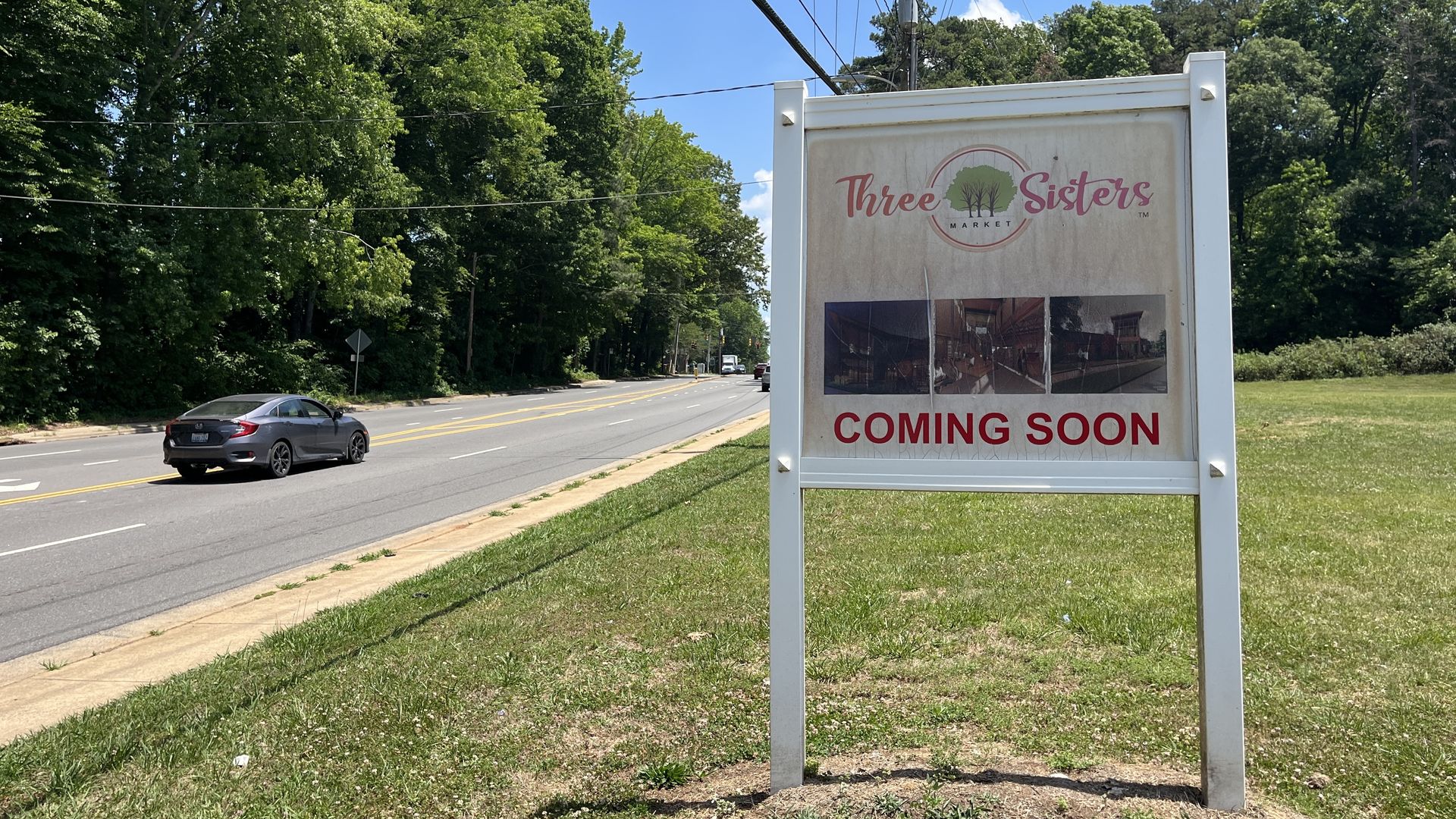
The sign promising that Three Sisters Market is "coming soon" has been up for years, and it shows. Photo: Alexandria Sands/Axios
South Charlotte is getting yet another grocery store as Wegmans prepares to open an upscale shopping experience, with a sushi bar, expansive cheese selection and a sprawling parking lot for hundreds of cars.
- In west Charlotte, volunteers have spent years seeking funding for food co-ops, so residents won't have to haul grocery bags down narrow sidewalks as far.
Why it matters: Charlotte has become a city where grocers compete to capture affluent areas while other communities struggle to replace a single supermarket that shuttered decades ago.
Follow the money: Grocers "go where the money is," Phil Lempert, the "supermarket guru," tells Axios.
- Wegmans, in particular, looks at education and income demographics, population growth, and areas "with high food interest."
- The New York retailer chose Ballantyne, the same area where Sprouts and Publix opened their first stores in Charlotte.
- Ballantyne's 28277 ZIP code has a median household income of $128,627 and is 58% white, according to census data.
Case in point: In east Charlotte, the median household income is $52,723, roughly three-fifths of the metro area's. The population is 71% Black and Hispanic.
- "Trying to explain this to neighbors — it's like, no, guys, we're not getting a Wegmans. We're not getting a Trader Joe's," says Greg Asciutto, CharlotteEAST's executive director.
- At Eastland Yards, developer Crosland Southeast has long promised but yet to secure a specialty grocer.
- Asciutto argues that the concentration of publicly funded affordable housing on the east side is keeping the median income too low to attract amenities.
- "It's not about density," Lempert says. "It's about how often somebody's going to shop, and what they're going to put in their basket."
Between the lines: To stretch margins, grocers are romanticizing the shopping experience with prepared meals and theatrical displays, like workers cracking cheese wheels.
- Lower-income communities can't always support those luxuries.
- Earlier this year, a Harris Teeter off Idlewild Road in east Charlotte quietly closed after a "strategic market review."
Zoom out: Much of west Charlotte is a food desert.
- The average age of death in the West Boulevard area is 65, versus 72 countywide.
- That's an 11-year gap from Ballantyne, where the typical life expectancy is 76.
The latest: Wells Fargo recently stepped up to commit $1.5 million to The Three Sisters Market, a project nearly a decade in the making on West Boulevard.
- Historic West End Partners secured $4 million in city funding for a food co-op at Beatties Ford and West Fifth Street, incorporating it into a six-story housing and office building to make the project financially viable.
- "You have to deliver a total experience these days for it to be profitable or sustainable," says J'Tanya Adams of Historic West End Partners.
Yes, but: Co-ops face the same economic challenges that prevent traditional grocers from opening in the area in the first place:
- High food stamp use, higher theft-prevention costs, and higher labor costs because employees would rather work at another store, Lempert says.
- Lempert says the best solutions to food access are mobile food units, pop-ups at transit stations, and city-packaged incentives for grocery stores, such as free land and tax breaks.
The bottom line: Wegmans plans to open more North Carolina stores. The not-so-wealthy corners of the city already know they won't be chosen, and they aren't waiting anymore.