Charlotte's new runway will be able to say when it needs fixing

Add Axios as your preferred source to
see more of our stories on Google.
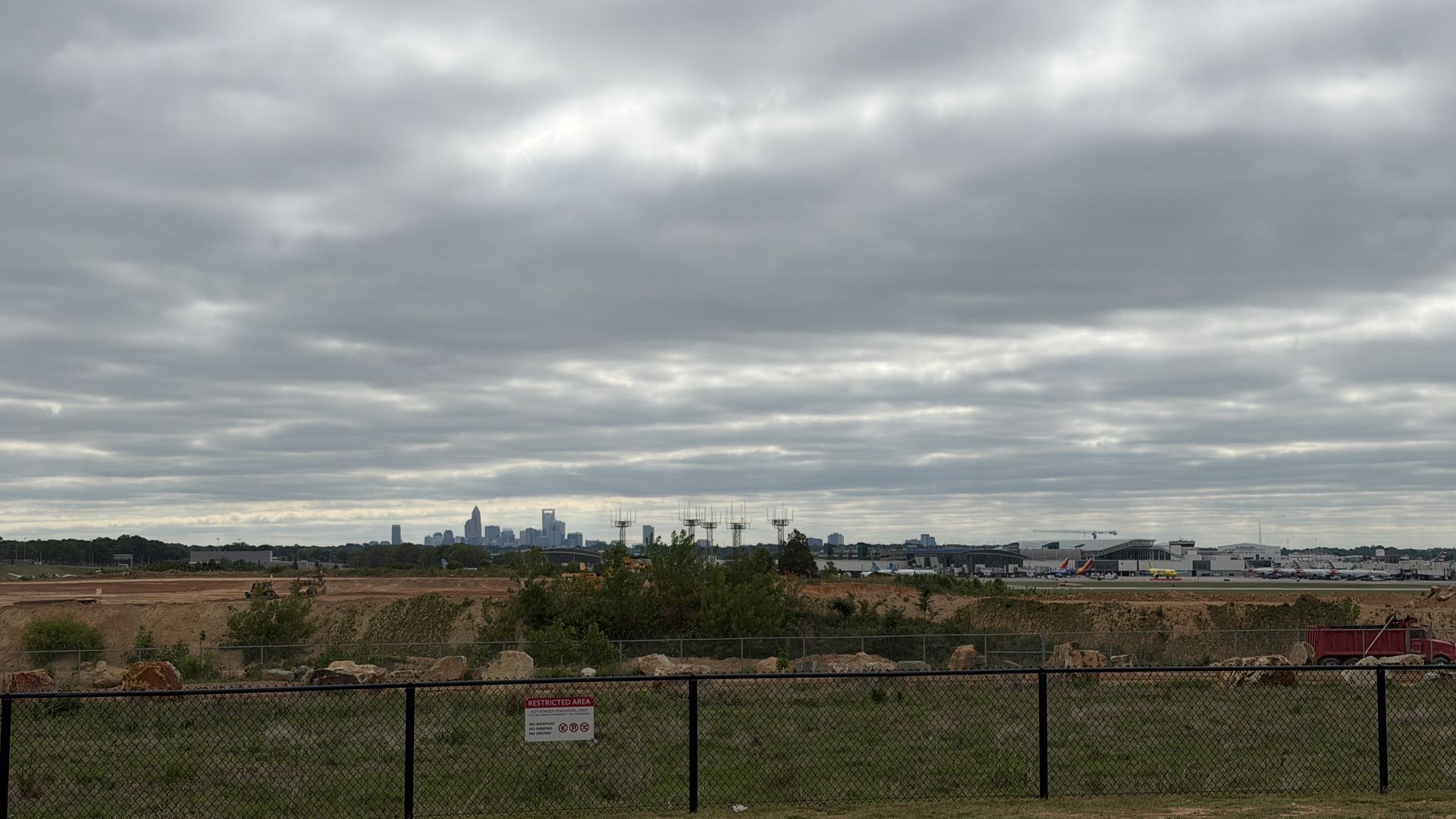
View of the airport's forthcoming $1 billion runway. Photo: Ashley Mahoney/Axios
Charlotte Douglas International Airport and UNC Charlotte's Aviation and Innovation Research Institute are working together on a project that will influence the future of runway design.
Why it matters: Soon, CLT will have the only runway in the nation with sensors in it. The roughly $6.5 million project will provide the Federal Aviation Administration with data that neither the FAA nor the airport can currently obtain regarding pavement performance and maintenance needs.
- Data from the sensors will help reduce pavement disruptions, lower maintenance costs and improve safety, UNC Charlotte vice chancellor of research John Daniels told reporters Monday.
Catch up quick: CLT broke ground on its fourth parallel runway in June 2023. The runway will be 10,000 feet long, 150 feet wide and 18 inches deep. It's expected to be commissioned in September 2027, CLT chief infrastructure officer Jack Christine says.
Flashback: UNC Charlotte's William States Lee College of Engineering and CLT established the Charlotte Aviation Innovation and Research Institute (Charlotte AIR) in 2023.
The latest: Charlotte Air has produced a system to imbed sensors into the new runway, as well as the technology needed to collect and analyze the data in real time. This also provides a framework for engineers and students to solve airport challenges as they happen, Christine says.
How it works: CLT will begin installing 2,000 sensors, roughly the size of a cellphone, under and above the north end of the runway next month.
- Plus the sensors are expected to last around a decade. While the price of each sensor varies, the cost is around $13,000 per sensor, per Charlotte AIR.
- The sensors will create a continuous virtual replica of the runway's condition and performance over that decade span. They'll track what's happening as airplanes taxi on the runway, takeoff and land, Christine says.
- "[The sensors] collect critical information to help us make better decisions about the maintenance, operations and safety in real time," Christine says.
By the numbers: The roughly $6.5 million project is funded by the FAA, UNC Charlotte and the airport. The university is not using state dollars on their portion of the project, Daniels says.
The big picture: The FAA will receive CLT's data, including if there is moisture or movement in the ground below the pavement. Christine says the new data will allow aviation leaders to consider how runway pavement is designed in the future and how to make these runways more resilient and stable.