Charlotte leaders push to pause I-77 toll lanes — but will it matter?

Add Axios as your preferred source to
see more of our stories on Google.
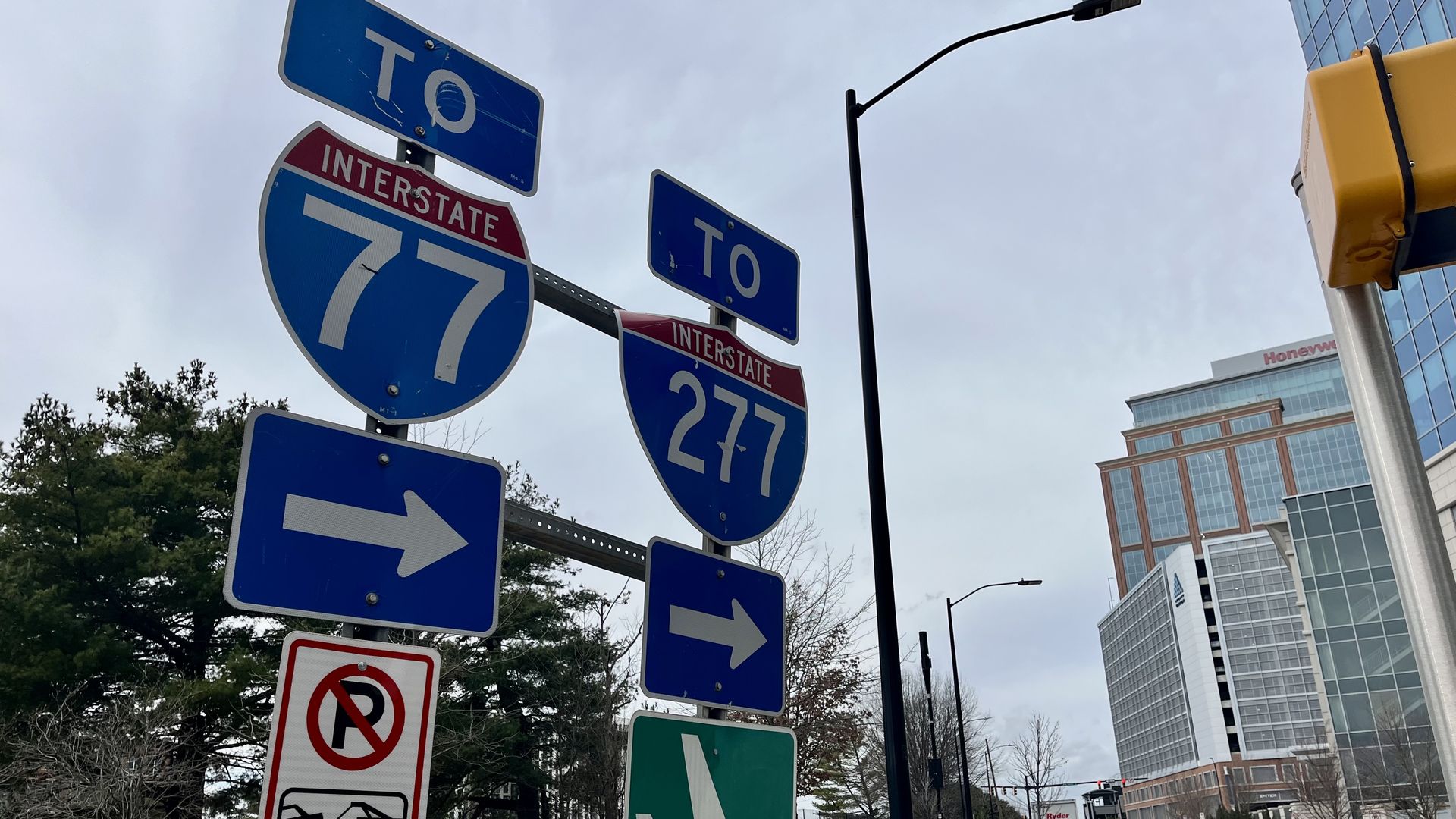
Photo: Alexandria Sands/Axios
The organized resistance to the N.C. Department of Transportation's multibillion-dollar I-77 South toll lanes through the Uptown area could upend the project.
Why it matters: Seven of 11 Charlotte City Council members now favor delaying a project most of them previously supported. The shift speaks to the strength of opposition to the toll lanes that would inevitably impact historically Black communities along the corridor.
The latest: City council's transportation committee is expected to discuss next steps at its March 5 meeting.
State of play: The history behind this project and the city's influence is complicated.
- In October 2024, the Charlotte Regional Transportation Planning Organization gave NCDOT the OK to move forward with the project using a private developer. NCDOT has committed up to $600 million, and the private partner is expected to finance the remaining costs.
- A similar partnership was done in the north with infrastructure company Cintra.
- Delegates from Mecklenburg County and other municipalities rejected the plan over gripes about the northern I-77 tolls toward the Lake Norman towns, while the Charlotte City Council unanimously supported it.
- As the most populous city, Charlotte holds the most power (31 of 68 weighted votes) on the CRTPO.
- But that was before NCDOT released maps showing the proposed infrastructure encroaching on people's properties, parkland, and the historic Pineville Cemetery.
- "The community hadn't seen any meaningful plans," Charlotte council member Malcolm Graham tells Axios. "They pulled a fast one on me."
Between the lines: Council member Ed Driggs, the city's representative on the CRTPO, said any halt to this project would actually be a reversal of the original CRTPO vote from 2014. He says that it may set a bad precedent if the city interferes with the past CRTPO board's decision.
- "The project in some form is going to get built," Driggs said, adding that it must get done in a way that causes as few disruptions as possible.
Driving the news: Seven city council members are calling to pause the project: Graham, James Mitchell, Dimple Ajmera and Victoria Watlington, as well as freshman members Joi Mayo, JD Mazuera Arias and Kimberly Owens, who did not partake in the 2024 vote.
- Graham, who represents west Charlotte, emphasizes that he and other council members are not out to stop the project entirely, but rather pause it to make time for more conversations with NCDOT.
- "We can't talk to the engineers anymore. They are taking orders," Graham tells Axios.
Catch up quick: As a compromise of sorts, NCDOT recently announced it would build the new lanes above ground for 1.5 miles. The entire express lanes project will stretch 11 miles from the Brookshire Freeway to the South Carolina line.
- The elevated lanes, built over or to the side of the existing interstate, would reduce impacts on neighborhoods like McCrorey Heights, Wesley Heights and Biddleville. NCDOT said this redesign avoids 41 homes that a traditional widening would threaten.
That option still "stinks," Graham says.
- "I don't think we want to put a cement and steel structure ... on the edge of our Uptown," he adds.
NCDOT's elevated-lane olive branch has not silenced the other critics either, whose worries range from noise to air pollution.
- Sustain Charlotte, in a press release signed by some council members, is advocating for NCDOT to pursue rapid transit along I-77 rather than toll lanes. This could mean turning existing roadways or the shoulder into bus-only lanes, the organization's leader Shannon Binns tells Axios.
- NCDOT has stressed, sometimes in bold text, that the $600 million assigned to this project, "[p]er state law ... cannot be transferred to a standalone transit project."
Proponents of the express lanes expansion, such as the Charlotte Regional Business Alliance, maintain that the project is necessary to manage the region's rapid population growth.
- "Widening roads doesn't help solve the [growth] problem," Binns argues. He calls it "akin to buying bigger pants but not changing your diet."
What's next: Council could ask the CRTPO to request that NCDOT delay issuing its initial RFP, set to go out this spring, to allow time to study other options.
- As of now, construction is still expected to begin after 2029. An NCDOT spokesperson tells Axios the design draft is 10%-15% complete.
- The spokesperson told Axios developer teams will be "incentivized to further reduce impacts," and that designs will be reviewed for safety, cost and feasibility.