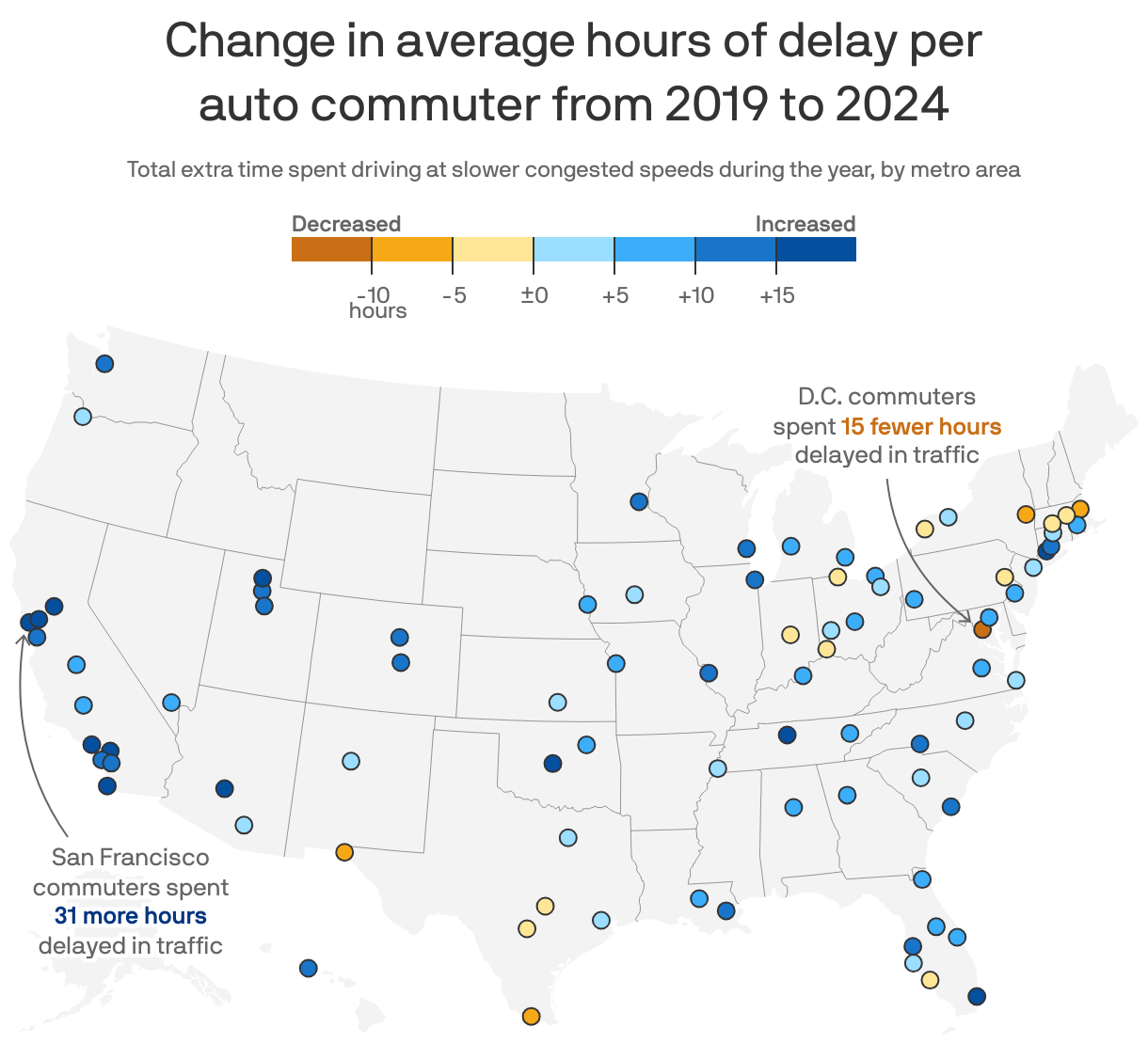
Charlotte is spending more time stuck in traffic than ever


Add Axios as your preferred source to
see more of our stories on Google.


The average Charlotte car commuter is spending a record 64 hours annually stuck in traffic — 11 hours more than they were in 2019, a new report finds.
Why it matters: It's not just annoying — it's bad for business, adding up to eight full workdays lost to traffic.
Driving the news: Congestion is the go-to talking point in Charlotte Regional Business Alliance's campaign for the 1% transportation sales tax (1 cent on every dollar), which will appear as a referendum on Tuesday's ballots to support a wide-ranging transit plan for the region.
Zoom out: Charlotte commuters have it about 60 minutes worse than the rest of the country when it comes to traffic.
- The average U.S. driver is spending a record 63 hours annually stuck in traffic, the Texas A&M Transportation Institute's 2025 Urban Mobility Report shows.
- That's the most since 1982, when the dataset begins.
Flashback: In the 80s, Charlotte was a much younger, less developed city. Drivers spent just 14 hours in traffic a year, the report states.
Yes, but: Charlotte's growing up, and the population is booming. The Alliance estimates 157 people are moving to the region a day — many with cars — up from 113 in a 2023 report.
Zoom in: To support the upcoming transit referendum, the Alliance has adopted the slogan, "Faster Commutes, Less Congestion." Its marketing is heavily focused on roads, even though 40% of the tax revenue from the transit plan would go to rail projects.
- The plan will benefit all commuters, according to Matthew Panik, chief advocacy officer of the Alliance. "This includes synchronized green lights, better roads, safer streets and more options for all forms of transit. It'll mean less time in traffic, faster commutes and a better way of life for all."
- For road projects specifically, the tax is estimated to generate $7.8 billion over 30 years across Mecklenburg County. The City of Charlotte is estimated to receive $102.4 million in its first year from its share.
Yes, but: The road money won't just be for pavement. It could go to many other types of projects, including bike lanes, sidewalks and street lights. And in Charlotte, at least, that appears to be where the focus would be.
- As WFAE reported, per state legislation, the road money is broadly defined as "costs associated with financing, constructing, operating, or maintaining roadway systems."
- Charlotte has published a 51-page "Strategic Mobility Blueprint" listing projects it would pursue with the tax revenue, but without any clear timelines or costs.
- Throughout the text, the words "bike" and "pedestrian" show up over 1,400 times. But "travel lanes" and "widening" are mentioned fewer than 50.
Reality check: Expanding a highway doesn't necessarily reduce traffic delays, researchers have found.
- Instead, more drivers show up to try to take advantage of the increased supply of roadway, and the traffic problem continues — a phenomenon called "induced demand."
The big picture: Nationwide, traffic has been getting worse — or at least different — since the COVID-19 pandemic.
- Charlotte's "yearly delay per auto commuter" fell from 53 hours in 2019 to 24 in 2020, then rose back up to 47 in 2021.
- Driver behavior has also changed, per the report.
- Traditional rush hours are returning. Yet there's also been a "noticeable rise in midday congestion," the national report finds, possibly tied to remote and hybrid work changing people's schedules and travel behaviors.
- Thursday has overtaken Friday with the highest share of weekly delay — perhaps "because some of the Friday travel is not associated with commuting, whereas Thursday has more of a typical commute pattern."
- It's getting harder to predict when it'll be busy out on the roads, leading to "added traveler frustration," as the report puts it.
- Delivery trucks are adding to traffic woes as well.
The bottom line: It's not just you — traffic is weird now.