The Leon Levine Foundation will triple its annual giving to $100M

Add Axios as your preferred source to
see more of our stories on Google.
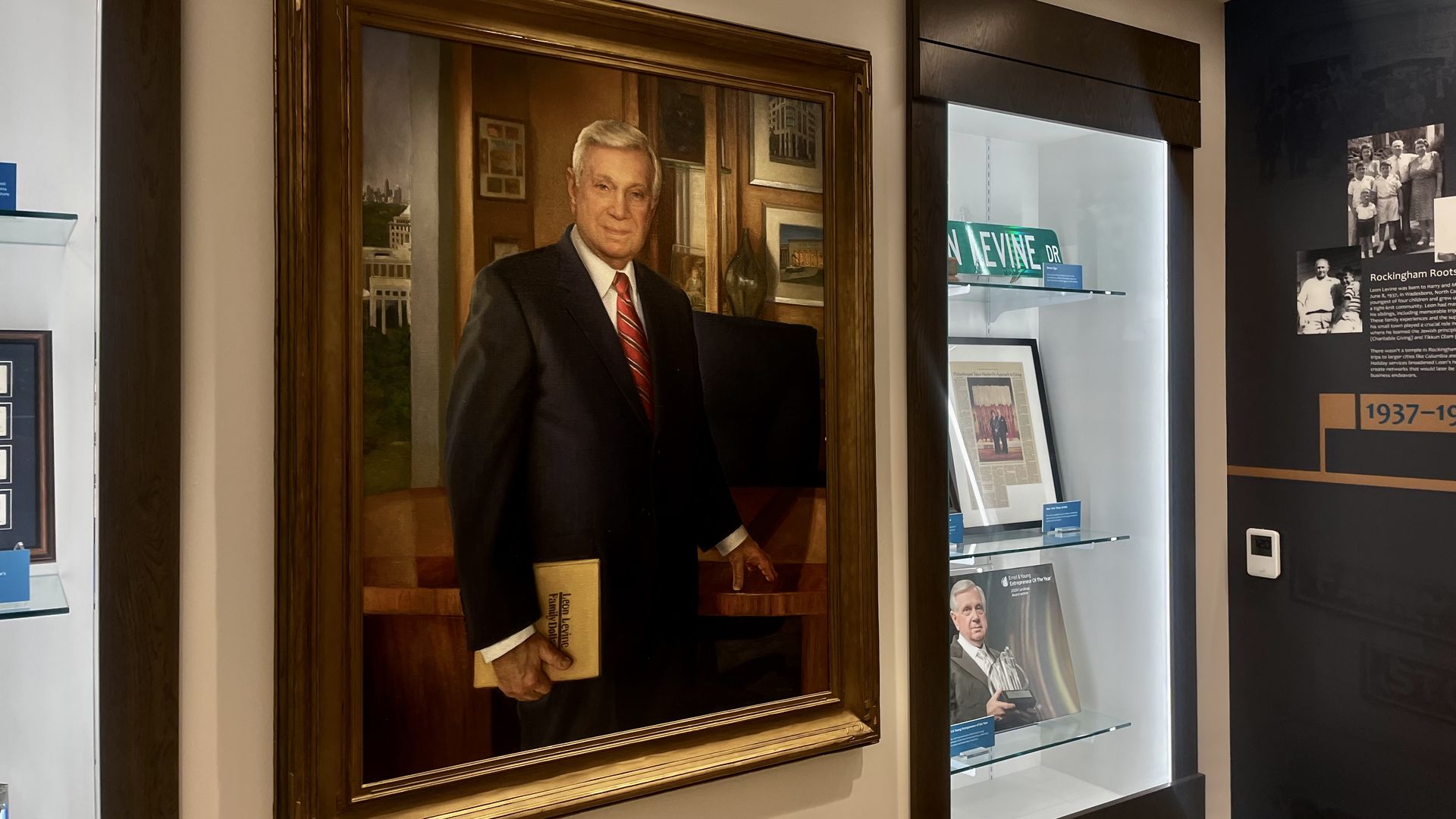
The Leon Levine Foundation's new office off Park Road. Photo: Alexandria Sands/Axios
When Family Dollar Stores founder Leon Levine passed away two years ago, he left a significant gift to his foundation, as was promised. On Tuesday, The Leon Levine Foundation announced that contribution tripled its assets to $2 billion and triggered a 50-year clock to spend it all.
Why it matters: The Charlotte-based foundation says it must "exponentially" increase its grantmaking in the coming years, upping its annual giving from approximately $35 million three years ago to $100 million today.
- The surge in funds to nonprofits across the Carolinas should create a noticeable impact, one that goes far beyond the public buildings that bear Levine's name.
The big picture: The Foundation will intentionally spend down its assets within the next five decades, per Levine's wish. Its mission areas are healthcare, human services, education and Jewish values.
- Levine intended to create urgency to solve challenges facing underserved Carolinians and the Jewish community, says Tom Lawrence, the Foundation's president and CEO. The sunset provision also frees the Foundation to focus solely on its mission rather than self-preservation.
- "We actually are looking at this concept as a sunrise," Lawrence says, "in terms of not just spending out the dollars over a certain amount of time, but how can we create permanency with some of the initiatives that are really helping the community?
Between the lines: Since its founding in 1980, the Foundation has awarded a total of $590 million and funded over 400 nonprofits, many through multi-year unrestricted grants. As it embarks on this new chapter, the Foundation leaders say they're shifting focus to funding specific, innovative ideas with the broadest reach.
Case in point: The Foundation supports Kintegra Health's school mental health program that is expanding across dozens of campuses. Lawrence says that model in Gaston County exemplifies what they'd want to fund because it's proven to work and is scalable.
What they're saying: Levine's legacy is evident from the way his name is on buildings like the Levine Center for the Arts. However, board chair Michael Tarwater says that's just "the tip of the iceberg." He expects Levine's impact will become even more evident in the coming years.
- The Foundation will begin publishing annual reports to share its progress, something Levine never wanted to do — "he felt like it was bragging," Tarwater tells me.
Zoom out: The Foundation awarded a record $101 million in grants last fiscal year. It's now the second-largest private foundation in North Carolina, among the top 10 in the Southeast and 75 in the nation, according to a press release, citing recent filings.
What's next: Over the past two years, the Foundation has built out its preeminent team and expanded its board from five to nine members to bring on new areas of expertise.
- It's also hired a four-person research team to measure the reach of its investments. The Foundation invests in for-profit companies, such as affordable housing developers, that make a social impact but still provide a return.
- That's on top of the 5% the Foundation is federally required to simply give of its assets each year. As the Foundation winds down, there will be years its disbursements exceed that 5% floor — "when the right project comes along with the right partner," Tarwater says.