Mecklenburg County manager will assess taxpayers' ROI as he starts new job

Add Axios as your preferred source to
see more of our stories on Google.
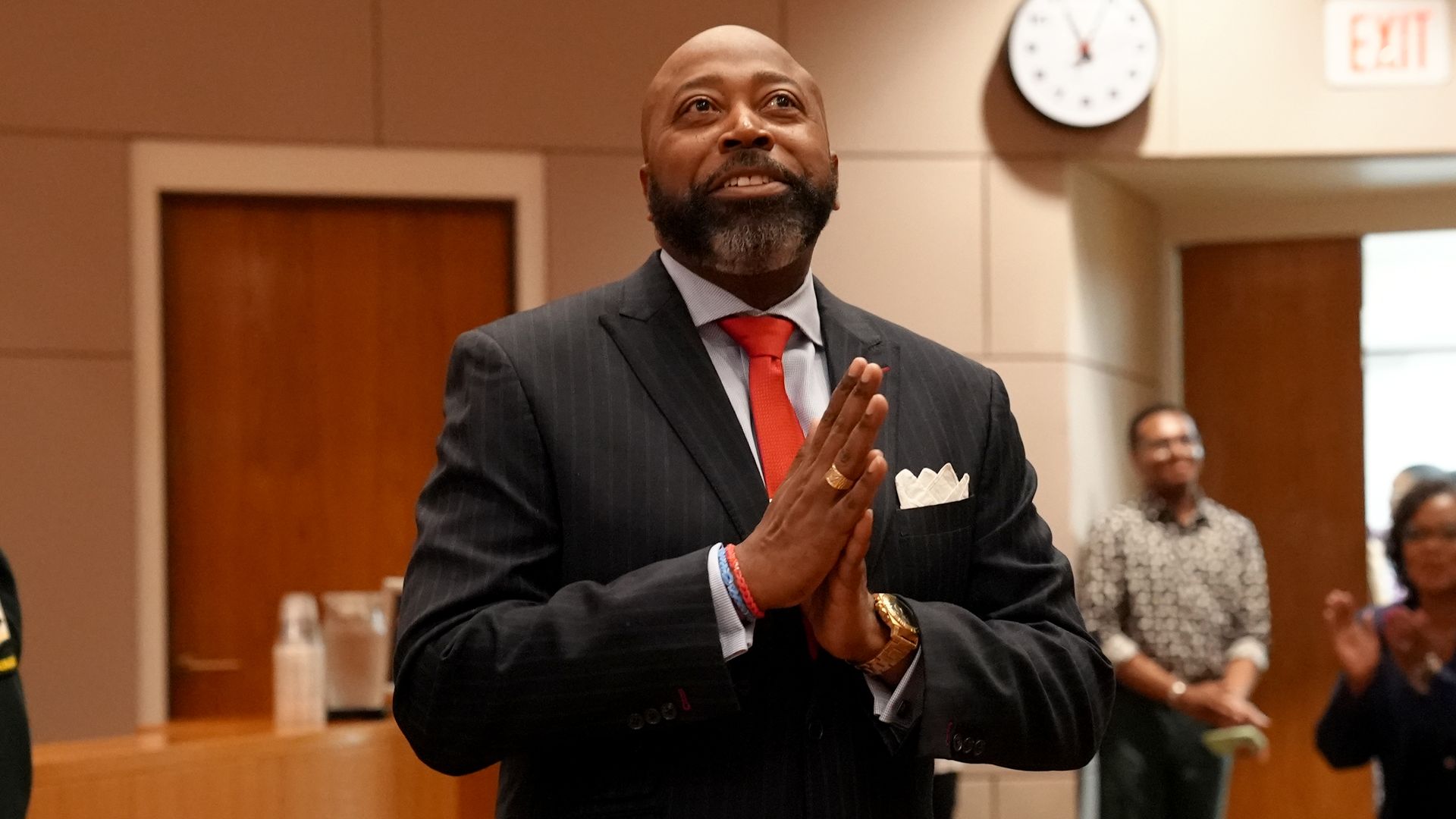
Photo: Courtesy of Mecklenburg County
Mecklenburg County is under new leadership for the first time in over a decade. Mike Bryant officially took the helm Monday, succeeding longtime manager Dena Diorio.
Why it matters: The county manager oversees all the agencies and departments that serve you and your more than 1.2 million neighbors.
- One of Bryant's biggest tasks each year is recommending a $2.5 billion budget, approved by commissioners, that is packed with ripple-making decisions for the area's schools, parks, public health services and other needs.
What he's saying: This is Bryant's "dream job."
- "I'm a public service junkie," he tells me. "I just firmly believe that there is no more notable field than public service."
Context: He has been with Mecklenburg County for over 22 years, starting in 2003 in the budget department, a role traditionally regarded as the pathway to becoming a manager in local government.
- Bryant moved up to director of the Office of Management and Budget in 2014 and then deputy county manager in 2020.
The big picture: Mecklenburg County already has a set list of priorities — health equity and wellness, education, services for seniors, workforce development, environmental stewardship, economic development and reducing racial disparities.
- Bryant says he'll step in to continue focusing on programming and investments for all seven.
Yes, but: His tenure begins after a tough budget cycle.
- This year, the county budget included a 0.96-cent tax rate increase — an additional $36 a year for the median homeowner. The county had to implement a deferred half-cent tax rate increase from the prior year while addressing a revenue slowdown.
What he's doing: Bryant says he wants to recommit Mecklenburg County to performance management, a framework for assessing the return on its investments.
- He's considering implementing a scorecard to track where money is going and the results. The card would better inform decisions, he says, related to adjusting the tax rate, launching new programs or continuing funding of existing programs.
What he's watching: Uncertainty at the federal and state level. As the federal government works to reduce the national deficit, Bryant says cuts may impact services like Medicaid.
- "If they do that, and the state decides to push it down to counties as well, we're not in a position to supplant the large dollar amount associated with some of these decisions," he says. "You can't tax your way out of it."
- Mecklenburg County receives more than $170 million in federal revenue.
Here's how he responded to other topics.
Transportation: On the afternoon I sat down with Bryant, Gov. Josh Stein had just signed the P.A.V.E. Act, which authorizes the Mecklenburg Board of County Commissioners to put a 1-cent sales tax referendum on the November election ballot.
- Bryant spoke to commissioners about the measure Tuesday night, his second day on the job. The board scheduled a public hearing and a vote for Aug. 6 to place the item on the ballot.
Charlotte-Mecklenburg Schools: Bryant has seen past fractures between school leaders and the county, but says those relationships have been strengthened.
- "In terms of what level of say counties should have in schools, I think that's debatable," he says. "However, since we're a funding partner, there certainly should be some level of collaboration between the two."
The City of Charlotte: Bryant envisions more opportunities for the city and county to team up on shared priorities, such as economic development and affordable housing.
- City manager "Marcus Jones and I have made a firm commitment that the city and county will work well together, and we've already gotten off to a good start," he shares.
Brooklyn Village: Bryant says he understands concerns over the stalled, public-private development. While he says he can't share much now, the county recently met with the developers, and county staff are reviewing some of the presented options.
- "Everyone involved has an interest in adding more affordable housing and bringing back that identity associated with Brooklyn," Bryant says. "Where it gets debatable is, how do we go about it in light of the history of this project and where it stands today?"
- I asked him if his fresh leadership could have an impact on sticking with that project: "It can make a difference," he says.
Public-private partnerships: He wants to do more.
- Bryant describes his leadership style as collaborative and says working with community partners is key to addressing budget strains.