How historic Elizabeth could avoid getting swallowed by development

Add Axios as your preferred source to
see more of our stories on Google.
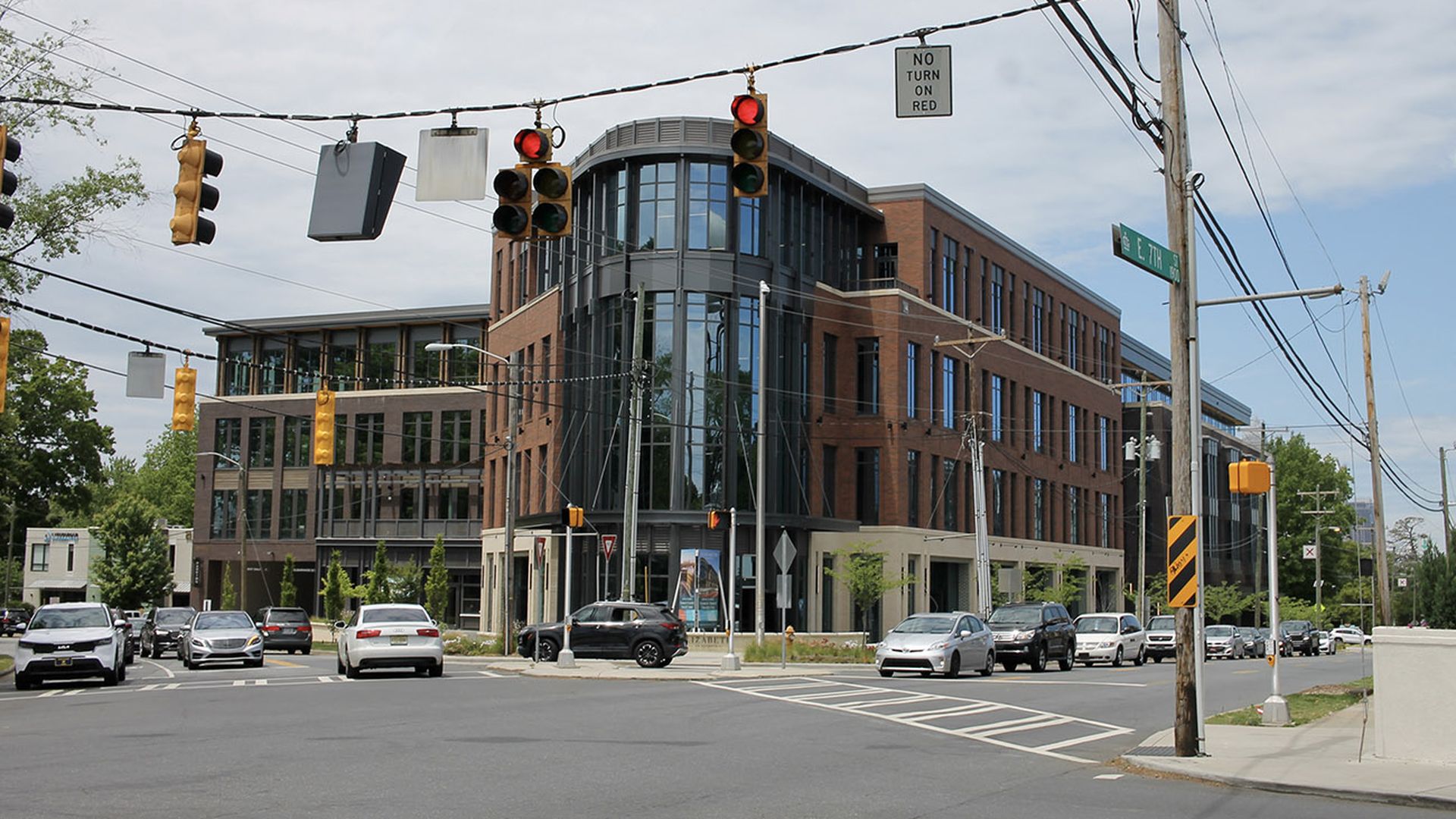
elizabeth 7th Photo: Alexandria Sands/Axios
Clifton Settlemyer’s blinker ticks as he waits to make a left onto Pecan Avenue. Cars shoot past while he looks for a gap.
- “Goodness sake,” he says. “A lot of things have happened that have really increased the traffic around Elizabeth.”
He’s heading toward the business district of Plaza Midwood. There, a trendy nightclub will open next to a tower of lumber and concrete — the construction site of a 12-acre mixed-use project, poised to reshape the neighborhood.
- “Developments like that have people worried,” he tells me.
What’s happening: As Settlemyer drives, he points out the changes happening in and around his Elizabeth neighborhood. We talk about the Gold Line streetcar that is spurring development. We talk about the distinctive design of a new office building on 7th Street. We pass over Independence Boulevard as commuters zoom between the suburbs and Uptown.
- Wedged between all this action are charming streets stuck in time, lined with aging oak trees and more than 600 historic structures, including Settlemyer’s 1905 house. Between the early 1900s and World War II, Elizabeth was erected in sections. Its wide streets, like Hawthorne, are now evidence of the streetcar that once ran through.
Why it matters: Neighbors worry Elizabeth risks of losing parts of its history. The immediate surrounding area is some of the most sought-after land in Charlotte for new development, including near Central Piedmont Community College and buzzing corridors like Central and 7th.
- In several cases, old bungalows have been torn down and replaced with larger homes.
From 1988 to 2022, the neighborhood lost 200 historical resources, or older properties that contribute to the historical integrity of the area, consultant Susan V. Mayer found.
Driving the news: The Historic Elizabeth Neighborhood Foundation wants to protect the area’s history. To do this, they hope to establish a local historic district. Such a designation would require property owners to wait one year before they tear down a structure.
- “It’s just a great neighborhood, and we want to try to keep it that way,” says Settlemyer, who is president of the HENF.
HENF must obtain signatures from more than half of the property owners to move forward with the designation process. Then city council must approve it.
/2024/01/06/1704510260451.jpg)
Yes, but: There are also plenty of people who are adamantly against stamping a historic designation onto the entire neighborhood.
- They argue it would infringe on property rights. Many residents moved to Elizabeth thinking they wouldn’t have to deal with a homeowner’s association. Now they are being asked to go through the city to make changes to the exterior of their home, like renovating a porch or replacing a door. Some applications may cost residents upward of $800.
“Trying to freeze Elizabeth to the early 1930s — that’s not logical,” says Melanie Sizemore, former Elizabeth Community Association (ECA) president and a resident since 2004.
- “If you look at the 1930s … segregation, depression … not really an era I think we want to embrace.”
What they’re saying: Eight other Charlotte communities — including Plaza Midwood, Dilworth, Wesley Heights and most recently McCrorey Heights — that have obtained a historic district designation.
- “Uptown has sacrificed all its historic inventory in exchange for becoming a New South city,” says developer Monte Ritchey, also an Elizabeth neighbor who’s in favor of the designation. You can’t replicate the feel of an old neighborhood, he added. “That’s worth saving.”
There’s a clear contrast between Dilworth’s historic boundaries and its outskirts where development is less restricted. Some consider this proof that a historic district’s protections work.
- “Local historic districts don’t stop change,” Ritchey says. “They just result in a more considerate approach to change.”
- But West Bryant, president of the ECA, sees Dilworth as “a little kingdom of very wealthy people surrounded by a legal moat.”
Context: This isn’t the first time a historic district hasn’t been an resounding “yes” from residents. Elizabeth had a local historic status in the ’90s, but only briefly. In a split vote, city council agreed to the label. Then a couple challenged the integrity of the process in court, and the label was revoked, according to Observer archives.
Also, Plaza Midwood’s historic designation in 1992 only included part of the neighborhood because the business district didn’t want to be included, the Observer reported at the time.
- In September 2021, the ECA board voted not to pursue historic status again. Bryant, a 14-year resident, says for decades the neighborhood has successfully negotiated with builders to manage development pressure.
- Settlemyer was in on the conversations for Elizabeth on 7th, the new office building, and says he is pleased with the outcome. But he’s worried future developers will be less cooperative.
Between the lines: That’s because of new development guidelines going into effect next month in the Unified Development Ordinance (UDO). Under the revised rules, builders can construct taller, denser projects without going through a rezoning process, which allows the public to chime in.
- Settlemyer says he’s concerned large-scale development will prompt residents to put their houses up for sale if it backs up to their property. Then, the new buyers could demolish the historic homes, replacing them with modern, multi-million-dollar houses.
The other side: Opponents to the designation say so far homeowners have, without oversight, preserved the historic characteristics of the architecture when completing renovations, with a few exceptions.
/2024/01/06/1704510260748.jpg)
- Bryant says development has made Elizabeth a better place to live, especially with new businesses coming in.
“The city is changing,” Bryant says, “and I love that Elizabeth has been able to adapt to support the needs of its residents.”
State of play: A historic designation is not the only option. Individually, homeowners could attempt to register their homes as local historic landmarks or put conservation easements on their properties when they sell.
/2024/01/06/1704510261229.jpg)
The new UDO will also implement several less restricted zoning options for neighborhoods:
- The Neighborhood Character Overlay will allow neighborhoods to establishes regulations that align with the area’s character.
- A Historic District Overlay Streetside only regulates what’s viewable from the street in historic areas.
What’s next: HENF’s petition is expected to circulate this summer. They could end up splitting the boundaries and leaving some parts of the neighborhood out of the historic designation, like Plaza Midwood did.
/2024/01/06/1704510261582.jpg)