Nearly 30 families are being displaced by plans to redevelop a south Charlotte motel

Add Axios as your preferred source to
see more of our stories on Google.
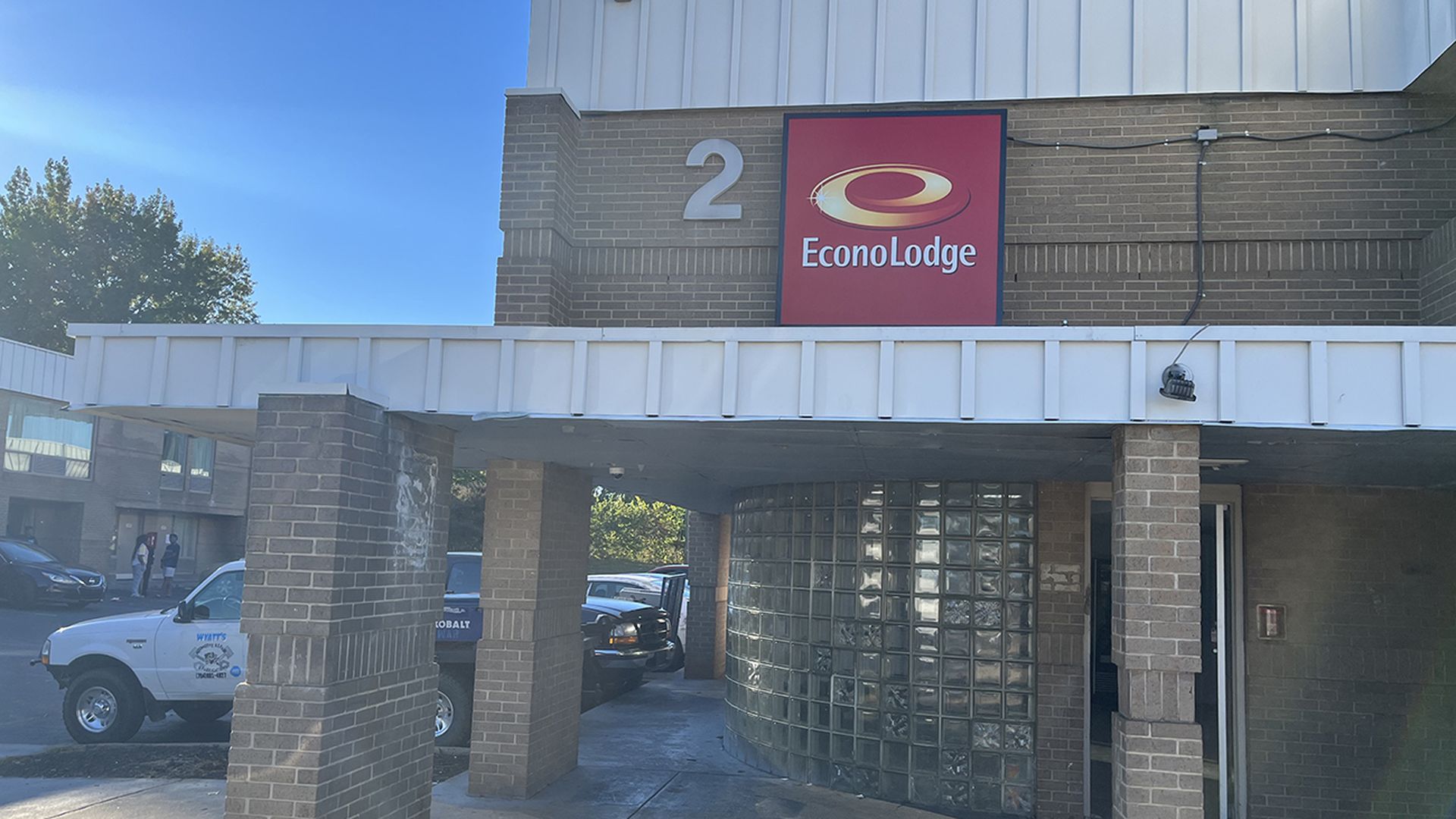
Photo: Danielle Chemtob/Axios
On the other side of South Tryon Street from the nightlife in LoSo, children ride bikes and play in the trash-laden parking lot of a dilapidated motel.
What’s happening: The Econo Lodge near the intersection of South Tryon Street and Pressley Road was home for nearly 30 families who represent a small sliver of Charlotte’s massive affordable housing crisis. But the motel appears to have closed in preparation for a developer’s plans to redevelop the property.
Still, most of the families remain and say they have nowhere to go. Meanwhile, their hot water and gas has been shut off.
Context: Charlotte City Council voted to rezone the property at the request of the developer, who proposed converting it into over 200 units of workforce housing, at an August meeting. “We committed to (the residents) that we’re not going to force anybody out,” the developer, Chris Ogunrinde, told council at the time.
- Residents received a notice on Sept. 14 informing them they have to leave by the end of the month. But the current owner, Shree Ganesh Charlotte, Inc., has not filed evictions against anyone on the property.
- Then, on Oct. 4, a paper was taped to residents’ doors telling them that the property is closed (though it still shows some availability for rooms online). “You are now trespassing on our location and you need to vacate this premises right away.” It said the “authorities” had already been notified.
- The letter also claimed that the gas was turned off because Piedmont Natural Gas deemed the buildings in a “hazardous” condition.
Though Ogunrinde originally said in his rezoning documents he would build workforce housing, now he tells me he’s not sure what the final plans are. Rehabbing the building would be costly, he says.
- Of note: The type of rezoning petition he submitted does not require him to stick to a certain site plan.
Why it matters: Motels are the housing of last resort before homelessness as our city faces a shortage of affordable homes. But they’re not cheap: Residents said they were paying around $1,600 or more per month, depending on the room, which is about the average cost of renting an apartment in Charlotte.
- That leaves people trapped in a cycle of poverty as they spend most of their income on housing, with little left for application fees or security deposits for apartments, if they can find a place that will accept them. Many who live in motels have prior evictions on their record or poor credit.
“It’s easy to get into a hotel, but it’s hard to get out,” says Isaac Sturgill, housing practice group manager with Legal Aid of North Carolina.
The other side: Ravi Sheth, with Shree Ganesh Charlotte, did not return calls or emails requesting comment.
Ogunrinde tells me his firm, Urban Trends Real Estate, is under contract for the site but won’t close on it until everyone is relocated, and doesn’t have anything to do with what’s happening with the residents.
- “We want the best for folks that are currently living there,” he says. He said he took the advice the city gave him to work with local nonprofits who can help residents with relocation.
- He wouldn’t say whether residents will have the chance to move back because the plans aren’t finalized.
/2024/01/06/1704505017838.jpg)
The big picture: People who live in motels can be considered tenants by the courts, Sturgill tells me, depending on circumstances like whether they receive mail there, if they have another home, how long they’ve lived there and if their children are picked up for school from there.
Many of the residents who I spoke with had lived in the motel for months, or close to a year. One of them is Michelle McLean, who lives there with her husband Kevin.
- They were some of the hundreds of people forced to leave the old Lake Arbor apartments around 2019 in one of the most high-profile mass displacements in recent years. For about a month after, McLean says she lived in her van, while her husband was on the road as a trucker, before they landed at Pressley Ridge Apartments.
- But after the pandemic hit, the company Kevin worked for went out of business, and then he needed surgery, and the couple fell behind on their rent. They were evicted from their apartment last year, and then moved into the Econo Lodge. Their rooms there have had roaches, insects and leaks.
- After living in Charlotte for 16 years, Michelle is looking at houses in Gastonia because it’s more affordable. But the eviction record makes it difficult to get approved.
“I look over at my life and I’ve never had to deal with something like this before in these kind of conditions,” she says. “And then it makes you feel like is there anybody out there that’s going to help? Is there anybody out there that’s not going to take advantage?”
Between the lines: City officials often say displacement is a result of market forces, and it’s difficult to stop. But in this case, it was a city council decision that kicked it off.
- Some council members expressed concern about the plan to transition residents into other housing during the August vote, which was 7-3, including Victoria Watlington, who represents the district the motel is located in. When Axios contacted Watlington requesting an interview, she directed us to city spokesman Jason Schneider for further comment.
Yes, but: Former council member Larken Egleston, who voted for the rezoning, says that there’s often a misconception that if council says no to a rezoning, a property won’t change.
- “My thought process would be, let’s make sure it ends up in the hands of someone who has a history in Charlotte and has a track record of good work,” he tells me. “As opposed to being bought up by somebody who comes in and doesn’t care about the people, and only cares about the bottom line.”
- Ogunrinde said most of his company’s current projects are related to workforce housing, where generally units are priced for those earning anywhere from 30% of the AMI (Area Median Income), which is $28,250 for a family of four, to 110% of the AMI, which is $103,600 for a family of four.
- Urban Trends Real Estate is working on an affordable housing project that broke ground this year for seniors in east Charlotte, the Charlotte Business Journal reported.
Relocation efforts: The city started working with the developer in June around the impacts of the rezoning on long-term residents, Schneider told Axios in an email. In July, he said the city requested Crisis Assistance Ministry lead an effort to assist residents with relocation. Crisis is also working with nonprofits Community Link and The Housing Collaborative (formerly Socialserve), which are serving as case managers for residents, and advocacy group Action NC.
Financial assistance is available for things like application fees, security deposits, first month’s rent and utilities. So far though, only about six of the 29 families have moved or are in the process of doing so, per a weekly update Crisis Assistance sent to the city on Oct. 4 and shared with Axios. What’s more, not all are in permanent housing: One moved in with family and two families relocated to other motels.
- “It takes more than 90 days to find someone housing with these barriers,” says Carol Hardison, CEO of Crisis Assistance.
- She said the ultimate goal is to prevent these kinds of situations by investing in affordable housing. But when displacement does occur, there needs to be a clear process to help the tenants find new housing while preventing them from being traumatized.
/2024/01/06/1704505018071.jpg)
What they’re saying: Janisha Smith moved to Alabama from Charlotte in 2016 because of how expensive the city was becoming. But she returned in February after losing her job there due to COVID-19, and started working at the Cookout on South Tryon, within walking distance of the Econo Lodge.
- She makes $14 an hour there before overtime, working over 40 hours each week. She hopes to move in with her sister, who is looking to buy a house, but hasn’t been able to help her with the down payment because almost all of her money went toward the $403 she paid each week for her room.
- She said she heard mixed messages from management on when residents would have to be out by.
- “It’s stressful because it’s hard enough to try to find somewhere to stay here in Charlotte: this is why I moved away,” she says. “You have a whole community of people, children and everybody, like you can’t just make plans and change them.”