Hot district race threatens GOP power in Charlotte

Add Axios as your preferred source to
see more of our stories on Google.
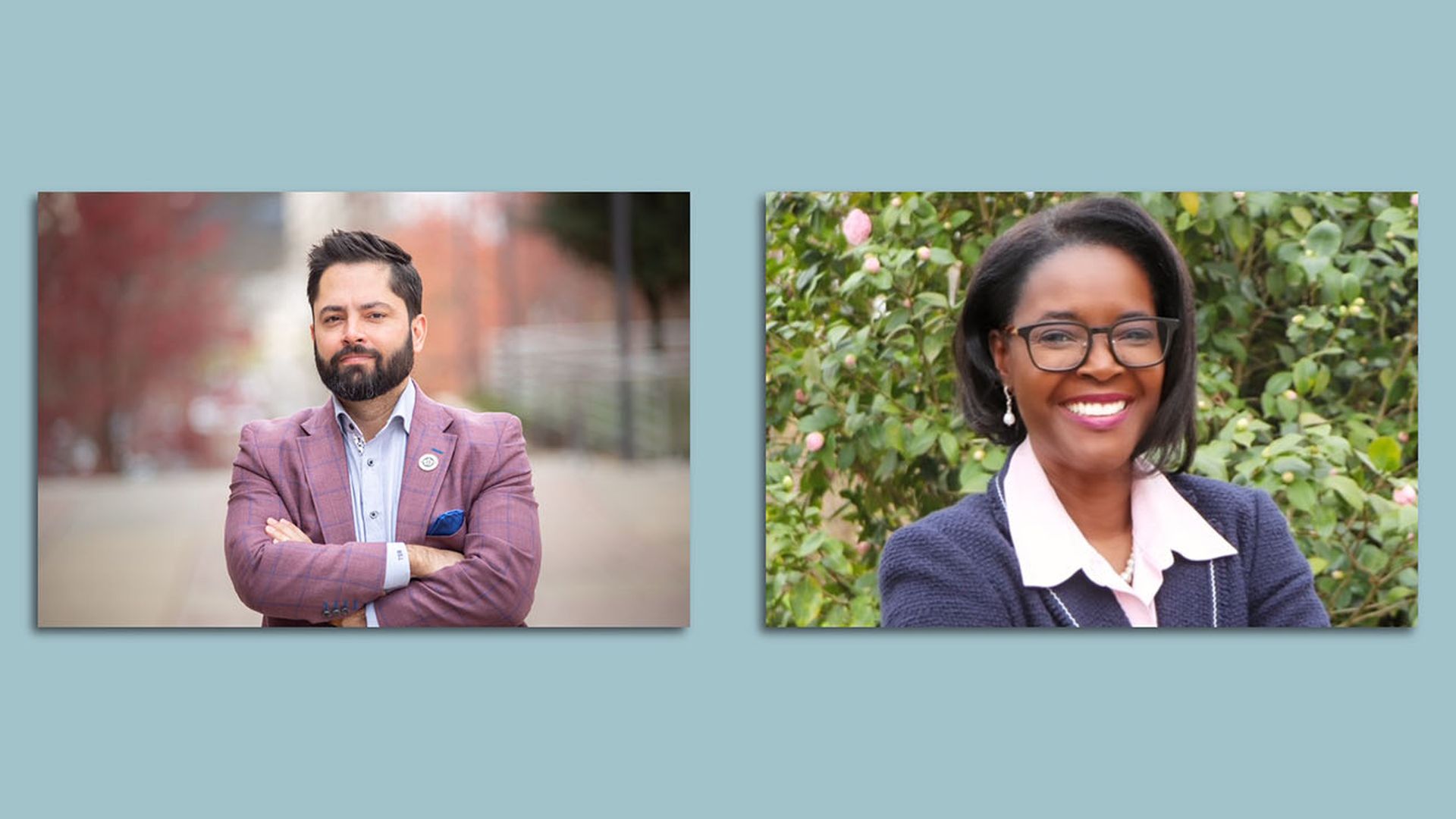
Photos courtesy of candidates
As early voting continues ahead of the July 26 general election for city council, a race in the southern district threatens the GOP’s remaining ground in Charlotte.
It’s the District 6 race between two-term incumbent Tariq Bokhari — an outspoken Republican and one of only two on the 11-person council — and newcomer Stephanie Hand, a self-described moderate Democrat.
Why it matters: Local elections have low turnout but wide-ranging impacts that hit close to home. District 6 is one of the few areas where the GOP finds success in this blue city.
Context: The SouthPark area is upper income, highly educated and predominantly (about 70%) white. Traditionally it has voted Republican. But over the past decade, attitudes have edged more toward Democratic. The two parties each represent about a third of the registered voters in District 6, while independent voters and other parties make up about 38%.
- Democrats now represent District 6 in the state legislature, notes Eric Heberlig, UNC Charlotte professor of political science and public administration. In the 2019 mayoral elections, its precincts supported Mayor Vi Lyles, also a Democrat.
- “Its ancestral roots are Republican,” Heberlig says, “but it’s been shifting towards the Democrats in the Trump era.”
/2024/01/06/1704505953286.jpg)
Still, Bokhari, who has served since 2017, has the incumbent advantage. He’s vocal, visible, and at times controversial.
- An eager Bokhari in his 20s ran in 2007 as a District 1 representative and in 2009 for an at-large seat. He lost both times.
- In 2017 Bokhari won his current seat with 62.51% of the vote. In 2019, he won 58.79% of the vote.
As a sitting council member, Bokhari touts a number of accomplishments and, as of Wednesday, a Charlotte Observer endorsement.
- The founder of Carolina FinTech Hub has helped recruit tech companies like Robinhood.
- He says he wants to combat violent crime by championing the police department to improve retention. (“They too often get thrown under the bus by our own council and mayor,” he says.)
- And his focus, he says, is “on the actual future” of Charlotte: “People here, they spend all their time talking about streetcars and trolleys, when I know, as any futurist would, that 20-30 years from now, it’s going to be autonomous vehicles and 5G that are moving people around.”
On Monday night, after hearing from frustrated vendors who have gone months without income, Bokhari vowed to find a new home for the Eastland flea market within 60 days. “I just took a big risk making that commitment, but we’re going to follow through,” he said over the roar of a cheering crowd.
Hand is a new name in Charlotte politics. Last year she applied for James “Smuggie” Mitchell’s vacated at-large seat but ultimately failed to win the appointment.
Hand has spent years the airport industry. She has experience working in affordable housing and has served as a United Methodist clergyperson. She received the influential endorsement of the Black Political Caucus and scored a $1,000 donation from former Bank of America CEO Hugh McColl.
- Her platform focuses on economic development, with a focus on opportunities for women and minorities, and tackling upward mobility and affordable housing.
- She tells the story of how she was at a July 4 parade and asked police officers if they lived in District 6. They couldn’t afford it, they told her.
- “That’s why I’m running,” she says. “Because we’ve got to figure that out, that these people who are serving and protecting our community — they said it, not me — ‘we can’t afford to live in the community.’ We have to ask ourselves, why? And then, what can we do to help them be able to afford to live in District 6?”
By the numbers: Bokhari has raised $20,975 this election but had more than $68,000 in cash at the end of the last finance period, including $31,000 he loaned to his committee, pre-primary campaign finance reports show. Hand has collected $19,481.
July is an unusual time for an election.
Voting was pushed back because the census delay prolonged redistricting efforts. The odd timing will present another obstacle for Hand, who notes that many voters are unaware the election is underway.
The “hardcore regular voters” are expected to make up the majority of the turn out for the mid-summer election, Heberlig says. And those “hardcore regular voters” are usually citizens who are upper income, well educated and Republican. Democrats are less likely to show up to the polls, especially now.
- “The national winds are blowing against the Democrats because of inflation (and) President Biden’s low popularity,” Heberlig says.
- Bokhari is capitalizing on his party allegiance, arguing he’s the sole differing voice at the dais. He says his unique position as a conservative on a nearly all Democratic council is also a major reason he’s running again.
- “I’m seeing a lot of people that aren’t hardcore R or D,” he says. “They’re just kind of looking around and saying, ‘I don’t like what’s going on right now.'”
Bokhari recruited a slate of Republicans to campaign alongside him: two at-large, two to represent districts and a mayoral candidate — all working together, Bokhari says.
- “It’s a tall task for any Republican to get elected in Charlotte, especially citywide,” Bokhari acknowledges, “but we’ve put together a really sound strategy. And we’ve been knocking on doors, making calls, a lot of voter interactions. So, I think we have a chance.”
One strategy for the Republicans is to focus on single-family zoning, which has become a contentious issue in Charlotte over the past 18 months or so.
- If Republicans add to their representation on council, they could halt efforts to permit duplexes and triplexes by right in single-family neighborhoods under the Unified Development Ordinance, a document that would consolidate the city’s zoning and development rules.
- The vote to pass the UDO is scheduled to happen next month, before the new council is sworn in. But Bokhari said he found a “loophole” in state legislation for delayed 2021 elections that allows an electee to take the oath of office as soon as results are certified, as early as mid-August. The UDO is expected to pass 6-5 under the current leadership, but one more vote against the single-family only zoning would empower a new majority to strike the policy.
Hand’s position on eliminating single-family only zoning is that adding density is a way to alleviate housing demand by encouraging the construction of dense housing developments. But, she adds, “The American dream is to own a home.”
- She notes the proposed policy, outlined in Charlotte’s visionary 2040 plan, would not do away with single-family housing. It would only target single-family-only zoning, which prevents some neighborhoods from adding diverse housing options.
The bottom line: “It’s always hard to beat an incumbent,” Heberlig says, “and to beat an incumbent, you need a challenger with lots of resources to do it and you need an electoral environment that’s going to give the challenger a boost. And those two factors are working against the Democrats this year.”
What’s next: The general is July 26.