People of color are driving Concord’s growth

Add Axios as your preferred source to
see more of our stories on Google.
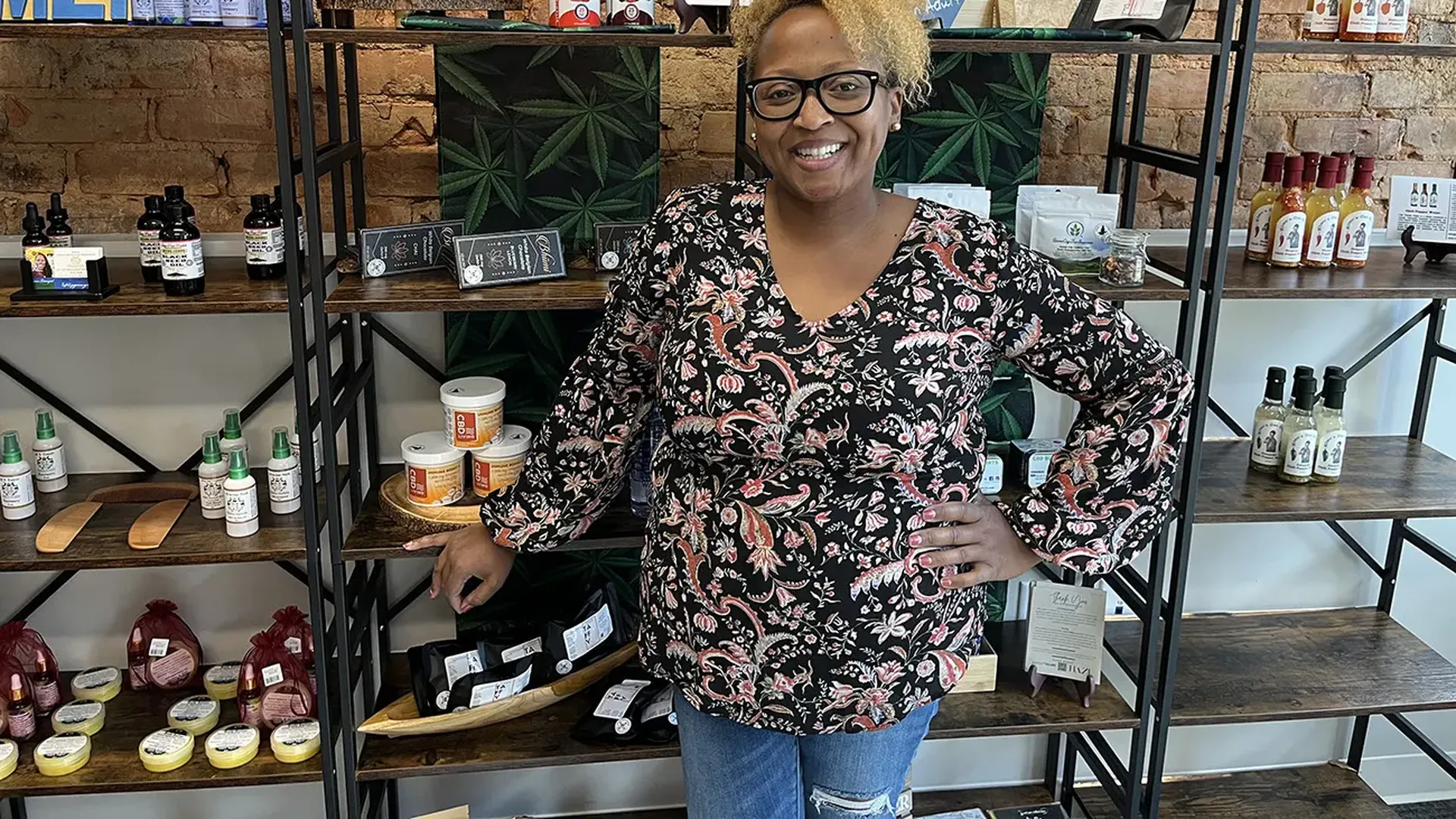
Kim DeLaney, owner of HaZi Enterprises. Photo: Danielle Chemtob/Axios.
In a race for statehouse just north of Charlotte, a person of color could soon replace a longtime representative who has called Abraham Lincoln a “tyrant.”
The election for District 73, which covers Harrisburg and a swath of Concord, looks a lot different than it has in the past: Three of the four candidates on both sides of the aisle are people of color.
Context: It was just a few years ago that Aimy Steele, executive director and founder of the New North Carolina Project, could count the number of elected leaders of color from that area on one finger.
- Since then, Steele, along with the other founding members of the Black Political Caucus for Cabarrus County, has helped elect five Black representatives in the county’s government.
Why it matters: The political changes in Cabarrus County and its largest city Concord are indicative of a broader demographic shift happening in Charlotte’s surrounding counties.
- Places like Cabarrus County are the face of the changing South. And that has implications for politics, culture and the economy.
By the numbers: Between 2010 and 2020, Cabarrus County grew faster than any other county bordering Mecklenburg, per U.S. census data.
Data: U.S. Census Bureau, Axios analysis; Chart: Simran Parwani/Axios
- The changes are almost entirely fueled by people of color: Throughout the decade, nearly 48,000 people were added to Cabarrus County’s population through both migration and birth.
- Of that: The Black population increased by more than 15,000 people, or 56%; the Hispanic population grew by just fewer than 10,500 or 63%; and the Asian population jumped by 8,473, or 245%.
The big picture: While much of Charlotte’s growth has been fueled by those early in their career, outlying counties like Cabarrus saw an influx of people in their mid-30s and 40s with children. They’re moving for the ability to purchase a larger home for a lower price, says Rebecca Tippett of Carolina Demography.
The pandemic only added to that trend:
- Between 2020 and 2021, Cabarrus’ population increased by 2.4%, or just under 5,500 people, according to the latest Census estimates. Mecklenburg County’s population grew 0.6% in that time.
- “We kind of had continued growth in our urban areas, but unlike last decade, that growth was much more substantially concentrated in the suburban and exurban areas,” Tippett says of the year-over-year growth.
Steele’s New North Carolina Project is modeled after the voter mobilization efforts started by Stacey Abrams in Georgia. Cabarrus and other counties like it are ground zero for that strategy, she says.
/2024/01/06/1704506767116.webp)
- “Cabarrus and these other bedroom communities off of major urban areas are … poised for the growth in our state,” Steele says. “And these are the areas that are also poised for more political diversity.”
A wave of diverse leaders in the county started with Diamond Staton-Williams. In 2017, she became the first Black woman elected to the town council in Harrisburg, a community of around 19,000 people that’s grown its population by nearly 65% in the last decade.
- She’s running as a Democrat for the newly redrawn District 73 seat, long considered a stronghold for the GOP. It’s now a tossup, with 51% of voters in its precincts supporting President Biden in the last election.
Yes, but: The road to being the “first” in these spaces hasn’t been easy for Staton-Williams.
- A fellow council member filed a complaint against her for her comments on the town’s drafted statement on George Floyd’s murder.
- And Staton-Williams spoke out against some of her colleagues for “knowingly” supporting the committee appointment of a citizen who referred to a proposed development as “Ebony Acres” (the development had no name at the time), the Independent Tribune reported.
Still, she’s resolved to keep trying to make history at a higher level.
“I know, it’s crazy,” Staton-Williams tells me, laughing. “I think it’s important for kids to see a woman do things that are bigger. I think it’s equally important for Black and brown kids to see someone that looks similar to them.”
In the GOP primary for District 73, Catherine Whiteford, who is Asian American, is running against Brian Echevarria, a biracial father who went viral for a speech at a school board meeting criticizing critical race theory, and Parish Moffitt, who previously ran in a district that covers northern Concord.
- Whiteford believes the race should be about who is most qualified, but she says she’s glad to see diversity among the candidates that reflects the area’s population.
/2024/01/06/1704506767382.webp)
- “I would love to see more of that in some of these different seats that open up over time,” she says.
Economy
Between the lines: Cabarrus County was decimated by manufacturing layoffs at Philip Morris and Pillowtex more than a decade ago. But now businesses are pouring investment into the area.
- On the land where the old Philip Morris plant was, pharmaceutical giant Eli Lilly is building a $1 billion manufacturing campus. Carvana, GoldenHome International, Ball Corporation, Red Bull and Rauch are also bringing jobs to the area.
Small businesses are expanding, too. After living in Charlotte for six years, Kim DeLaney, founder of HaZi Enterprises, was nervous about how she would be received in Concord as a Black woman starting a CBD company.
- “Will they just look at it as a bunch of people that want to get high?” she said.
- Instead, DeLaney found support from local business organizations, as she operates inside a downtown space called the Retail Lab pop-up store, where new local retailers can test their concepts.
Barriers
In 2017, Sandra Torres and Natalie Marles helped start El Puente Hispano, which aims to serve as a bridge between the Latino population and resources in the community.
Latino residents have been left out of many of the opportunities that have come with the area’s growth, Torres tells me.
For example, many don’t have access to the internet, she says, making it difficult to receive information about public health initiatives (like signing up for a COVID-19 vaccine or testing appointment), affordable housing or school registration. And even if they do, most of the information is in English.
- Often, the companies hiring in Cabarrus County will require at least a work permit, Marles says, leaving few options for those who are undocumented.
Torres says local leaders have been receptive to her organization’s work. She’s part of the Concord United Committee, which was established by City Council last year to focus on racial inequity.
But there’s still a long way to go.
- “For many communities, and I’m not saying necessarily this community, but for many communities the Latinos are like that fly that is in your house: you want it out because it doesn’t belong in your house, but you don’t want to kill it because it’s a fly,” Torres says.
- “We have to understand that they are people that have feelings, that have kids, that have suffering, that have happiness, that cry, laugh, just like you and me,” she added.
The bottom line: The center of gravity is shifting outward from Charlotte, and as that happens, local leaders will have to address disparities to ensure that everyone can participate in the prosperity.