The transition to electric vehicles in NC will be an uphill battle

Add Axios as your preferred source to
see more of our stories on Google.
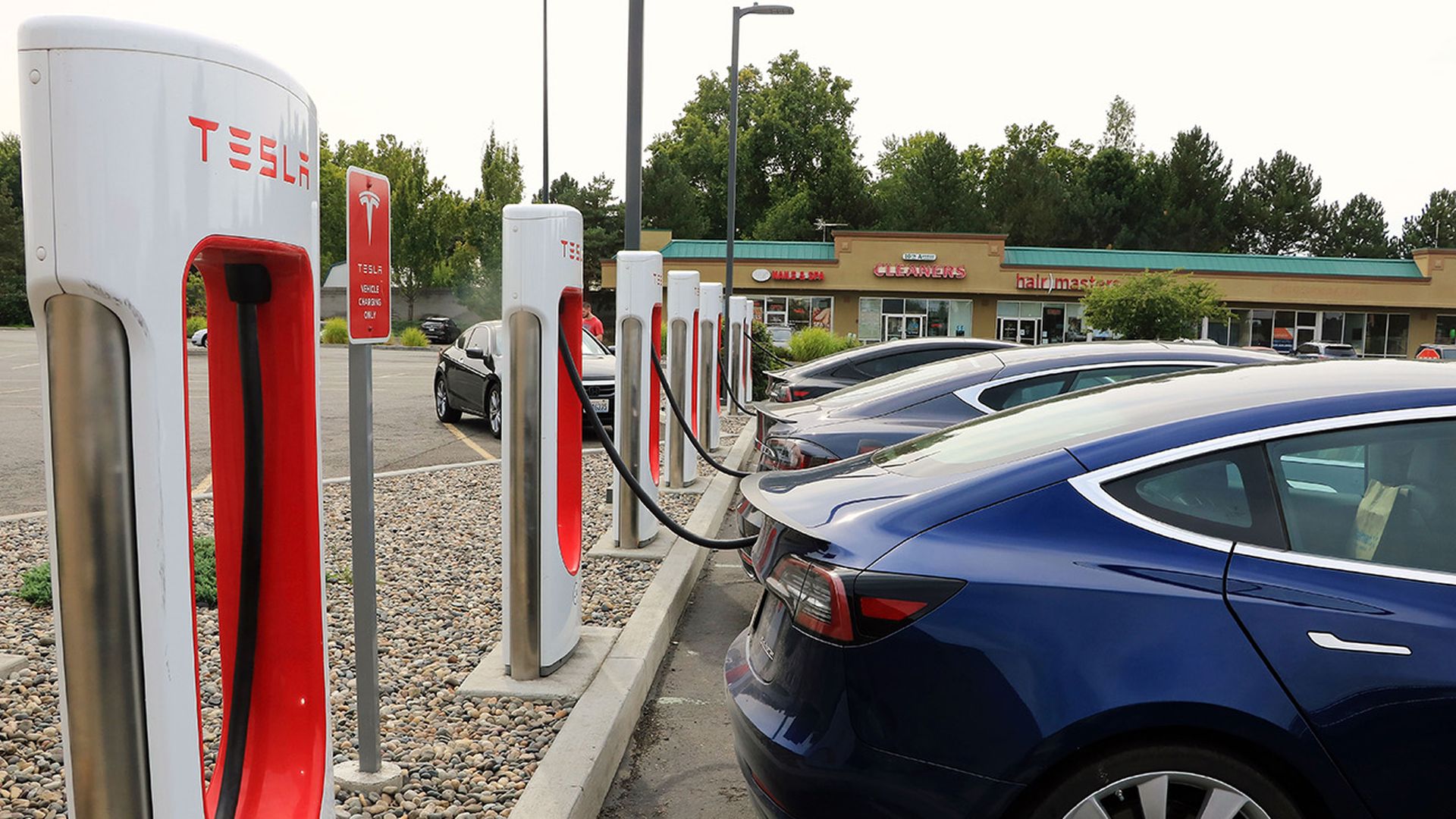
Photo: Don and Melinda Crawford/UCG/Universal Images Group via Getty Images
North Carolina has lofty ambitions to shift to electric vehicles (EVs) as a way to cut down on emissions. Large-scale fleets are beginning to move that way — but plenty of challenges lie ahead for households.
The state of play: Earlier this year, Gov. Cooper set a goal of having at least 1,250,000 registered zero emission vehicles in North Carolina by 2030. We’re a ways off from hitting that target:
- As of December 2021, North Carolina had 24,997 EVs and 12,038 plug-in hybrids for a total of 37,035, state data show.
Zoom out: It’s fair to think, however, that large-scale fleets will help drive the overall shift to EV usage, says Dr. Robert Cox, associate professor of electrical and computer engineering and associate director of the Energy Production & Infrastructure Center at UNC Charlotte.
- Companies like the idea of having predictable, set costs. That’s difficult when gas prices fluctuate.
- Corporations also want to show their commitment to sustainability.
A high-profile local example of fleets converting to electric is through Arrival, the British EV maker that’s establishing a North American headquarters in Charlotte. The company is opening a microfactory out near the airport, where it’ll produce up to 10,000 electric delivery vans a year — many of which will ultimately be used by UPS.
- As the U.S. continues to depend more on freight for deliveries of online shopping orders, every penny saved on diesel is a major cost-savings for companies, notes Jason Wager, assistant regional planning director at Centralina Regional Council.
“It’s going to ripple through, in a very massive way, these large fleets and ultimately to your pocket,” Wager tells Axios.
/2024/01/06/1704506838658.webp)
Of note: On a city-wide scale, Charlotte has said it plans to transition to an all-electric bus fleet by 2030 as part of its Strategic Energy Action Plan.
Yes, but: There are plenty of factors holding back the widespread adoption of EVs by individual households.
Education
“I think one of the biggest barriers to adoption is the fact that people don’t understand the vehicles,” Cox says. For instance, people get anxious about the range of EVs, or the distance they can go between charges. There’s a perception as well that all EVs are much pricier than regular cars, too.
Further, he adds, many drivers don’t know that maintenance costs are lower for EVs. The big challenge is that it’s not clear whose job it is to educate the public on these details.
Policy
North Carolina doesn’t offer any incentive or rebate for purchasing electric vehicles. These rebates can significantly help offset the cost of electric vehicles — and it can help spur demand for them.
- Such rebates have helped encourage sales of EVs elsewhere. California, for instance, offers tax credits of up to $7,000 for electric vehicles and a $1,500 “clean fuel reward” to encourage adoption of EVs, WFAE’s David Boraks recently reported.
Infrastructure
Cities like Charlotte are still working to bolster their infrastructure to support electric vehicles — whether it’s at public locations like the new one out on Beatties Ford or at private residences.
- An interesting tidbit: 70-80% of EV charging takes place at home or at a workplace parking lot, according to a 2021 Fuels Institute report. EV drivers tend to recharge daily or once every two days.
Perception
Simply put, the fact that EVs aren’t exactly mainstream hinders sales. In the U.S., pickup trucks comprise a massive portion of the total single-passengers vehicles sold, Cox notes. But EV pickup trucks are coming. The Ford F-150 Lightning is available to order, and demand is already high.
“I feel like until we become competitive in that space, I think it’s going to be a long slog,” Cox says.