Six months after it opened, Charlotte’s new streetcar line struggles with reliable service

Add Axios as your preferred source to
see more of our stories on Google.
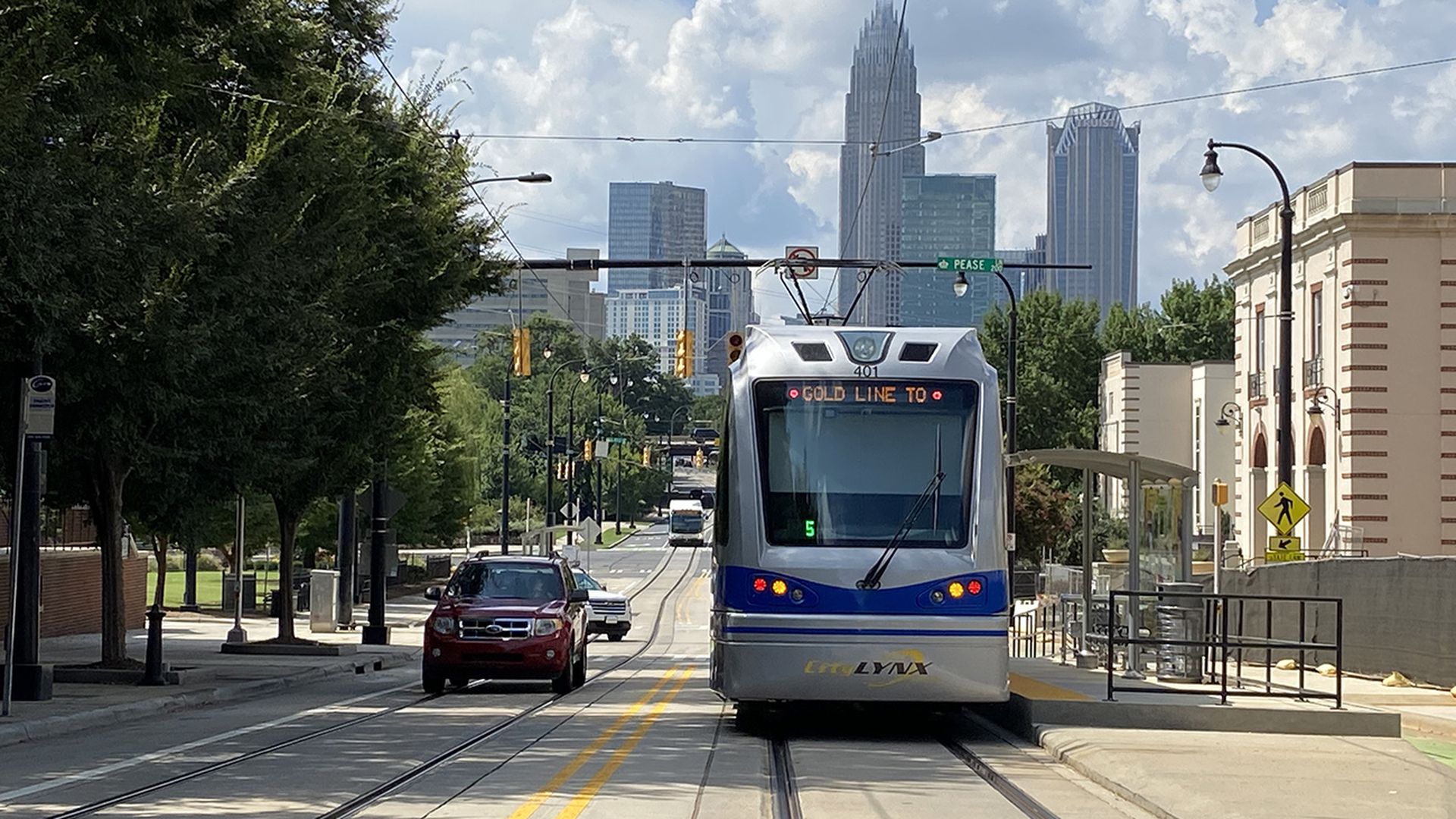
The Gold Line streetcar stops at CPCC. Danielle Chemtob/Axios
The CityLYNX Gold Line streetcar was intended to bridge communities torn apart by past transportation decisions. But six months after the opening of its second phase, the project still faces delays and reliability issues.
What’s happening: The expanded streetcar route, running four miles from near Johnson C. Smith University to Plaza Midwood, opened at the end of August last year, a year behind schedule. Since then, it’s faced plenty of challenges:
- CATS has reported problems with the Gold Line on 25 days in 2022, a scan of the agency’s Twitter account shows. Those have included delays, in some cases of 20 to 30 minutes, vehicles blocking the tracks, inclement weather, manpower constraints and mechanical issues.
- A December analysis from WFAE of the first 100 days of the Gold Line’s operation found a similar pattern. Because of the system’s inability to operate the streetcar at the intended 20-minute frequency, the streetcar is free for the foreseeable future.
Why it matters: Charlotte is still a car-oriented city, and as we grow even faster, we face increasingly dire consequences from that, from urban sprawl to carbon emissions. But public transit has to be reliable and efficient.
- Charlotte leaders say they want to plan a more equitable city, and transportation plays a critical role. In a city ranked worst in the nation for economic mobility, residents spend 22% of their income on transportation.
What they’re saying: CATS CEO John Lewis says staffing shortages, which transit agencies nationwide are facing, have led to many of the challenges with running the train on-time.
- Over the last two years, the agency has had a 44% turnover rate, he says. But they’ve been rushing to fill positions, and have hired over 300 people in that time.
- The agency is offering retention bonuses of $2,000 to $3,000, recruitment incentives and flexibility with the workweek.
- Lewis says the agency appears to be over the hump with the problem: the Gold Line has been fully staffed for the last few weeks.
Context: When former Mayor Anthony Foxx was pitching the Gold Line to City Council, his opponents called it a “streetcar to nowhere.”
But the eventual 10-mile route planned, from the Rosa Parks Place Community Transit Center to the Eastland CTC, isn’t nowhere to large swaths of the city’s residents who live in the crescent. That’s the east, north and west of the city, where the city’s lower-income and minority residents are concentrated.
Flashback: The places along its route are where past transit planning decisions have isolated communities.
Foxx, who grew up near Beatties Ford Road, remembers his grandparents spending their Saturdays driving to two grocery stores in different parts of the city to pick up vegetables and meat.
- The construction of Interstates 77, 85 and 277 spliced historically Black neighborhoods on the west side and cut off residents from amenities like grocery stores. Even the name Uptown shows how the city was planned in a way that was not equitable, he says. The streetcar was part of an effort to remedy that.
“I think it was absolutely stupid to call center city Uptown,” says Foxx, who later served as U.S. Secretary of Transportation under President Barack Obama.
- “Because from a certain vantage point, the city sits on a hill if you’re coming from the south, but the highest point of the city is actually Johnson C. Smith’s chapel. And, you know, we never called it Uptown when I was growing up; it was downtown, geographically. Literally, it was downtown.
- “And so I think there’s all sorts of ways in which we’ve oriented this city in a non-inclusive way, and even our language can do that.”
Equitable development: Leaders also wanted to spur economic development in areas neglected historically by the private market. At the time he was proposing the project, Foxx said that the wedge, the overwhelmingly white and wealthier portion of the city, generated three-quarters of the city’s property tax values.
Yes, but: Foxx says he was happy to see the streetcar’s expansion open last year. But he is disappointed that it has taken so long, which he believes cost the city — literally, given inflation. And it cost the communities that it was intended to serve.
- “We’ve paid a heavy price for the time we lost,” he said.
/2024/01/06/1704507330972.webp)
Ron Tober, who helped plan the Gold Line as CEO of CATS from 1999 to 2007, said its route runs along the lines of CATS’ most frequented buses. Streetcars can carry more people and are more cost effective for the agency.
- But he said the challenges the transit agency has had running the streetcar on time will likely lead to people not depending on it.
Ridership: CATS predicted around 4,000 trips per day on the Gold Line during the project’s development, but the latest ridership figures provided by the agency show about 750 people are taking it each day on the average weekday.
- Lewis attributes the low ridership to the pandemic and expects an uptick as employers bring workers back.
On a recent streetcar ride from Plaza Midwood to the end of the line at French Street and back, I spoke with five people who ride the streetcar frequently, and all said they were happy the city invested in it.
- Cynthia Reyes, a second-year student at Central Piedmont Community College, takes it to the Transportation Center Uptown, where she transfers to a bus to get home. Reyes said she feels safer riding on the streetcar, especially as a woman.
Impacts: But the delays have had real consequences for people relying on the Gold Line. Paige Risberg, who lives in Plaza Midwood and works Uptown, said there were several times she shared an Uber with other riders because the streetcar was so late. And she’s frustrated that CATS is communicating delays via Twitter.
- Chris Hood, who rides the Gold Line to work from Biddleville to Uptown, said he observed, particularly right after the streetcar’s opening, that the day after a service delay, there would be fewer riders.
Still, most of the riders said they’ve noticed improvements with the frequency in the last month or so.
- When I rode the streetcar on February 23, I was a minute late, and I actually missed it. The next train was on time too, and I didn’t have to wait long at French Street to catch the train back.
Funding conundrum: The Gold Line is funded by the city of Charlotte, with some help from the federal government for construction. It’s not supported by the half-cent sales tax approved by voters in 1998 that subsidizes light rail. Foxx said there were few discussions about who would pick up its operating costs.
It’s still unclear how the city will fund the Gold Line’s third phase.
- Lewis said he’d like to get some of the money from a proposed 1-cent sales tax to fund transit that faces numerous hurdles, if it moves forward.
Dedicated lanes: In order to prevent vehicles from inhibiting the streetcar, CATS could build a dedicated lane for the Gold Line. If that happened, it would operate like the light rail.
David Bragdon, executive director of the New York-based TransitCenter, said streetcars are slower and more unreliable when they share the street with cars.
What’s next: CATS plans to present design plans for the third phase of the streetcar to City Council in the near future, Lewis said.
- The streetcar currently attracts riders who may have otherwise walked, biked or scootered, he says. With the full 10-mile route, it becomes more of a commuter service that competes with cars. Lewis wants the city to consider a dedicated lane for the third phase.
- “We’ve got to find ways to pick up speed or else we’re not going to attract riders,” he said.