New book highlights the history of Black excellence in Charlotte

Add Axios as your preferred source to
see more of our stories on Google.
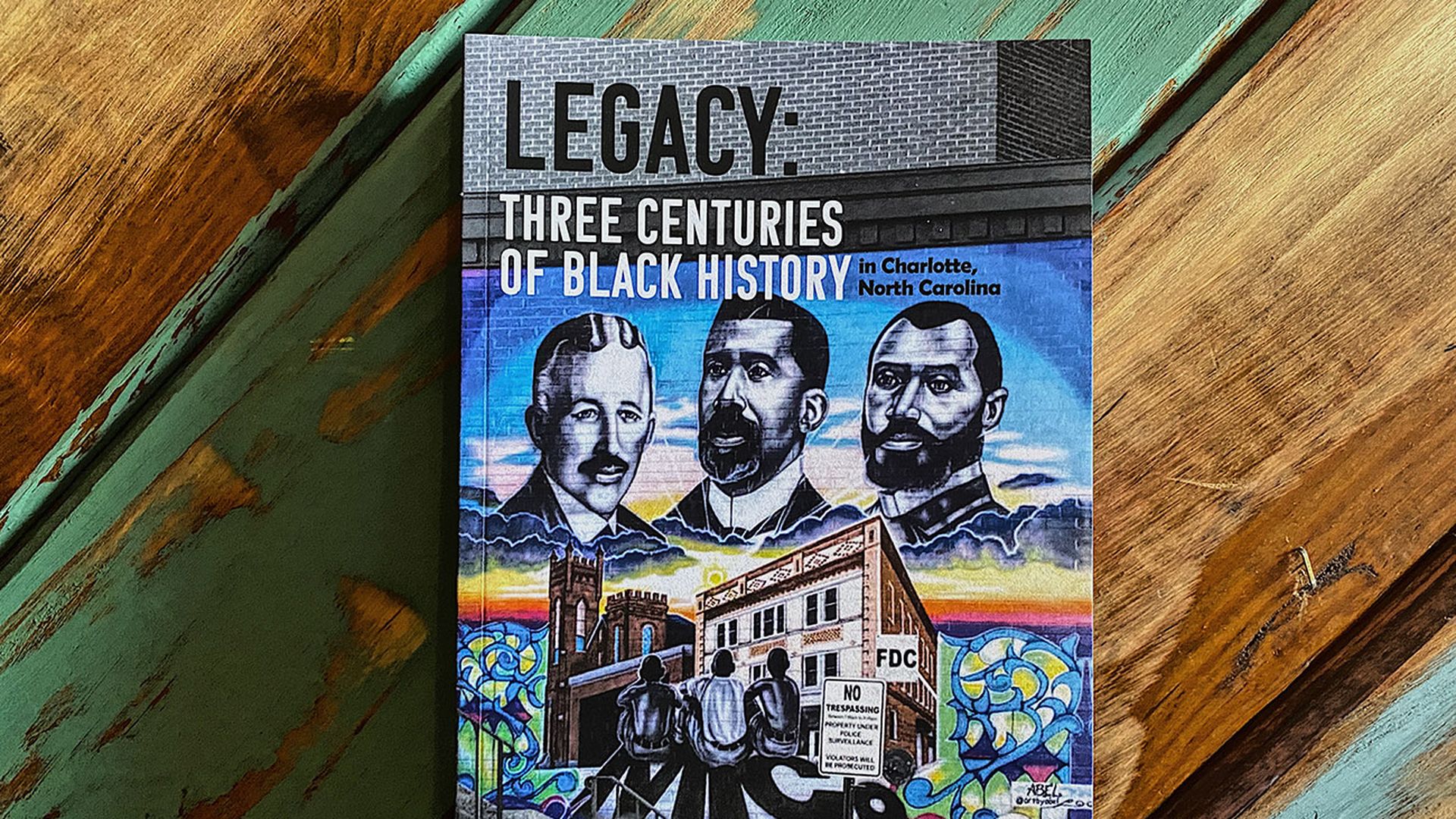
Photo courtesy of Queen City Nerve
The writer and activist James Baldwin came to Charlotte in the late 1950s to see, first-hand, what kind of community this was.
- Was it the racist place where white kids and adults spit on and threw rocks at 15-year-old Dorothy Counts as she integrated Harding High School, as he’d seen on the front page of the New York Times?
- Or was it something better?
What he found: “I was told several times, by white people, that ‘race relations there were excellent.’” Baldwin wrote in the Partisan Review of his visit. “I failed to find a single Negro who agreed with this.”
That’s one of many striking lines in the new book “Legacy: Three Centuries of Black History in Charlotte, North Carolina,” by local historian and author Pam Grundy, published by Queen City Nerve.
Why it matters: The book is a brisk, useful overview of Black history for Charlotte newcomers or those just new to the city’s story. But it has several moments — like the Baldwin quote — that were new finds even for a historian like Grundy.
- More than that, “Legacy” centers the role of Black excellence in Charlotte’s past.
- Along the way, Grundy presents the many ways white leaders harmed generations of Black progress. But by presenting it through the lens of the Black leaders who pressed through, a consistent thread of hope grows as you flip the 127 pages.
What she’s saying: “I don’t think this book downplays the oppression,” Grundy told me Saturday. “But I do think it really tries to focus on what African Americans did to deal with the realities that they faced and all that they accomplished, and the hope and the joy.”
What to expect: It starts with the contributions of labor from Black people who had their freedom stolen.
- “… enslaved men made and likely laid the bricks for institutions such as Davidson College, the Mecklenburg County Courthouse and the Charlotte Mint. They labored on farms, in workshops, in mines and in mills. They positioned the rail lines that would transform the region, maintained the tracks, hauled wood and water for the big steam engines.”
The book rolls through the names and stories of Black protagonists through time. There’s:
- John Schenck, Charlotte’s first Black elected official and an organizer of the state’s Republican Party.
- Samuel Pride, who elected not to leave the South after 1898 and stayed to become an educator and principal at the all-Black Myers Street School, starting a generation of focus on education.
- Trezzvant Anderson, a journalist and activist and World War II serviceman whose accomplishments have only recently become known, thanks to the work of Levine Museum of the New South historian Willie Griffin.
- Hattie Ann Walker and Edith Strickland DeLaine, who helped lead the sit-in protests here. (“Women were at the heart of the sit-in demonstrations. You don’t hear our voices very much,” DeLaine once said. “But you cannot look at a picture and not see a female in it.”)
- John Richmond, who in 1939 passed the civil service test in hopes of becoming a mail carrier but was denied the job by a racist postmaster. The Black community rose up to get the postmaster fired.
- And then there are the accomplishments of civil rights leaders like Counts, Julius Chambers and Harvey Gantt. On up to more modern stories of people like former mayor and U.S. Transportation Secretary Anthony Foxx.
On the cover: The Abel Jackson “Historic Brooklyn” mural on Brevard Street in what was Second Ward. The three men are Thaddeus Lincoln Tate, J.T. Williams and William C. Smith, leaders of the 19th and 20th centuries. And the three boys looking up is actually from a locally famous picture of three boys looking at Second Ward High being torn down during urban renewal.
- “He (Jackson, the artist) wanted to move those boys from looking at the destruction to looking at these men who had built it,” Grundy says.
- In some ways, she says, she hopes her book does the same.