Why neighborhood names matter in Charlotte

Add Axios as your preferred source to
see more of our stories on Google.
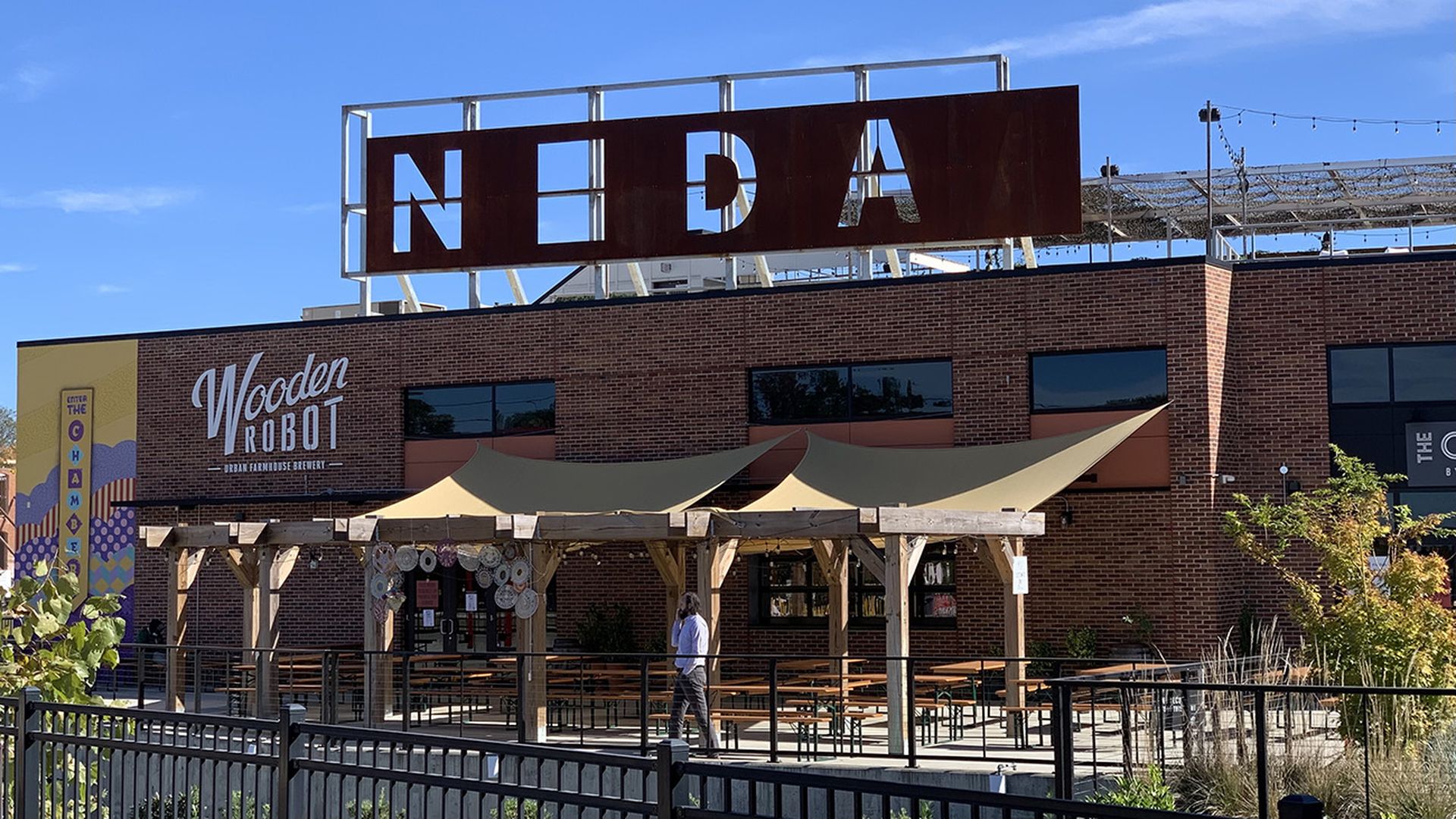
Photo: Katie Peralta Soloff/Axios
Every neighborhood name started somewhere, be it SoHo or Nolita in New York or South End in Boston.
But for some reason, neighborhood names like LoSo and MoRA in Charlotte can evoke some serious eye rolls.
These newer names often are concocted by developers, or by marketing firms, or by neighborhood organizations. They usually have a similar goal: To establish a neighborhood identity, to give people a sense of place, and to give an area a way to set it apart from other areas in town.
- Yes, but: The backlash often comes from a feeling that these names feel manufactured. Should a neighborhood brand be a marketing effort — or should it come about organically?
- Others note that the naming of a neighborhood must include longtime residents — particularly in fast-changing areas.
Why it matters: The “name game” is a result of a fast-growing city that’s adding thousands of new residents every year, as Ely Portillo wrote for the Observer in 2016. Names like MoRA are newer, but people have used NoDa for so long that it’s widely accepted.
Few of today’s Charlotte neighborhoods still look like they did when they were laid out decades ago, and few have the same names, says Charlotte historian Tom Hanchett.
- For instance, in the early 1970s, residents of a subdivision called Midwood and others who lived near The Plaza banded together to stop construction of a major road through their neighborhoods.
- As a show of unity, they wanted a name for their common cause and their area. Plaza Midwood was born.
/2024/01/06/1704500893625.jpg)
Today, in areas like MoRA (Monroe Road Area), the naming comes from those within the neighborhood who want to see investment flow in from new business and government, Hanchett says.
“As a neighborhood becomes more successful and identified, real estate folks start to use those names in their marketing. If it’s really successful the name kind of overflows into surrounding neighborhoods,” he adds.
That’s certainly happening in LoSo, or Lower South End, an area where people are striving to differentiate from its well-known neighborhood to the north. In recent years, LoSo has established itself as a brewery hub, with names such as Old Mecklenburg, Sugar Creek, Brewers at 4001 Yancey and Protagonist.
Although it didn’t establish the LoSo name, Beacon Partners is one of the developers that has used it in a major project it built — LoSo Station, a mixed-use property with office and retail.
- “In our quest to create a relatable and recognizable brand for Beacon’s new office development, it seemed best not to attempt to re-brand the neighborhood with our own preferred labels,” says Erin Shaw, Beacon’s director of office investments.
But there are other concerns about the effects of these new neighborhood names.
In New York about a decade ago, for instance, a state assemblyman named Hakeem Jeffries wrote legislation that would punish real estate agents for inventing neighborhood names, the New York Times reported at the time.
His reason: Not only did he think some names “sounded silly” — but more importantly, the new naming artificially inflated housing prices, Jeffries argued.
In Charlotte, investment is pouring into the area around Tuckaseegee Road, a historically Black community in West Charlotte. This leads to concerns over home prices and gentrification in those areas, as Danielle Chemtob has reported.
- For instance, off Tuckaseegee and Thrift roads, an Atlanta developer is marketing the $80 million transformation of old warehouses as “Lower Tuck.”
Flashback: In Charlotte, the name “NoDa” first appeared in the pages of the Observer in 1995. Art gallery owner and painter Steve Holt christened the name, and it apparently quickly caught on, according to a February 1995 Observer story.
- “If there’s a place for new ideas, this is it,” Holt, then 43, told the paper. “Hey, we’re creating history here. Fortunes are made by people who create excitement.”
- The Observer wrote in September 1997 that the two-syllable abbreviation was beginning to gain traction with “the young and with-it.”
Today, White Point Partners is one of the local developers giving new life to old mill buildings like Optimist Hall and Chadbourn Mill. The neighborhood both of those properties are in, Optimist Park, is adjacent to NoDa, but stand apart from it.
- Keeping those names distinct helps preserve the history of the areas, White Point co-founder and partner Erik Johnson tells Axios.
“It helps ground people to what an area is,” Johnson says of neighborhood names.
“What we’ve found works well is if you dig into that history and kind of turn back the clock and really understand what a neighborhood was in its infancy. I think that resonates with a lot of people.”
South End is another name that feels like it’s been around forever. But WFAE reported in 2013 that the branding and design firm Shook Kelley helped come up with “the grand-sounding ‘Historic South End.'”
- It was “a ‘tongue-in-cheek’ nod to the district’s lack of historic buildings,” per WFAE.
“That was tongue-in-cheek, because the truth is about Charlotte in general and South End in particular, there’s very little that’s historic,” the firm’s co-founder Terry Shook said at the time.
A bit more about other other neighborhood names:
- SouthPark: A neighborhood named after a mall that opened in 1970 on property that was once a dairy farm.
- FreeMoreWest: The name that resulted when the Freedom Drive Development Association merged with the West Morehead Business Association in 2010 to promote the two business corridors and residential areas, the Observer reported at the time. Over the years leaders and community organizers started referring to the combined area as FreeMoreWest, Observer archives show.
- Montford Park: A combination of the Montford Drive and Park Road Shopping Center area names, as the Observer reported in 2016. Grubb Properties, which has both its headquarters and hundreds of apartments in the area, met with residents to pick that name.
- Ballantyne: A south Charlotte enclave named after Barbara Ballantyne, the aunt of developer Smoky Bissell, as Charlotte magazine wrote in 2012. Bissell established Ballantyne in the mid 1990s as an office park with a hotel and golf course.
Editor’s notes: This story was updated to include the preferred stylized version of the MoRA name, not MoRa; and corrected to note that Tom Hanchett is a Charlotte historian, not historian-in-residence at the Charlotte Mecklenburg Library (that position ended last summer).
- Also, it’s been corrected to note that both of White Point Partners’ properties are in Optimist Park, not in Villa Heights and Optimist Park.