Our affordable housing shortage, in numbers

Add Axios as your preferred source to
see more of our stories on Google.
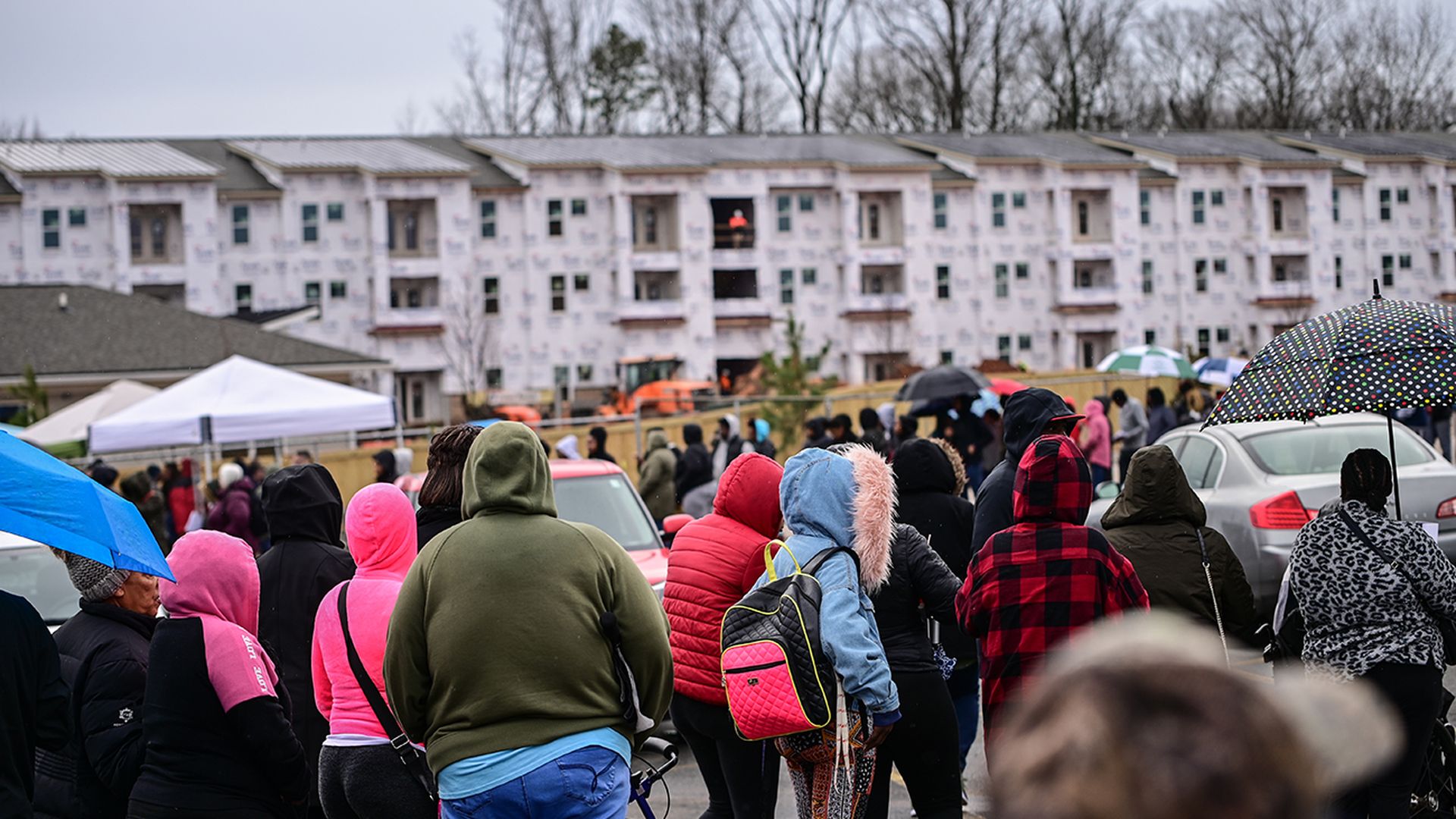
People line up for a chance to apply for an apartment at the Mezzanine at Freedom, an affordable housing project, back in January 2019. Photo: Alvin Jacobs/Axios
The pandemic has only exacerbated the growing affordable housing crisis in Charlotte, a new report from the county found.
What’s happening: Mecklenburg County released the 2021 Charlotte-Mecklenburg State of Housing Instability and Homelessness report, which found that the supply of affordable housing is continuing to decrease despite increasing demand.
Details: Someone earning minimum wage and working a 40-hour week would not be able to afford a one-bedroom apartment at $1,010. The study found that they would have to work nearly three times as many hours.
And it’s not just minimum wage workers who can’t afford rent.
- The average wages for bus drivers, firefighters, nursing assistants, janitors and cleaners, and construction workers are all below the $21.04 per hour that is needed to afford a one-bedroom apartment.
So it’s not surprising that just over 83,000 Mecklenburg County residents, or 44%, are cost-burdened, as of 2019, which means they pay more than a third of their monthly income on housing expenses.
- Another 18% are severely cost-burdened, meaning they spend more than half of their income.
Why it matters: The report paints a clear picture of how the need for affordable housing is only increasing, despite the city spending millions of dollars to address the shortage.
Between the lines: Compounding the problem is the dwindling supply of affordable housing.
Data: Mecklenburg County. Chart: Axios Visuals
- In 2011, 45% of rental units cost less than $800 a month. In 2019, just 22% of units were in that price range.
Part of the issue is driven by the demolition or renovation of older apartment buildings, which are often more affordable than new complexes.
- There’s a shortage of about 23,022 units for the people at the lowest end of the income range, which earn 30% of the area median income or less (that’s about $25,000 for a family of four).
Driving the news: COVID-19 has deepened the housing crisis. An estimated 28,000 renters in Mecklenburg County are behind on rent as of July, with an average debt of $3,589.
- With the eviction moratorium now lifted, that means thousands could face eviction without assistance.
- The city of Charlotte and Mecklenburg County have disbursed over $24 million in emergency rental aid to 6,561 households.
Homelessness: As affordable housing has become more difficult to find, homelessness has worsened.
As of June, more than 3,100 people were experiencing homelessness in Mecklenburg County, an increase of 55% year-over-year. Seventy-seven percent of them are Black.
The bottom line: Affordable housing is likely to remain at the top of minds for elected officials and voters for years to come as Charlotte grapples with the impacts of its rapid growth.