Is an affordable housing developer fueling gentrification?

Add Axios as your preferred source to
see more of our stories on Google.
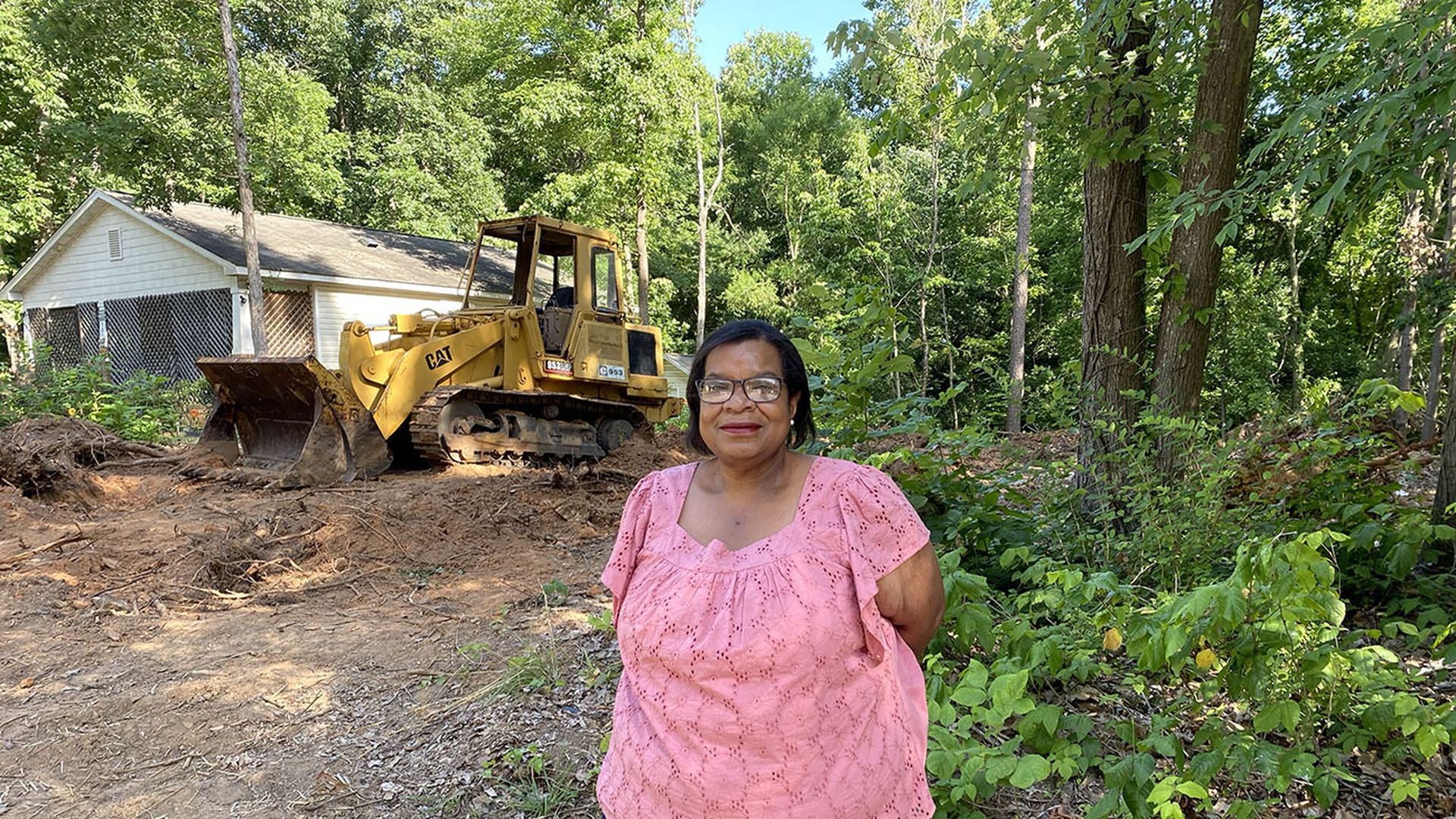
Melissa Gaston, a community advocate and widow of Darryl Gaston, in front of one of the sites DreamKey Partners is looking to sell. Photo: Danielle Chemtob/Axios.
Affordable housing developer DreamKey Partners started working in the Druid Hills neighborhood in the late 1990s, long before the flood of investment arrived.
At the time the neighborhood was full of dilapidated buildings and vacant houses. DreamKey, then the Charlotte-Mecklenburg Housing Partnership, renovated and built homes as part of a master plan, funded by the city, to revitalize the neighborhood.
Fast forward more than two decades: The improvements attracted scores of investors, and with it, rising property values that are squeezing out longtime residents.
What’s happening: Now DreamKey is looking to sell more than a dozen of its lots to a private developer that will build “modest market-rate homes.”
- That has prompted concern from people like Melissa Gaston, a longtime advocate for the area with her late husband Darryl. She fears the sale will spur gentrification.
Why it matters: DreamKey plays an outsize role in creating affordable housing in Charlotte. It’s created more than 100 units in Druid Hills alone. But the market-rate sale means it will now also play at least a small part in the soaring prices that are pushing longtime residents out.
The state of play: On street after street in Druid Hills, new homes dwarf the original ranch-style houses.
- The average home price in the zip code that includes Druid Hills, 28206, has increased 111% in the last five years, according to data from Zillow.
Data: Zillow; Map: Sara Wise/Axios
What they’re saying: Julie Porter, president of the nonprofit DreamKey, tells me the group needs the proceeds from the sale of the 13 parcels to fund the construction of 11 other affordable homes in the neighborhood. She cited the rising costs of homebuilding.
- The organization did not disclose the sales price for the 13 homes. But in a previous deal that fell through, Porter said the homes would have started in the low $300,000s.
- The median sales price for a home in the Charlotte region is $323,000, according to the most recent data from Canopy MLS.
Gaston, meanwhile, criticizes what she sees as a lack of transparency with the community from the organization around the sale.
- She said the deal contradicts the image DreamKey Partners has cast as an affordable housing proponent. “On the back end, you’re selling off to developers,” she said.
- Gaston doesn’t believe that DreamKey set out to prompt gentrification when the organization started working in Druid Hills. But as the neighborhood was stabilized and the market shifted, it was an inevitable consequence.
Porter insists that from the beginning, the organization planned to build a combination of market-rate and affordable housing in Druid Hills.
But Gaston, whose late husband was on the DreamKey board, and others involved with the efforts in the neighborhood over the years say that all of the homes the nonprofit was building in the area were originally slated to be affordable.
- Bert Green is the former executive director of Habitat for Humanity of the Charlotte region. The two groups built together in Druid Hills, and he said the expectation was that all of the new housing they created in the area would be affordable.
- J’Tanya Adams, program director at Historic West End Partners who served on the board of DreamKey for about six years, said the goal was to create affordable homes that would cost around $200,000. There was no discussion of building market-rate housing, she said.
Zoom out: For years, communities like Druid Hills in the “crescent,” an area of the city that includes majority-minority, lower-income neighborhoods in the north, west and east, suffered from disinvestment.
- Then, as new residents flocked to the city, investors began snatching up properties in many of those areas due to their proximity to uptown.
Green, who also served on the board of DreamKey, calls gentrification the reality of the work being done in neighborhoods like Druid Hills. The investments make the neighborhood more appealing to developers and to individual homebuyers, he said.
Charlotte’s inequities are on full display in Druid Hills.
/2024/01/06/1704502153974.jpg)
A home across from one of the DreamKey lots went under contract for nearly $450,000. Nearby, the sprawling Camp North End complex, once a manufacturing facility, has drawn new businesses to the area.
The neighborhood is also flanked by a men’s shelter and an apartment building that houses the chronically homeless.
- Many of the people who pass through Druid Hills will likely never get a chance to live in the new homes being built.
Between the lines: If the 13 lots fetch market value, that could signal to other investors that own homes, many of which are rented out for cheap, that it’s time to sell, Gaston said. Those renters would then be displaced from the neighborhood.
- And as the sale helps fuel higher land values in the surrounding area, that will eventually lead to higher property taxes. In rapidly-gentrifying areas of Charlotte, property taxes surged in the 2019 revaluation, pushing out longtime residents.
Porter said while she’s concerned about gentrification, in this case, no one is being displaced. She believes it’s a positive situation for the neighborhood because they’ll bring in a diverse range of incomes and help build homeownership.
Porter said DreamKey has always had a dual purpose in the neighborhood of providing affordable housing and eliminating blight.
- The organization has built two affordable senior housing buildings, called the Gables at Druid Hills, which total 136 units.
- DreamKey maintains 55 affordable rental homes in the neighborhood, Porter said, and has already built 12 single-family homes that were sold to low- and moderate-income buyers.
“We’re very proud of our work there,” Porter said.
The 11 homes funded by the sale of the other lots will be affordable to those earning less than 80% of the area median income. That’s equivalent to $66,800 for a family of four, according to city data.
Porter said that in discussions with the neighborhood, residents said they did not want only affordable housing to be built.
“It was always important to us and the neighborhood itself to bring in a mix of incomes and create more economically diverse communities,” she said. “There was just a wide acknowledgement that the concentration of poverty was probably not helpful.”
Socioeconomically diverse neighborhoods are seen as a key strategy to reduce segregation and improve economic mobility.
- Charlotte was ranked last of 50 cities for economic mobility in a 2014 study, and a subsequent local report recommended a dramatic increase in the amount of mixed-income housing in the city.
While Gaston said the area is over-saturated with low-income rental housing, she wants to see affordable opportunities for homeownership.
/2024/01/06/1704502154229.jpg)
- “How do you bring yourself out of poverty if you can’t build wealth?” she said.
What’s next: In an email, DreamKey spokeswoman Noelle Bell said the city will need to approve the deal. Before the sale, the nonprofit will engage with the community and conduct educational efforts with residents who may be interested in purchasing a house.
That’s a positive step, Gaston said. But she plans to hold DreamKey accountable for their promise.
After all, it’s not just her advocacy work. It’s also Darryl’s.
Darryl Gaston was a champion for Druid Hills and the unofficial mayor of the North End. He died in February at age 59.
On Thursday, dozens of people gathered at Camp North End to celebrate him on what would have been his 60th birthday.
Darryl and Melissa met doing community service. Now, she’s fighting for the future of Druid Hills to carry on his legacy.
“I’m sure that if he’s able to look and see what’s happening, and know about these things, that he’d be right there, pushing along behind me, saying ‘OK Melissa, you got this, make sure you hold them accountable.
“Don’t let this happen just because I’m not there any longer.'”