Why new-to-town developers are still salivating over Charlotte

Add Axios as your preferred source to
see more of our stories on Google.
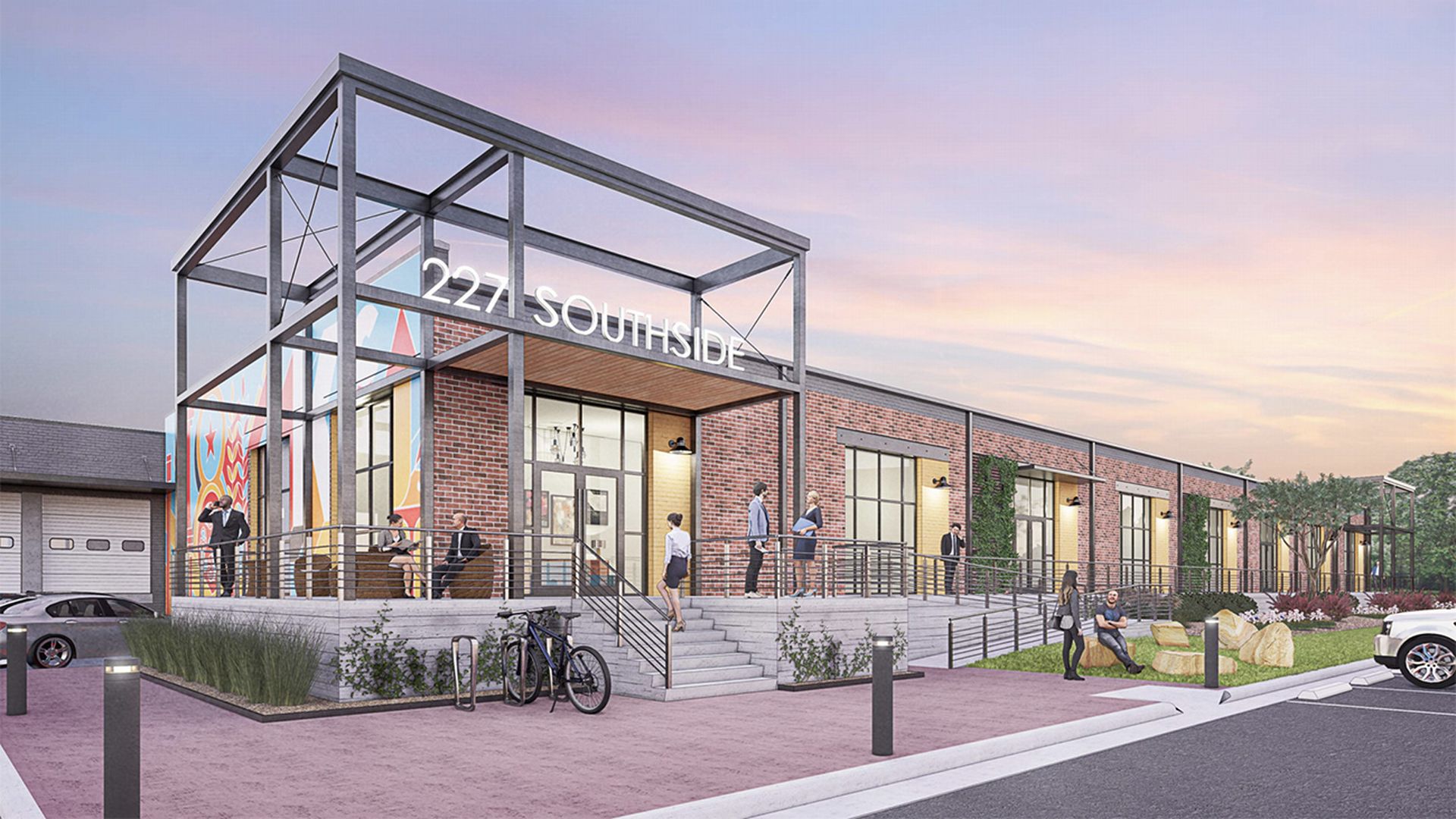
Rendering courtesy of Acram Group
Even during a pandemic, out-of-town developers are buying up properties all over Charlotte.
Why it matters: National developers see Charlotte as a lucrative investment opportunity because of the city’s growth, in particular the number of young professionals who’ve moved here. “It’s important to follow the workforce,” said Aaron Lazovik, managing director of Acram Group.
- Charlotte, many firms say, is well positioned to rebound — especially when it comes to a physical return to offices.
- The pandemic is still on developers’ minds, though, and it’s shaping how they think about the projects here.
Driving the trend: Some of the most popular investment targets are old industrial buildings in hot neighborhoods.
- New York-based Acram bought its first Charlotte property in October 2019: A brick building at 300 Rampart St. in South End for $12.6 million. In late December, the firm bought 227 Southside Dr. in Lower South End for $14.5 million, county property records show.
Both properties are single-story former manufacturing plants in fast-growing neighborhoods. Both will include a mix of office and retail tenants (227 Southside is where Protagonist Brewing has its second location). They both have ample outdoor space, plus parking lots.
- In the post-pandemic return to work, these types of properties will have an advantage over crowded office towers with parking decks and elevators, the Acram team says.
- “In a post-COVID world, that’s pretty attractive. Tenants can control their own space and have direct access to outside air,” said Acram managing partner Matt Cassin.
/2024/01/06/1704503540309.jpg)
Yes, but: It remains to be seen what demand for future office space will look like. In Charlotte, companies like Grant Thornton are downsizing, CBJ has reported.
- Furthermore, neighbors often worry that new development could drive up property values — and price longstanding residents or businesses out.
Back in South End, Kairoi Residential bought the 13.5-acre Stax fitness property at 3722 South Tryon for $12.65 million last fall. That was the San Antonio firm’s foray in Charlotte.
- At the Stax site, Kairoi plans to build a sprawling, high-end apartment community.
What drew them here was Charlotte’s diversified job growth, said Daniel Zunker, president of development. The city is a financial hub, but its STEM growth is equally impressive, Zunker says, and according to at least one list, we’re No. 1 in STEM growth nationally.
“We absolutely love Charlotte. It’s a place we’ve wanted to break in for a long time,” Zunker said. He describes four cities — Denver, Austin, Charlotte and Nashville — as the “new guard,” fast-growing cities that are ripe for investment.
“That’s where action is happening. That’s where businesses are going to be started. That’s where entrepreneurship is going to flourish,” Zunker said.
Austin-based Artesia Real Estate, also lured by the job and population growth, bought the old City North Business Center on North Tryon in 2018 for $8.8 million. Artesia has spent the last few years rehabbing the property for office and retail tenants.
By the numbers: City leaders anticipate nearly 385,000 people will move to Charlotte over the next two decades.
- There’s $3 billion in new development planned in 2021 for Uptown and surrounding neighborhoods like South End and midtown, according to a new report from Center City Partners.
- The Charlotte region has recovered nearly 88,000 of the jobs it lost in the first two quarters of 2020, according to the latest economic report from the Charlotte Regional Business Alliance. If Charlotte keeps up this pace of job growth, we could return to job levels we had pre-pandemic by the end of this year. [Go deeper]
/2024/01/06/1704503540667.webp)