‘Hammer their ass.’ Breaking down the videos that show CMPD’s plan to ambush crowds protesting police brutality

Add Axios as your preferred source to
see more of our stories on Google.
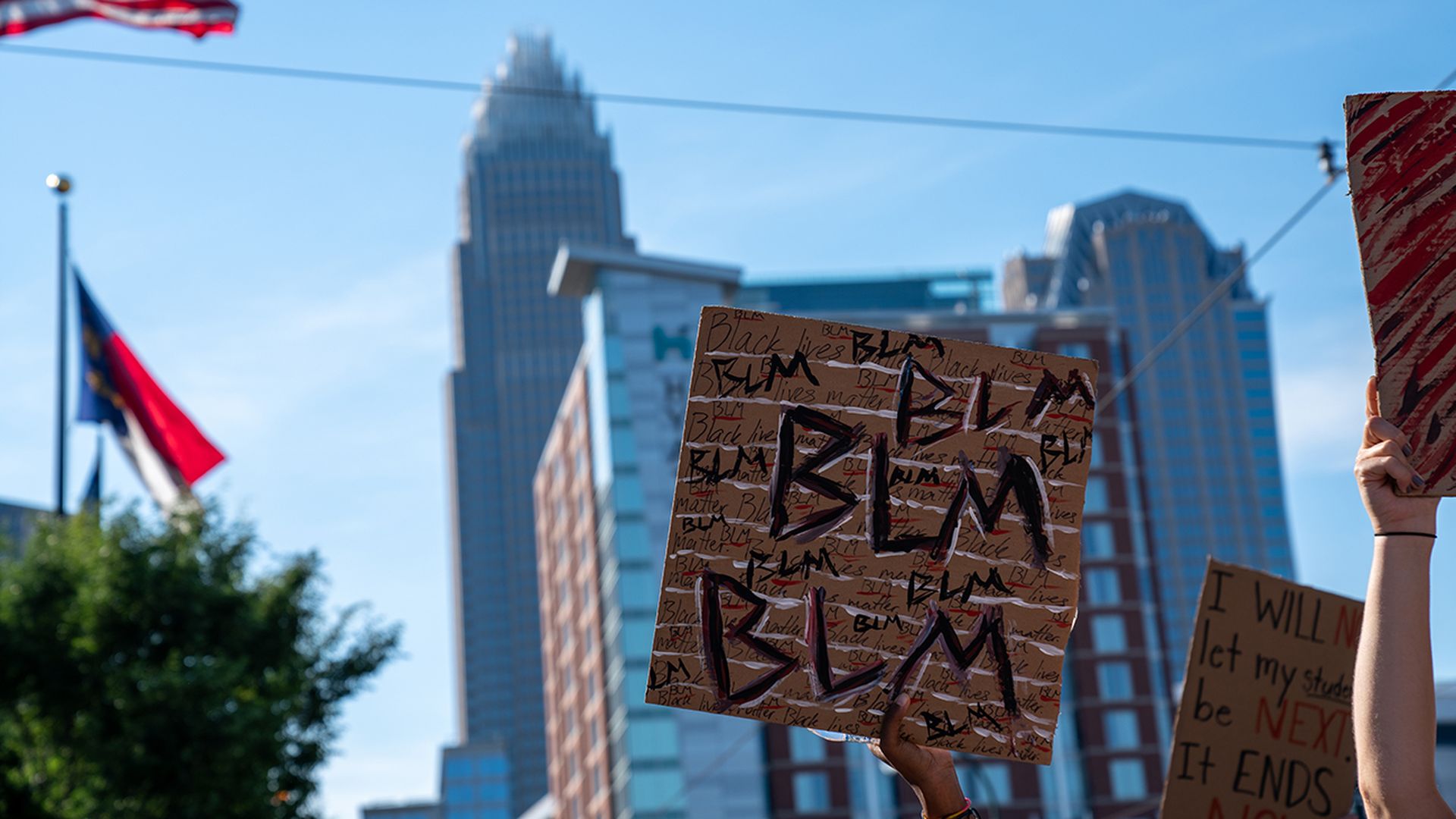
NAACP uptown protest June 2 2020
They call it “the plan.” Multiple times, and in multiple videos.
At around 9:30 p.m. on June 2, “the plan” filters into the ears of dozens of police officers in Uptown as they monitor protesters marching up Fourth Street. They will let them pass through College Street — in fact they say they will “push them” that way — but they won’t allow them to go any farther than Tryon, the next street up. There, the people will meet a wall of uniforms and gas.
At one point, a line of officers appears to create a wall of bicycles as protesters approach on College. The protesters are yelling “Hands up! Don’t shoot!” The officers are saying, “Make sure the walls are strong.”
The details of what happens next have been debated by police and protesters for nearly three months.
But this week, the Charlotte-Mecklenburg Police Department released 57 body-worn cameras that give a much clearer picture. We reviewed all the videos this week, and they confirm that officers had planned, using flash bangs and tear gas, to trap the protesters.
“We’re going to stay here and watch the show,” says an officer wearing the body-worn camera.
The line of officers faces the street. The officer wearing the body-worn camera turns to a colleague who’d asked about the plan.
“We’re going to push their ass straight up Fourth. Soon as they get up on Fourth, because we’ve got a bottleneck now, Rorie’s squad is going to step out and hammer their ass. When they start running down, Dance’s squad is going to step out and hammer their ass with gas.”
The officer takes a couple of swigs from his water bottle, then walks closer to the street. The chants from the crowd grow louder as protesters march through.
“Hey, wave goodbye. They’re all about to get gassed!” the officer says.
CMPD calls the sergeant’s remarks inappropriate and insensitive.
As punishment for “conduct unbecoming” and turning off his body-worn camera, the department suspended the officer for two weeks without pay. He won’t be eligible for a promotion for at least two years, either.
CMPD spokesman Rob Tufano says North Carolina state personnel statues restricts CMPD from releasing the identity of the supervisor.
“We’re human. There’s always going to be mistakes that are made. I think what we need to be judged by is how do we get better after mistakes are made and how do we better serve our community?” CMPD Chief Johnny Jennings said during a press conference August 26.
City councilman Braxton Winston slammed the officer’s actions on Twitter Wednesday.
“I wonder if my colleagues will join me in abolishing this or nah? 🤷🏽♂️ @CLTgov is supposed to provide municipal services. Who does this serve?” Winston tweeted.
Similarly, Congresswoman Alma Adams said she was deeply disturbed by the videos. This, Adams said, is another example of why municipal police shouldn’t have chemical agents. “It is clear that previous reports did not tell the full story of this intentional assault on protesters.”
In an interview with the Agenda, Charlotte Mayor Vi Lyles praised Jennings for making reforms based on the concerns of the community. The police department and the city, she said, will continue to examine police policies.
“When we talk about police reform, we see that in Chief Jennings,” Lyles said of the head of police, who assumed his new role in early July. “He’s addressing these issues in real time.”
August 26, the day CMPD released its videos, is the day the Lakers and Clippers voted to boycott the NBA season following the police shooting three days prior of a Black man named Jacob Blake in Wisconsin.
And June 2, the day of the incident in Uptown, marked a week and a day after police in Minneapolis killed a Black man named George Floyd.
Protests over police brutality carry on from one incident to the next now.
Earlier in the evening on June 2, more than 10,000 people gathered in Marshall Park that night for a peaceful demonstration organized by the local NAACP and the group Kidz Fed Up.
Volunteers handed out water bottles and snacks and face masks. There were tables to register people to vote. Entire families attended and listened to impassioned speeches imploring equal treatment for Black people and an end to police brutality.
At first, things were calm. No one got arrested.
But the sun went down, and the crowd thinned a little. The videos released this week give some insight into what happens as the night wears on, and tension between police and protesters escalates.
In the footage, officers talk about people tearing things down. They give an order to disperse crowds after an officer was apparently hit in the head with a rock. Put your team on Tryon, just prepare for a plan, one officer says.
Police say one woman has a laser and discuss spraying her with a chemical agent if she points it at them. Some protesters hurl expletives at officers. Others approach the officers, offer fist bumps, and thank them.
In the videos, it’s hard to see all that’s happening on the ground below as police trapped protesters with tear gas, a tactic known as kettling.
But video from the crowd, including the one widely circulated by Queen City Nerve, documents a violent scene that was seemingly unprovoked.
In CMPD’s video, after flash bangs and tear gas send crowds running, officers leave the College Street area on their bikes. When they reach a meeting spot nearby, one officer, laughing, says “that looked like total chaos.”
At the time, Putney sounded confident the body cam footage would vindicate the officers.
“This is a punch to the gut because we don’t want to be perceived as being anything but what our mission is about, which is protecting the sanctity of life and holding ourselves to a high standard,” Putney said.
A State Bureau of Investigations review of the June 2 events found that protesters had possible escape routes.
That officer, the one who made the “insensitive” comments, is the only one being punished because technically, he’s the only one who broke protocol. If the June 2 incident were to happen today, whoever planned the kettling would be disciplined as well.
After June 2, CMPD says it made a number of updates to its strategies on de-escalation and its Civil Emergency Unit’s dispersal of demonstrators.
For one, police must clearly communicate exit routes for crowds after they issue dispersal orders. That’s a big thing that was missing on June 2, Jennings said. Crowds felt like they were boxed in.
Police must order dispersal orders at each new location where a crowd of protesters assembles. For instance, earlier in the night on June 2, police issued a dispersal order when crowds were trying to cross Independence a little after 9 p.m. Now, police must issue another if the crowd reassembles in Uptown.
This past week, as protests over the Republican National Convention’s presence in Charlotte sprouted up, police regularly pulled out cans of pepper spray and doused protesters’ faces. But they can no longer use tear gas to control crowds. CMPD wants to be sure, Jennings said, that everybody gets an opportunity to leave once a dispersal order is given.
All of these policy changes, Jennings said, are a way CMPD is working to improve the way it operates.
“What you should be proud of as a community is that our department has responded and we have gotten better and will continue to get better.”
Feature photo by Andrew Weber.
This story was updated to include analysis from a review of CMPD’s helicopter footage.
Join us: This coverage is made possible and free to all (no paywall) with the help of Agenda Members. If you’d like to support more reporting like this, become an Agenda Member.