Protesters filled the streets in Myers Park, and Myers Park cheered them on

Add Axios as your preferred source to
see more of our stories on Google.
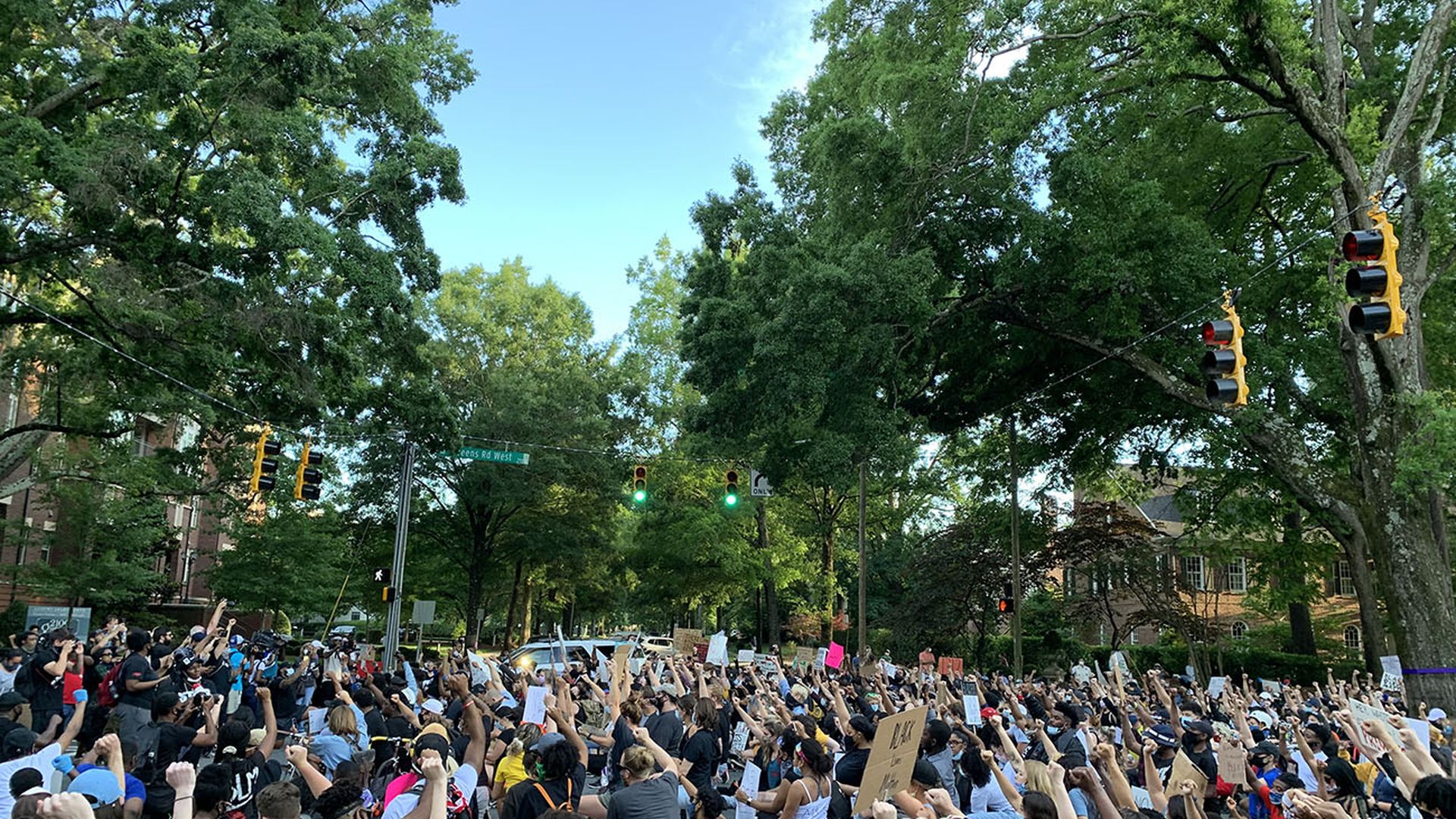
Protesters in Myers Park
The woman with the bullhorn held up a hand.
“Stop,” she said to the front-line protesters.
It was just after 8 p.m., and the last of the sun twinkled in the century-old willow oaks of Charlotte’s most prestigious neighborhood.
Hundreds of people were still filling in. Their three-mile Justice Walk was hitting its homestretch. Already they’d pressed their knees against the hard asphalt for nine minutes in honor of George Floyd, the black man in Minnesota killed last week after a police officer knelt on his neck for that long. The crowd was now more than 1,000. They’d drawn fans along the way. The people in the houses on the hills stepped outside when they heard them coming, then started waving and holding up fists, as if to say, “we’re with you.”
Kass Ottley had been protesting for three long nights — out on Beatties Ford Road in historically black west Charlotte on Friday, and in Uptown on Saturday and Sunday — and at 55 years old she says it’s starting to leave her a little sore. But she co-organized this one because she wanted to bring awareness of the injustices toward Black people to a neighborhood where most residents don’t have to worry about that.
She found that place in Myers Park, a wealthy neighborhood that was laid out as a streetcar suburb in the early 1900s, when the deeds included restrictions that said: “This lot shall be owned and occupied by people of the Caucasian race only.”
So here stood Ottley, in the median on Queens Road, a Black woman with a bullhorn, leading a march for Black lives.
“We’re taking this street,” she said into the microphone. “Both sides.”
—
/2024/01/05/1704498262324.jpg)
Since the first protest fist was raised in Charlotte on Friday evening, CMPD arrested about 70 demonstrators for offenses ranging from failure to disperse to assault of a governmental official.
Most of them came after dark. That’s when Charlotte, like many cities around the country, “turned up” each of the first three nights, with confrontations between officers and protesters escalating and resulting mostly in minor injuries and burning eyes.
Most of those arrested were from Charlotte, WFAE reported yesterday. It’s a hell of a thing, the protesters say, to have been pushed so much, to seethe so much, that you’re willing to punch holes in your own walls.
“I don’t condone and I don’t condemn,” Ottley, one of the most established protest organizers in the city, said of the broken glass. “I understand.”
One of those arrested over the weekend was Braxton Winston, a city councilman. Winston was walking in front of a line of officers on Friday when they rushed him and charged him with failure to disperse after a dispersal order was given.
Winston had a chance to ask a direct question about it Monday to the deputy chief Johnny Jennings, who’ll become the chief in a couple of weeks. In a public meeting with Jennings on Monday night, council members went around and asked him questions. Winston’s were pointed.
“What could I have done differently to have not been arrested?” Winston asked.
“You could’ve left,” Jennings snapped back.
—
In the middle of Freedom Park is a “forgiveness” bench, dedicated to Dorothy Counts-Scoggins and Woody Cooper.
In 1957, Dorothy was a 15-year-old girl who integrated Charlotte’s schools, walking through a crowd of angry white kids who spit on her and threw rocks at her on her way into Harding High. One of those kids who made faces was Woody, who contacted her later in life to apologize. Of all the kids or adults at Harding that day, Cooper remains the only one to do that.
Dorothy, or Dot as she likes to be called, formed a friendship with him, was even by his bedside the night before he died a few years ago. And now there’s a bench here, in the garden of forgiveness in this park, the entrance to which was filling up with protesters at 6 p.m. Monday.
To be clear, this walk was not about forgiveness. It was about accountability. About shouting the troubles of inequity and injustice in the tree-lined hallways of affluence, and asking those folks to join in the effort to end the other two.
“I love you! Spread the word!” one black man kept shouting to the people in the yards.
A woman with silver hair and a mask held up a small sign toward him that read, “White Silence Equals White Consent !!BLM!!”
/2024/01/05/1704498262688.jpg)
In the crowd were Shaq Thompson and Tre Boston, Carolina Panthers players, just standing against the tennis court fence like anybody else, before taking the walk with everybody else.
Before the rally I asked Ottley how her day’d been. She said she’d received more notes and messages about this one than any other.
“Worried neighbors?” I asked.
“Shook,” she said.
Earlier on Monday, SouthPark mall remained closed over rumors of protests there. Several demonstrators did show up around lunchtime, but the event was over by the early afternoon.
Attendees at Freedom Park carried signs reading “Courage Over Comfort” and “Discrimination Has No Justification.” In her opening remarks, Ottley reminded the white people there, “It’s not enough for you to come here.”
That sentiment was repeated to the demonstrators over and over: It’s easy to show up to a crowd of like-minded people; it’s harder to challenge people who disagree with you.
In the early part of their march, life seemed to go on as normal in Myers Park. A walk-up mailman made a delivery to a brick home. Bicyclists zipped by in the opposite lanes of the four-lane divided road. Several people handed out water to the protesters. Every few hundred yards, Ottley would stop the crowd, let them fill in, let them build, and then keep going.
At the intersection of Queens and Selwyn, she again took to the bullhorn, only this time she told them to take a knee.
“Do you know how hard it is to kneel for nine minutes?” someone said. The point, of course, was that the officer really had to want to kneel on Floyd that long, that it wasn’t a spur-of-the-moment killing but a cold-hearted murder fueled by hate.
Here now were hundreds of people, many of them at their first rally since this all started. The Black fists held high to say they wanted to be treated better; the white fists held high to say they wanted to be better. It was a striking moment on a striking evening and still there was walking — and work — to do.
As they went down Selwyn now, the chants grew louder and the responses grew more enthusiastic. At the seven-story Queens Oaks Condominiums, people stood on balconies and cheered them on. Turning down Wellesley Avenue as the 3.3-mile loop was nearing its end, a family had written “Black Lives Matter” written in chalk in the driveway.
By the point where Wellesley intersected with Queens again, everybody was feeling good. That’s where Kass stopped them and told them to take the street. So they did. They filled up the two lanes on either side of Queens. They’d taken it, if just for a minute, and just symbolically.
—
/2024/01/05/1704498263002.jpg)
Kass Ottley woke up Monday tired. Tired from the walking. Tired from the dying. Tired.
But she got a jolt from a phone call with Georgia Ferrell, the mother of Jonathan Ferrell, the unarmed Black man who took 10 bullets from an officer in 2013. Talking to Georgia was what Kass needed, she said.
She then talked to the two Panthers to say they wanted to participate. And she knew this audience needed to see what she wanted to show them. Especially the ones who meant well.
“Bringing it here was part of letting the people in these beautiful, million-dollar homes, who have power, privilege, and have the power to make decisions, that we are not going to be confined,” she said. “They’re not just going to be detached from what’s going on. We’re gonna bring it in your backyard. We’re gonna bring it in your front yard. We’re gonna bring it in your neighborhood. We’re gonna be heard. We’re not going to stop until only are we heard but that people start changing. You’re either going to be with us or we’re gonna run you over.”
A couple of hours later, another set of protests broke out Uptown. More tear gas and broken glass and fireworks. But not nearly as bad as the other nights. CMPD reported one arrest by midnight, with more undoubtedly to come. Maybe some midnight in the future, it’ll be a quiet hour in Uptown again, or maybe these sounds are just part of the new symphony of the Charlotte night for some time.
The Justice Walk didn’t save the world. But it was a nice evening under the oak trees.
And when the march came to the end, the demonstrators arrived back at the starting point, at Freedom Park. There at the entrance, a plaque tells the origin story of the park, and how it was created to honor veterans in 1945. The words seem appropriate for the current moment, too: “in memory of all who served so fearlessly — and so gallantly gave the laughter from their hearts — that others might play in a happy world.”
Notes: Brianna Crane and Katie Peralta contributed to this report.
Join us: This coverage is made possible and free to all (no paywall) with the help of Agenda Members. If you’d like to support more reporting like this, become an Agenda Member.
/2024/01/05/1704498263575.jpg)
/2024/01/05/1704498263910.jpg)
/2024/01/05/1704498264215.jpg)
/2024/01/05/1704498264535.jpg)
/2024/01/05/1704498264841.jpg)