Charlotte’s summer of coronavirus

Add Axios as your preferred source to
see more of our stories on Google.
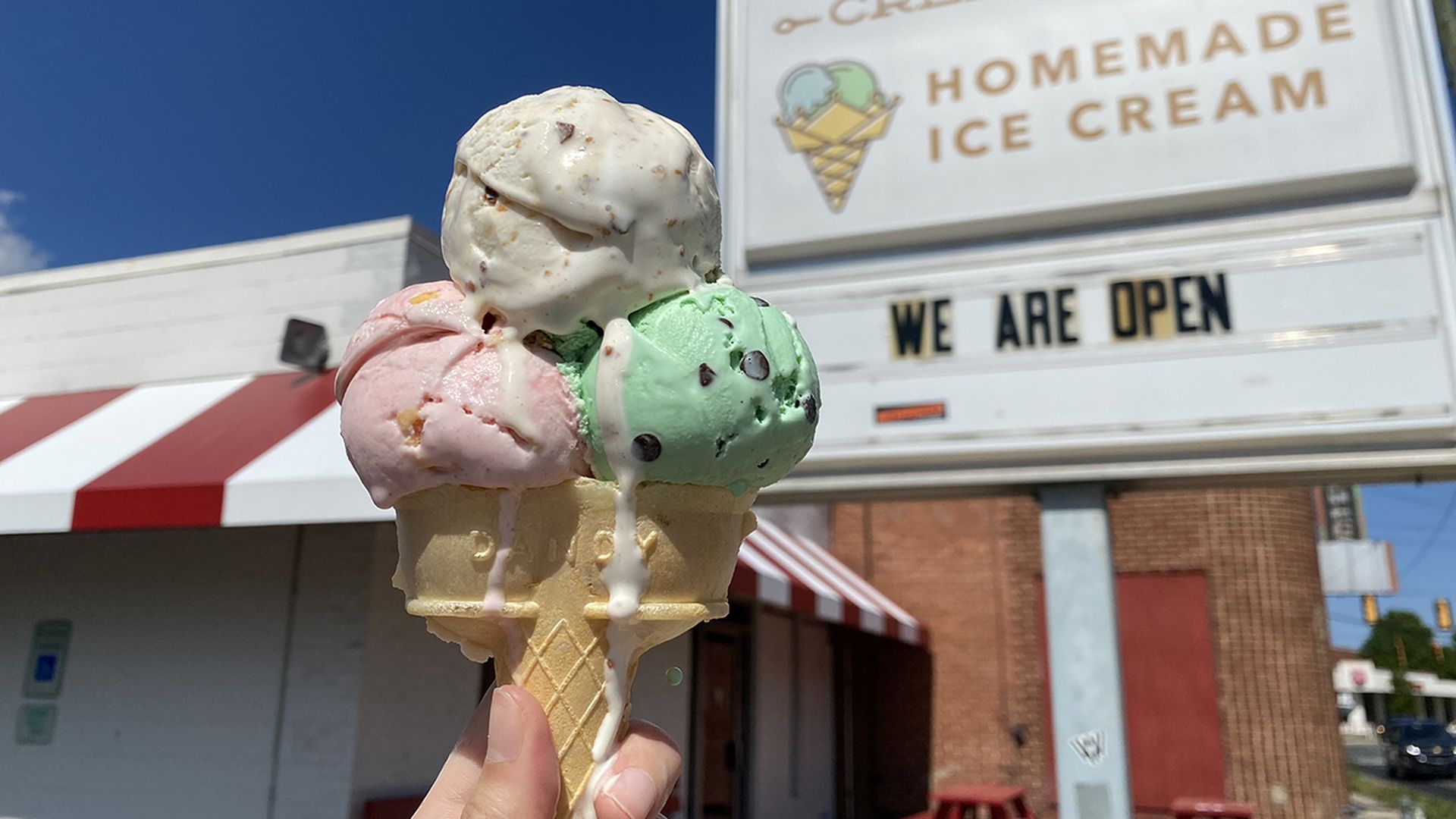
two scoops ice cream
Summer camps: Whether summer camps are on as planned is still a big question mark for parents.
When North Carolina confirmed its first case of COVID-19 in early March, it was almost inconceivable that we’d still be battling this virus through summer. Now, with Governor Roy Cooper’s phased reopening plan spanning weeks and continuing into July, coronavirus has taken a jackhammer to summer.
Outdoor concerts, crowded restaurants, vacations, neighborhood block parties — we’ll see you guys next year.
But there are still bits and pieces of summertime that can be salvaged. For one, corona can’t touch this beautiful weather.
We can still eat plenty of ice cream. We can take a boat out on Lake Norman and grab a lobster roll to-go from Hello, Sailor. Or see a double feature at Hound’s drive-in movie theatre, and walk through one of Charlotte’s nature preserves — Ribbonwalk, Reedy Creek, Evergreen.
We can also continue those ever-important, socially distant neighborhood strolls. Perhaps even more so with the new Charlotte Shared Streets initiative.
Starting May 9, three Charlotte streets will be closed to through traffic and will be open only for those walking or biking. More roads will be added soon to allow for more space for walkers beyond sidewalks.
/2024/01/05/1704498441292.jpg)
Most importantly, though, restrictions like the stay at home order and reduced capacity in restaurants can also save lives.
On Monday, Cooper announced that he wants to start the first of a three-phase reopening plan this weekend.
Phase one: On May 9, the short list of reasons we can leave home would expand to include some commercial activities like shopping. Additionally, gatherings of up to 10 people would be allowed, though face coverings and teleworking are still encouraged.
Phase one will last about two to three weeks, assuming the state continues its progress in decreasing or sustaining the number of new cases and hospitalizations, among other metrics.
Phase two: Late May is about when restaurants and bars can reopen, but brace yourself for restrictions when it comes to capacity, floor plans, and more. Public playgrounds can also reopen during phase two.
Cooper also said the ban on mass gatherings will loosen, but we still don’t know exactly what this means. Could it include backyard barbecues of up to 20 people? Or weddings of up to 100? TBD.
Phase three: Starting sometime from late June to mid July, the state will enter a third phase, in which restrictions will loosen even more. Capacity guidelines for restaurants, bars, and other businesses will ease some, but tight restrictions at congregate living facilities like nursing homes will continue.
Unlike the flu, or other viruses, we don’t know for sure how the hot and humid weather will affect COVID-19.
Studies show: Many cold- and flu-like illnesses spike during the cold and dry winter months and subside in the summer. Preliminary lab research from the Department of Homeland Security suggests this could happen with coronavirus, but even if infection rates slow, it doesn’t mean COVID will vanish.
Second spike: This also points to the possibility of a second spike of coronavirus once temperatures cool down again much like the 1918 influenza pandemic and H1N1 (swine flu) in 2009.
Preparations: Essentially, we can’t count on summer temperatures to kill (or even slow) COVID-19. In order to reopen, Dr. Mandy Cohen, Secretary of N.C. Department of Health and Human Services, says the state needs to be prepared with tests, contact tracing, and personal protective equipment (PPE). Specifically the state needs:
- The capacity to test 5,000 to 7,000 individuals in the state daily.
- To hire a total of 500 investigators to trace cases. As of April 24, the state currently had about 250.
- To secure enough PPE to last for more than 30 days. Currently the state has enough face shields, gloves, and procedure masks, but not enough N95 respirators and gowns.
Summer isn’t totally ruined, but it will be unlike any other year.
When Marques Johnson thinks about summer, he pictures spending time outside with his family, enjoying the sun and relaxing. A co-owner of Two Scoops Creamery, Johnson also imagines the prime weather for ice cream, of course.
Business: “(Summer) is huge for us,” Johnson says. Summertime business accounts for approximately 60 percent of revenue for the year across the ice cream shop’s three Charlotte-area locations.
Two Scoops is open year-round, but summer is the season that matters most.
/2024/01/05/1704498441556.jpg)
This is the case for many seasonal-dependent businesses, from creameries to travel agencies to amusement parks like Carowinds.
Economic ripples: And it’s not just about revenue for the businesses. A slow summer also means fewer people employed, pouring salt on an already wounded economy.
Johnson says he’s currently employing about 18 people. Normally, Two Scoops would be ramping up hiring, bringing on twice as many people and growing the team to about 40.
He’s optimistic the creamery will still have a strong summer, but Johnson isn’t bringing on new hires yet. He’s applied for, but hasn’t received anything from the Payroll Protection Program yet.
“If we get it, we get it. If not, we’re going to stay afloat and keep working hard,” Johnson says.
Schools closed: With in-person learning on hold for at least six months, families and students are affected in many ways. For one, a long gap in education can be detrimental to students, especially those that are already vulnerable.
/2024/01/05/1704498441864.jpg)
This stretch without schools open also means months without the childcare parents depend on. Many childcare centers have remained open for essential employees, but some have closed.
“The availability of summer camps are going to depend on meeting health guidelines that are going to be established later,” Governor Cooper said at a press conference on April 24.
Even if camps are able to go on, they will likely have to make modifications in order to practice social distancing.
Inner Peaks has canceled its June rock climbing camps, but is still planning to run camps in July and August with no more than 10 kids in each group.
Overnight camps like Cheerio Adventures are adding additional safety protocols, including daily temperature checks.
Pools: According to the CDC, COVID-19 can’t spread through pool water (or hot tubs) that has been maintained properly with chlorine and the like. This is good news, but doesn’t necessarily mean pools will open as planned this year. They’ll still have to practice social distancing measures when they do, especially in gathering areas around the actual pool.
Lakes: The two lakes closest to Charlotte, Norman and Wylie, have been largely immune to coronavirus-related restrictions so far. So long as no more than 10 people are aboard a boat, they’re still allowed on the water.
Events: One of many hard-hit industries during the coronavirus pandemic is the events industry. From concerts to weddings, events have had to be postponed or canceled for nearly two months.
Already, many summer events have been canceled, including the Charlotte Symphony’s Summer Pops series, suspended through June. Events have been postponed at the Charlotte Metro Credit Union Amphitheatre until June 24 and the Visulite Theatre until July 15.
Rich & Bennett’s St. Patrick’s Day pub crawl was pushed back from March 21 to June 27, but that could very easily be too soon for an event that draws 25,000, according to Cooper’s phased reopening plan.
This isn’t the summer we had planned.
In March, we had no idea summer would look like face coverings on 90-degree days and playground equipment blocked off from energetic kids.
Social distancing is working, and restrictions are loosening, but this “new normal” kind of summer isn’t what we’ve daydreamed about for seven weeks of quarantine.
Join us: This coverage is made possible and free to all (no paywall) with the help of Agenda Members. If you’d like to support more reporting like this, become an Agenda Member.