A few words on Junior Johnson, the ‘American hero’ who lived a quiet Charlotte life

Add Axios as your preferred source to
see more of our stories on Google.
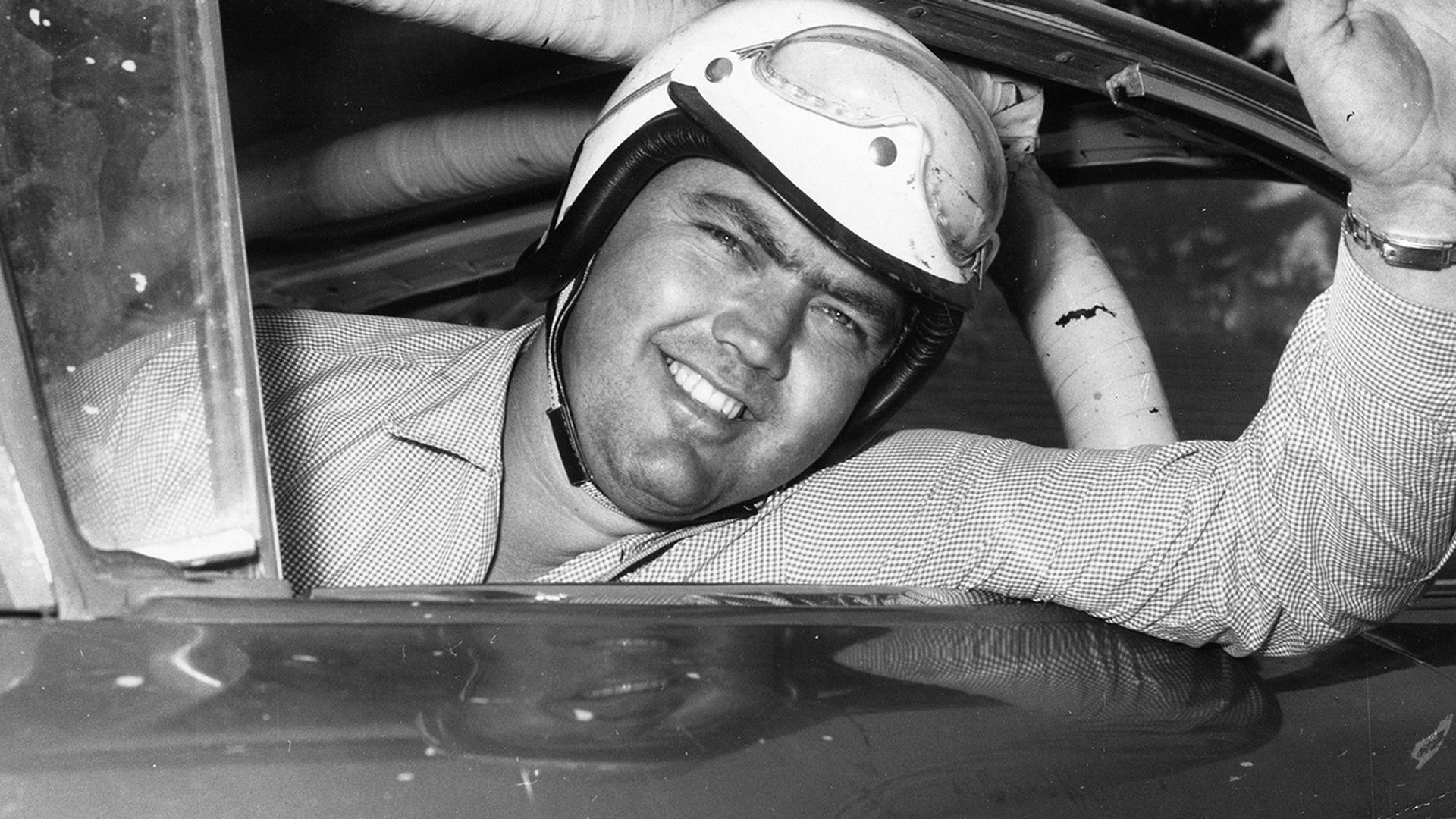
1959: Junior Johnson looks out his car window before a race. Johnson racked up 50 wins during his NASCAR Cup Series driving career, being named one of the organization’s 50 Greatest Drivers. (Photo by: RacingOne/Getty Images) *** Local Caption *** Junior Johnson
Main photo by RacingOne/Getty Images, courtesy of the NASCAR Hall of Fame
Junior Johnson died Friday afternoon in a Charlotte hospice house. If you’re not from around here, or haven’t been here a minute, or maybe aren’t of a certain age, you may not even recognize the name.
Johnson was one of the founders of NASCAR, back when the sport occupied most of Charlotte’s mind on a weekly basis. He was the “The Last American Hero” in a famous Tom Wolfe Esquire story in 1965, back when print magazines were king. And he was a driving legend who honed his skills running moonshine through the North Carolina hills, back in the years after prohibition.
He spent most of his final seven years living near Quail Hollow in south Charlotte, and he was 88 years old.
When news started to make the rounds Friday evening, my friend Tommy Tomlinson tweeted, “RIP Junior Johnson, a true American badass. Have a sip of moonshine in his honor, if you’re so inclined.”
One of the cruelties of life is that the longer we’re around, the smaller the number of living souls who remember what we did. Johnson died in a city that’s changed so much, so fast, it would hardly recognize his influence. But Tommy hit on a good point, and a good reason we should all — boomers or millennials, NASCAR fans or MLS nuts — take a quiet moment to remember Junior Johnson.
If you were so inclined, as Tommy put it, you really could’ve just gone to your ABC store Friday night, waved to the clerk, picked up a bottle of Midnight Moon or whatever other fire is on the shelves, and raised a glass to Junior. If that’s not your thing, you could’ve raised that glass at one of Charlotte’s thousand or so local breweries, or at a fancy cocktail bar, or at a high-end wine shop.
You could do that and it might never occur to you that drinking openly is a wild act.
Not too many years ago, if you’d told someone to raise a glass of moonshine in North Carolina, they’d have given you the address of their church.
The U.S. government ended prohibition in 1933, but North Carolina refused to ratify it. Two years later, the state established the ABC system and gave counties control. Many remained dry for decades; Graham County still is, technically, although it allows the sale of beer and wine in the town of Fontana Dam.
Junior and his friends were among the first to see the business opportunity in local liquor. In the 1940s, they’d fire up stills deep in the woods, jar up the moonshine, and ride like hell to move it somewhere.
Along the way they’d occasionally be spotted by the authorities who, truth be told, were more concerned about losing out on tax money than they were the effects of alcohol. But Junior and his buddies knew how to fix up a car to make it go faster than the feds’, and they almost always slipped away.
And that’s, in a rough sense, how NASCAR came about. That’s the stripped-down origin story of how it came to be that we have a building called the NASCAR Hall of Fame here in Uptown.
In fact, if you go to the Hall today, you can see a still made by Johnson. Executive director Winston Kelley asked him to produce a small model when the building opened in 2010. But Johnson went ahead and built a full-sized version, made to 1940s specifications, and brought it down from Wilkes County himself. Staff couldn’t figure out how to put it together, so Johnson showed them.
“As I watched him connect the still I realized that was equivalent to if Babe Ruth had designed, built, delivered, and installed an exhibit for Cooperstown when they opened in 1939,” Kelley said in an email.
/2024/01/05/1704489519040.jpg)
Junior Johnson was bigger than racing. He was a cultural icon, a revolutionary in a Bible Belt state, and “one of the coolest people I’ve ever met,” according to former Observer sports columnist Tom Sorensen, who’s met a lot of people.
Johnson made North Carolina mainstream thanks to the 1965 Esquire piece. After that, he became the subject of a Hollywood movie. And later a character in a song called “Cadillac Ranch,” written by Bruce Springsteen, the rockstar from, of all places, New Jersey.
Back in May 2009, Springsteen stopped in Greensboro, not far from where Johnson grew up. Every show on that tour, Springsteen closed the main set with the anthem “Born to Run.” But that night in that coliseum, he rolled from “Born to Run” right into the first notes of “Cadillac Ranch.”
The place flipped out. And when he got to the line, “Junior Johnson runnin’ through the woods of Carolina,” he didn’t so much sing it as shout it.
For someone like Springsteen, a northerner who just turned 70, Junior Johnson was what he knew of North Carolina. Johnson was a representation of a place that was, to people from more sophisticated lands, all taillights and dust.
Of course, the city where Johnson spent his final years is now one of those “sophisticated” places. The folks who speed around taxes in Charlotte today are developers and big businesses. A lot’s been said of the $110 million in taxpayer money offered to David Tepper to help bring a soccer team here. It would’ve been fun if we could’ve made him earn it by putting him in a car and telling him to outrun the mayor and 11 council members.
Meanwhile, maybe our biggest controversy surrounding alcohol in Charlotte this year involved a Sycamore beer can design that showed reindeer in sexual positions. The revenuers ruined all that fun, too. ABC forced Sycamore to cover up the reindeer and issued a fine.
Pretty tame stuff, by comparison.
/2024/01/05/1704489519325.jpg)
/2024/01/05/1704489519658.jpg)
When I moved to North Carolina in the fall of 1997 to attend college, the first boss I had at a real newspaper was an old man named Benny Phillips, the sports editor of the High Point Enterprise.
Benny, who’s since died and been honored by the NASCAR Hall of Fame, was one of the first writers to cover racing seriously. He had polio as a kid and used metal crutches to walk, and when he showed up to drivers’ shops, they’d talk with him for hours.
I’d sit by Benny’s desk and listen to him tell stories of flying to the islands with Dale Earnhardt to work on his biography, or of the Pettys or Labontes. And of course, of Junior Johnson, the “mountain man from Wilkes County,” as Benny called him.
Last year I sat down with Richard Petty and listened to stories of how Benny and the other writers of his day would just hang around the shop. Now, Petty says, reporters and TV crews already have the stories in mind when they show up.
“We’d do an interview but we’d talk personal stuff, too,” Petty said. “Now, you’ve got so many reporters going, it’s hard. The personalities are so much different now. They didn’t try to push anything then. They didn’t think they were somebody. We’ve got a different society now.”
Several years ago, when Charlotte writer Ryan McGee was working on a story about NASCAR’s beginnings for ESPN, Johnson invited him to a Moonshiners and Revenuers reunion in Wilkes County.
When Ryan turned off the paved road at the location Johnson gave him, two guards in overalls asked him for the secret phrase.
“I see the moon, the moon sees me,” Ryan said, and the guards let him drive on into the North Carolina woods.
In these overanalyzed and data-driven days, it’s a good time to pause and remember characters like Junior Johnson. People who’ll invite us into the passenger’s seat for a good conversation. Citizens who’ll run circles around a meddlesome government. Reckless heroes and storytellers who fought for something and won, won so handily that the thing they drove all those miles for became ordinary, so ordinary they had to make up secret phrases to keep it interesting.
/2024/01/05/1704489520024.jpg)