Drivers in Charlotte run red lights with reckless abandon. What’s being done to address the problem?

Add Axios as your preferred source to
see more of our stories on Google.
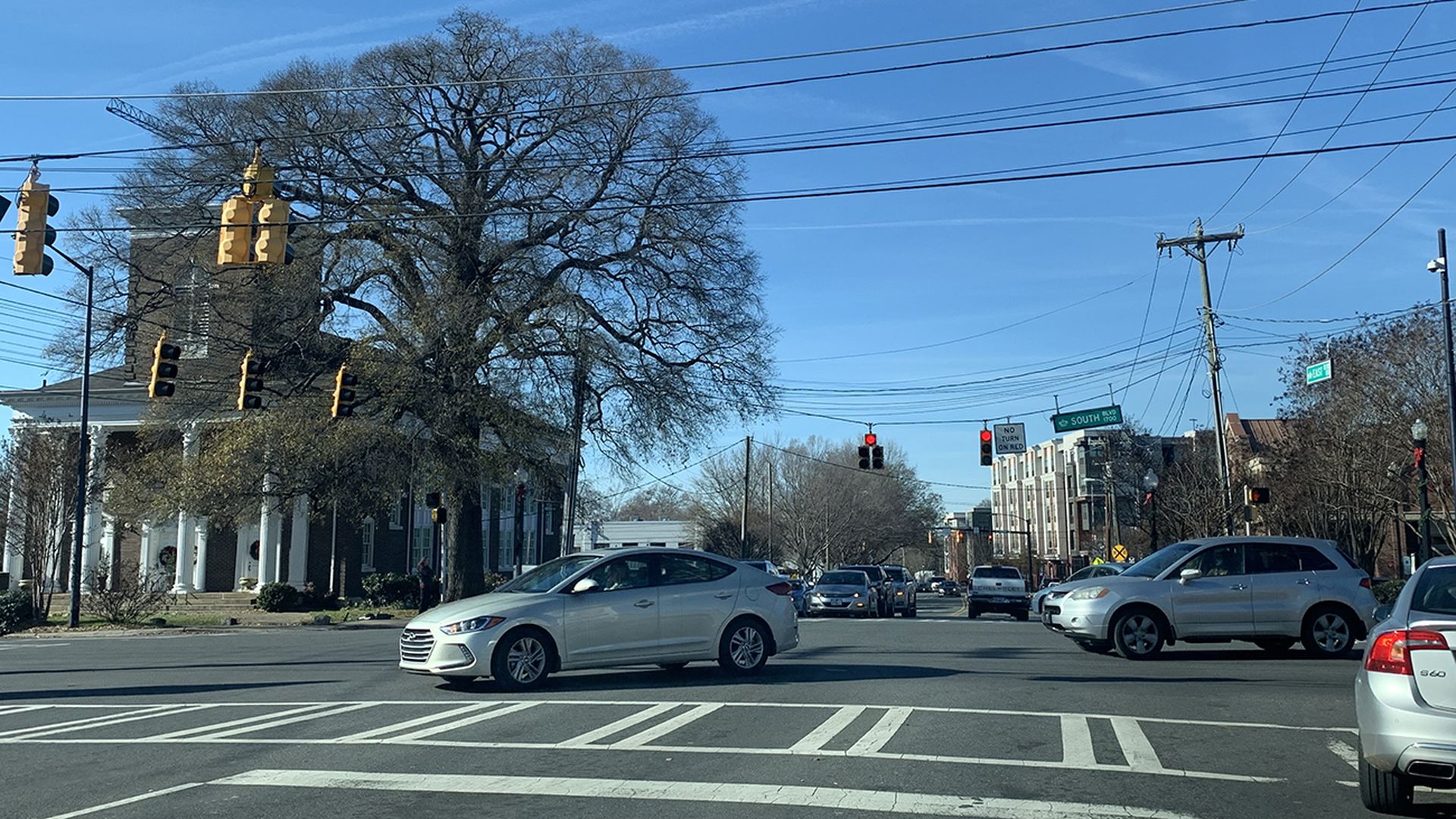
If you drive a car in Charlotte — really, even if you ride in one regularly — you know that people run red lights. A lot.
We’ve probably all done it. You’re running late and don’t want to get stuck. You’re driving too fast to safely stop in time. You aren’t paying attention and breeze through a solid red.
City leaders hear complaints on a regular basis.
Last week, one person sent an email to all city council members with a screaming subject line, in all caps: PLEASE ADDRESS RED LIGHT RUNNERS. The sender implored council to do something about the problem. “People are getting killed,” the sender wrote.
Mayor pro tem Julie Eiselt says the issue is on councilors’ minds. There just isn’t an easy solution for dealing with it.
“There are going to be tradeoffs and choices that we have to make if we really want to get to a place where we are a more walkable city,” Eiselt says.
The city continues to expand, putting more cars on the road, so there very well might be more red-light runners these days. Aside from citation data, there isn’t a clear-cut way to find out exactly how often it happens if offenders aren’t being stopped. These days, Charlotte’s police force is stretched thin, making enforcement difficult.
City leaders grapple with how to improve road safety and are conflicted on what should be done.
One way the city has tried to curb the problem in the past was through red-light cameras, which are connected to traffic signals and automatically take a picture of cars that run red lights.
Charlotte had them in place from 1998 through 2006. You’d get fined $50 for each violation. A study of the program showed that red-light cameras reduced certain types of crashes by almost 50 percent at four intersections, the Charlotte Observer reported.
The city stopped using them after an appeals court ruled that cities must allocate 90 percent of the revenue from the program to the local board of education, the Observer wrote. Charlotte officials said the city couldn’t afford to pay the Florida contractor that manages the program if most of the money — an estimated $4.6 million — went to the school system.
A couple of years ago, some city officials proposed bringing them back as a way to address road safety.
Ultimately, city manager Marcus Jones quashed the suggestion, although the issue still comes up periodically.
Eiselt would like the city to at least study the traffic camera program as a possibility.
“I’m not saying it’s the right answer, but why not look at it?” Eiselt says.
“Why not look into whether or not it’s feasible and would that free up CMPD’s time and address an issue that people have been complaining about and asking about?”
Some opponents of red-light cameras point to the cost it takes to operate them.
Others, such as councilman Braxton Winston, say they see them as an equity issue. Red-light camera fees are a burden for low-income residents, he has said.
Research shows that red light cameras effectively cut down on bad accidents. They act as a deterrent because law enforcement can’t address every violation.
In a 2017 study, the Insurance Institute for Highway Safety looked at cities with 200,000 residents or more. In those with cameras installed at traffic lights, the rate of fatal car crashes was 21 percent lower than before the cameras were turned on.
Researchers say the study was the first to demonstrate that ending camera programs increases fatal crashes.
It is unclear if that’s the case in Charlotte since the camera program ended 13 years ago. North Carolina’s Department of Transportation doesn’t break down its fatal collision data by contributing factors of the accident (for example, running red lights).
When CMPD analysts looked at collision data where disregarding traffic signal was a contributing factor, they found that the numbers have been relatively steady from 2015 through November of this year.
/2024/01/05/1704489599027.jpg)
In Charlotte, the numbers point to a trend that on the surface doesn’t make a lot of sense: Even though there are more cars on the road, police are issuing fewer citations for drivers who run red lights.
According to data from the Charlotte Mecklenburg Police Department, citations for running red lights surged almost 200 percent from 2009-2013. But from 2013 through 2018, such citations plummeted 45 percent.
/2024/01/05/1704489599292.png)
That’s despite the fact that over that period, the city’s population swelled by 10 percent — or almost 80,000 new residents, census data shows. The city continues to grow: Officials say there are 60 people moving here every day.
The data suggest that drivers are better at obeying traffic laws more these days. In reality, police actively aren’t issuing as many tickets as they did in the past.
There are a few reasons for that, says CMPD deputy chief Jeff Estes. There wasn’t one specific thing that changed in 2013 that prompted some kind of change.
For one, CMPD is short about 180 officers, the department says. It’s not an effective use of CMPD’s resources to post officers at an intersection and watch for people to run red lights, Estes says.
On top of that, Charlotte is about to wrap up its deadliest year for homicides since 1993.
“If there is a violent crime increase, then those crimes of course take priority, and those take longer to investigate,” Estes says.
Officers these days also may be issuing more written and verbal warnings instead of issuing citations. Many times, those can have the desired effect of changing drivers’ behavior, without having to put people through the criminal justice system, he adds.
Another reason for the citation drop is the fact that officers are taking on more responsibilities within the community now. Today they’re in the prevention and intervention and social work realm. They have to be prepared to respond to people in crisis, Estes says.
“Philosophically, police departments, including CMPD, are being asked to do much more than just enforcing criminal law.”
One night last month, I was driving home from dinner, heading toward Uptown on Kenilworth. The light in front of me on Morehead turned green. But right when I should have been making my way through the intersection, another car sped through in front of me, zooming through the red light. After I later tweeted about the prevalence of red-light running, other frustrated drivers chimed in.
It seems like nothing is being done to stop the problem, one guy said. I almost get hit on a regular basis, a woman added. Someone else said it’s “anarchy out there.”
A discussion thread on Nextdoor last week began like this: “Explain to me like I’m 5: what’s up with all the red light running?” The problem seems like it’s getting worse, one neighbor wrote. Bring back the red-light cameras, others said.
Sustain Charlotte has asked the city to address red light violations for years. Shannon Binns, the group’s executive director, says the issue should be discussed in the city’s Vision Zero plan, which is aimed at eliminating traffic injuries and fatalities.
“As somebody who bikes around, I still see a lot of red lights being run,” Binns said.
Eiselt, the mayor pro tem, says red-light violations don’t seem to be a priority for city council at the moment. But they should be — especially if Charlotte is serious about reducing its pedestrian deaths and becoming a more walkable city, she says.
“Is it fair to let people run red lights and get to a point where you pretty much know nobody is going to stop you?”