Does Charlotte need its own version of Pike Place Market?

Add Axios as your preferred source to
see more of our stories on Google.
While grocery chains like Harris Teeter and Publix battle for Charlotte’s affluent neighborhoods, the city’s farmers markets have struggled to break through.
You rarely just happen past a farmers market in Charlotte.
While nearly two dozen of them are scattered across Mecklenburg County, most are seasonal, suburban and tucked into parking lots. Others have odd hours, or are only open two days per week.
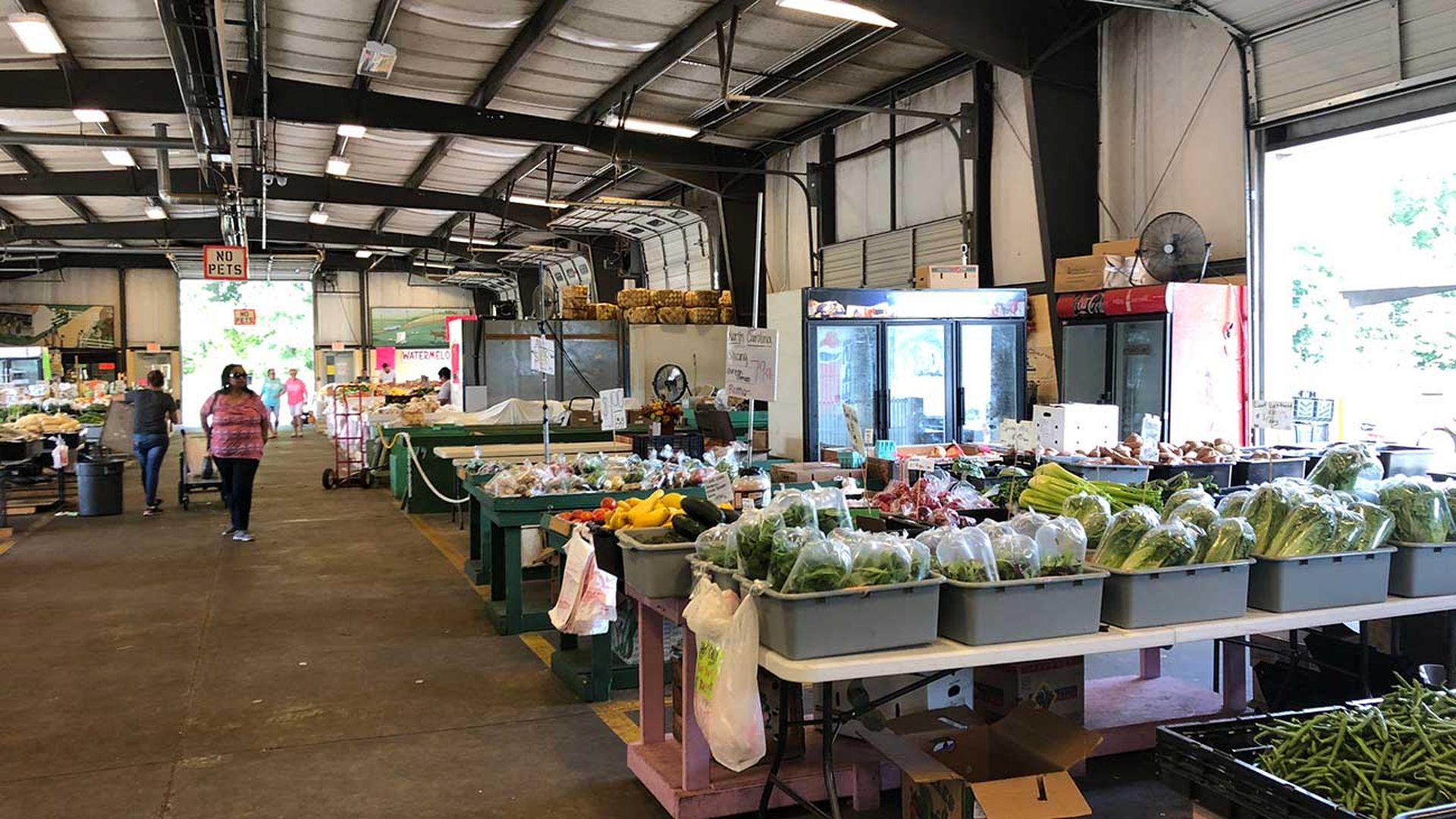
The city’s state-run regional farmers market is open year-round, but isn’t really convenient to anybody and often lacks locally grown produce. The Matthews Farmers Market is excellent, but not quite centrally located.
/2024/01/05/1704482581995.jpg)
Is this why Charlotte lags far behind peer cities in farmers market patronage?
/2024/01/05/1704482582613.jpg)
A report prepared for the City Council this summer by consultant Karen Karp & Partners shows that farmers market sales in Charlotte are only a fraction of you’ll find in cities like Austin, Minneapolis, New Orleans and Milwaukee.
The consultants see some easy fixes: better branding, easier ways to pay, more standard hours. But they also recommend that Charlotte take some bigger steps.
Charlotte could one day consider permanent farmers markets in places like Camp North End and Eastland Mall. Or, perhaps, a new signature location like downtown Seattle’s Pike Place Market.
/2024/01/05/1704482583203.jpg)
/2024/01/05/1704482583802.jpg)
Thus launches a chicken or egg question: What needs to come first — the big central farmers market, or the demand for their produce?
Charlotte has been thinking about farmers markets for more than a decade.
The city of Charlotte has been considering an Uptown farmers market since at least 2004. Four years later, Center City Partners opened the 7th Street Public Market, which has periodically been home to vendors offering fresh produce.
The report from consultant Karen Karp & Partners is a more recent effort at finding out how the city can support expanding access to fresh produce and farmers markets in general.
/2024/01/05/1704482584345.jpg)
It starts with fact-finding. The report tallied up 23 total farmers markets across the county.
But quickly, the news gets grimmer.
That large dot is the Charlotte Regional Farmers Market, one of four large state-run markets across North Carolina. Last year, it counted only 500,000 visitors, compared with 3.5 million in Raleigh and 1.2 million in Asheville.
/2024/01/05/1704482584869.jpg)
The location could be one reason why. You have to know exactly where it is, and you sure aren’t walking there.
/2024/01/05/1704482585233.jpg)
The consultants also reported that current farmers markets are not in the areas of greatest need, where people are underserved by traditional grocers.
What’s on the table?
The first step is the easiest. The consultants are recommending that Charlotte create a “Charlotte Farmers’ Market Association” to coordinate between markets across the county and better market themselves.
This organization would streamline farmers’ applications, create best practices, expand programs for low-income customers and coordinate getting unsold food to organizations that can put it to good use.
After that, things get hard.
The report calls for numerous improvements to the Charlotte Regional Farmers Market, but these would have to come from the state level. The state has not appeared to be willing to devote more resources to Charlotte.
And then there’s the prospect of building new, larger farmers markets.
Consultants call on the city to help identify areas that will generate high traffic while attracting both customers in greatest need for fresh food and affluent big spenders.
/2024/01/05/1704482585883.jpg)
They cite the $30 million Grand Rapids Downtown Market, which opened in 2013, and the $10.5 million Milwaukee Public Market (2005) as good examples to emulate.
The 7th Street Public Market would seem to be a natural place for this, though the market has moved away from produce in recent years. It’s also not the most convenient for regular shopping trips.
The consultants cited Camp North End and Eastland Mall as potential sites, and they do seem feasible. The city owns the Eastland Mall site and has struggled with what to do with it. Camp North End has abundant land and buildings, and wants to be a part of civic life.
Beyond that, expect more expansion of the Rosa Parks Farmers Market in west Charlotte. To the south, the Cotswold Farmers Market seems like a natural fit for expansion.
Look for more discussion of these plans in 2019.