Inside plans for Tompkins Hall, a transformative project that’s about to put Optimist Park on the map

Add Axios as your preferred source to
see more of our stories on Google.
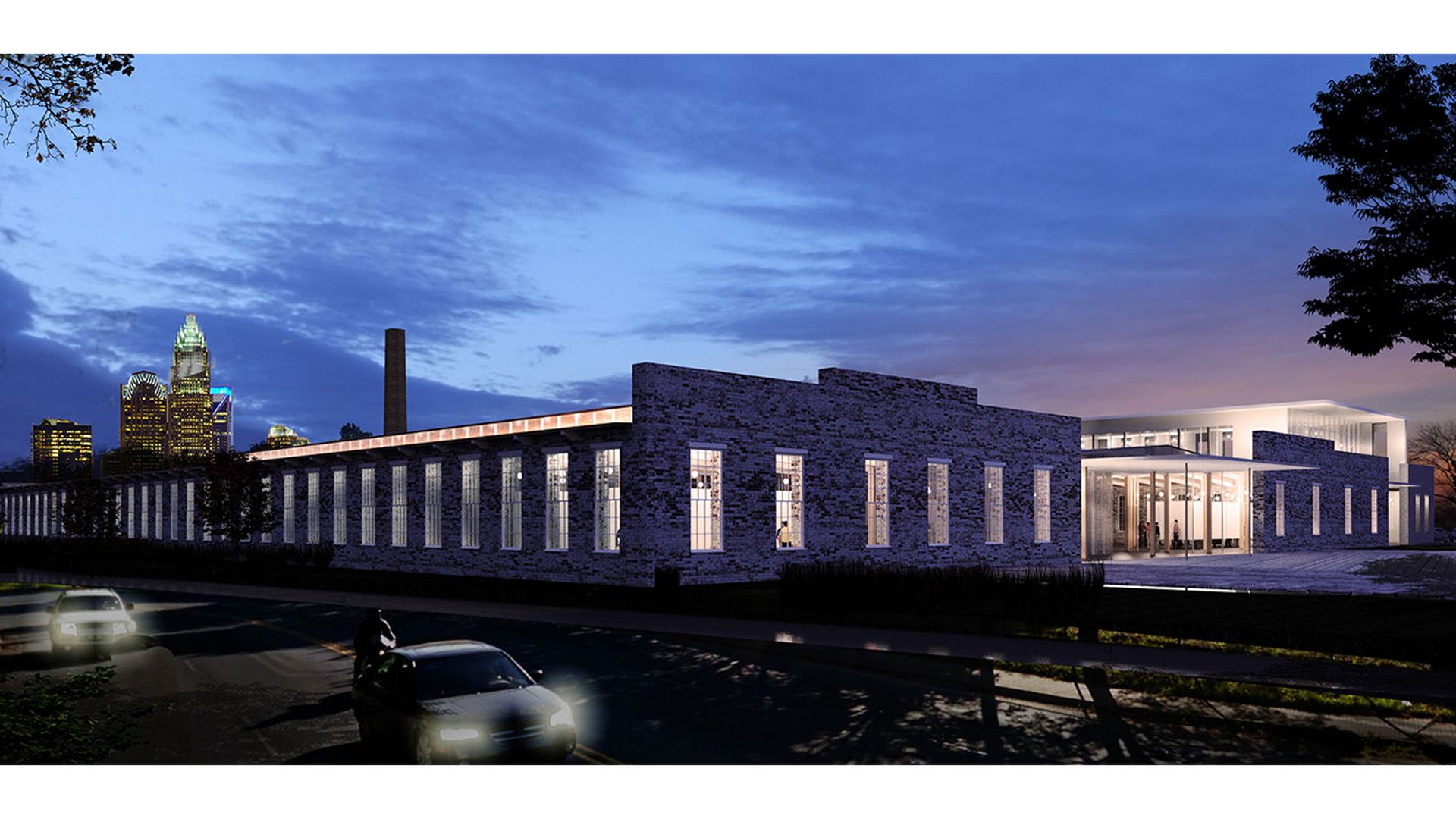
tompkins-mill cover via Paces Properties and White Point Partners
In years past, Optimist Park always felt like the neighborhood I drove through to get to NoDa.
It was always just there, a mostly residential place where people lived, and did little else but carry on their daily lives. With projects like Tompkins Hall under development now, its clear there’s no turning back — Optimist Park is poised to be one of the next big neighborhoods.
Optimist Park is the skinny neighborhood between Uptown and Noda, Villa Heights and Belmont, made up of properties that once had homes built to house workers at Highland Mill (on 16th and N. Brevard). Not a ton of those houses still exist, with many of the original homes being demolished in the Carter Presidency to be one of the banner Habitat for Humanity communities of the 1980s.
The tradition of being a sleepy, unnoticed inner-city neighborhood has started to fade away, investors have started moving in, people are building and a shiny new Blue Line stop is officially open on Parkwood and N. Brevard. In short, the times are changing.
The project at the heart of this transformation is Tompkins Hall, a large-scale adaptive reuse project containing 83,000 square feet of office space, and around 55,000 square feet of retail space, including a 22,000-square-foot food hall.
All of this is housed in what was once Highland Mill, a former gingham factory, built in 1890.
/2024/01/05/1704483933162.jpg)
The project is being developed in partnership between Charlotte’s White Point Partners and Atlanta’s Paces Properties.
“We partnered, in late 2015, with White Point Partners to purchase the textile mill property – with a vision to create an incredibly different gathering space for the city. Tompkins Hall will be uniquely Charlotte while contributing to the area’s vibrancy and accessibility,” added David Cochran, President and CEO of Paces Properties. “It’s all about moving the city’s food, industry and culture forward.”
/2024/01/05/1704483933553.png)
Featured office and retail tenants
Duke Energy
Tompkins Hall’s office tenant is one of the most important feathers in its cap. Five years ago you would have never guessed that Optimist Park could steal a little thunder from Uptown, yet it did.
Duke Energy signed last year to anchor all 83,000 square feet of Tompkins’ commercial space, creating a Center for Innovation that’ll bring 500 office jobs to the neighborhood.
/2024/01/05/1704483934102.jpg)
“Duke Energy’s forward-thinking vision matched our intent to create a center of collaboration and innovation at Tompkins Hall,” said Jay Levell of co-developer White Point Partners. “To have the largest energy company in the U.S., with deep roots in Charlotte, anchor the project means that 125 years after helping launch Charlotte’s textile boom, Duke will continue the tradition of innovation at Tompkins Hall. We are excited to have them as future office tenants.”
[Related: Tompkins Hall lands its first major tenant – Duke Energy]
Optimist Park’s employee base has been mostly blue collar for more than a century, it will be interesting to see how the neighborhood changes with an influx of white-collar workers.
Fonta Flora Brewery
Fonta Flora Brewery, a nationally recognized Morganton, N.C. staple famous for using locally sourced ingredients and making complex and delicious beers, has decided to open a satellite tap room at Tompkins Hall. Their beers have an inherent sophistication and attention to detail that’ll undoubtedly stimulate the palates of Charlotte’s swiftly growing beer culture.
Fonta Flora is hoping that its ample outdoor space and unique beer offerings will inspire people to visit and keep coming back.
/2024/01/05/1704483934467.jpg)
Co-owner Michael Kren put it best: “Charlotte LOVES an outdoor craft beer scene, yet to date, most of these popular venues have been asphalt, gravel, and concrete. Drinking world class beer on a picnic blanket, spread over some nice green grass is where it’s at! Add some live music, and there is no better venue in the city.”
Food hall tenants
While office space takes up the majority of this project, a large portion is dedicated to the food hall that will call Tompkins Hall home. Food halls are a growing trend nationwide – Krog Street Market in Atlanta, also by Paces, Reading Terminal in Philadelphia, and Workshop in Charleston are all great examples.
Featuring 22,000 square feet of space, this food hall will provide up to 19 stalls where both local and regional up-and-coming restaurants can set up shop and potentially thrive. Concepts like this give all types of people a foot in the door, whether it be a seasoned restaurant group, or a local entrepreneur looking for a piece of the action.
/2024/01/05/1704483934874.jpg)
Currently signed tenants include a French rotisserie from the team who brought us Aix En Provence in Eastover and Undercurrent Coffee, a full-service coffee bar with handcrafted espresso beverages, pour over drip coffees and numerous specialty offerings.
On Friday, Moffett Restaurant Group (the guys behind Good Food, Stagioni and Barrington’s) announced plans to open Bao + Broth, an Asian-inspired eatery that’ll focus on traditional bao (steamed buns), ramen and other Asian staples.
I spoke to Tara Murphy of 360 Media in Atlanta, and she expects more names to be announced in the coming weeks.
It’s not just the food hall we will be following closely – Tompkins will offer an additional 33,000 square feet of retail that’ll be filled with a range of tenants.
I’d expect a couple of full-service restaurants to be announced very soon, possibly up to 6 total, depending on how the spaces develop.
Looking through renderings and floorplans I can’t help but notice all of the opportunities for enjoying nature, whether for outdoor dining, hanging out or taking a stroll. Outdoor spaces are well programmed and integrated into the project, and there is tons of square footage of patios.
/2024/01/05/1704483935276.jpg)
/2024/01/05/1704483935726.png)
What this project means for the neighborhood
Most importantly, Highland Mill, one of Charlotte’s few remaining Historic structures, gets a chance at a new life as Tompkins Hall. Highland was built at a time when the industrial sector was the backbone of this country. Industrial buildings were made to stand for centuries, clad with intricate brickwork, and featured huge windows that allowed in tons of natural light.
Standing in the finished building, it’ll exude historical charm. From its original hardwood floors to its soaring 14-foot ceilings, it will feel like a step back in time. Its name pays homage to D.A. Tompkins, who designed and built the mill, along with hundreds of others around the Country. Historical structures like this one contribute so much to the urban fabric of a city, keeping buildings like this are of the utmost importance.
When complete, Tompkins Hall will give the entire area around it a center of gravity that it hasn’t had before. Thanks to Tompkins, Optimist Park will no longer be somewhere you pass through to get to NoDa, it’ll draw people from all over. The developers see this as a destination that will serve all of Charlotte, and everything points to their hopes coming to fruition. The site sits only three blocks from 277, two blocks from the Parkwood Station stop on the Blue Line Extension and only one mile from Trade & Tryon.
The best is yet to come.
In a few years, Tompkins will anchor a completely transformed Optimist Park. Within two blocks there are nearly 1,000 apartments and 50 townhouses under construction. With this growth, along with the new light rail stop, Optimist Park is trending up quickly. I just hope the neighborhood has good leadership in place to help manage the potential hardship that goes with being an “it” neighborhood.