At stake in school boundary decisions: Hundreds of thousands of dollars for homeowners

Add Axios as your preferred source to
see more of our stories on Google.
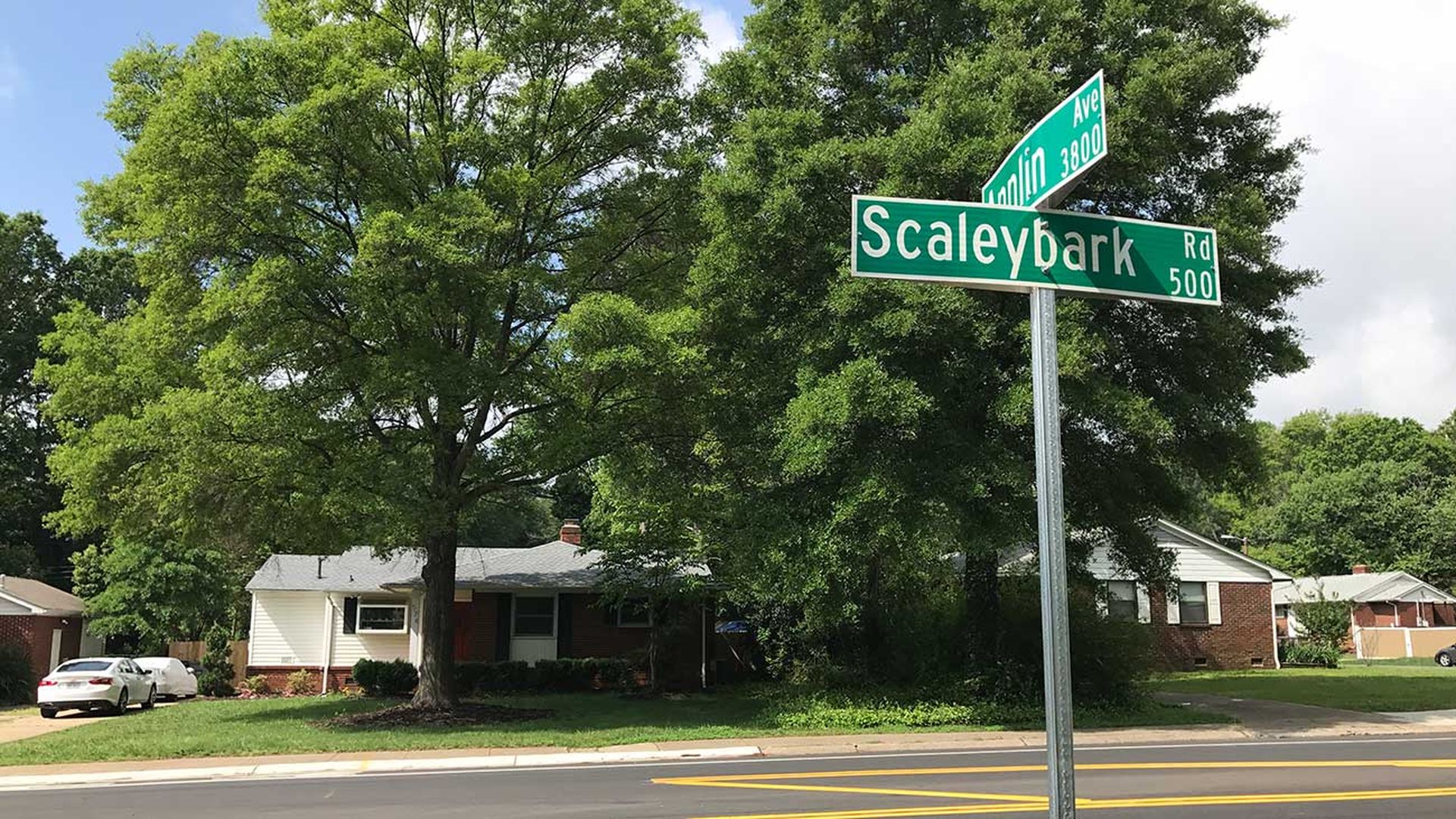
Scaleybark Road is more than just a peaceful tree-lined street running through south Charlotte neighborhoods.
In the real estate and education worlds, it’s a boundary line of significant consequence.
For little obvious reason, the dividing line separating the zones for Myers Park High and Harding University High traces Scaleybark Road.
Homes on one side of the street send their children to Myers Park, a school with a desirable reputation and a “B” letter grade from the state. The other side sends their children to Harding, a school with a “D” grade and a higher concentration of low-income students.
The style and size of the homes aren’t much different. The perception and the demand is. And thus are the home prices.
The Agenda analyzed home sales in the past 12 months in areas along boundary lines between schools that are — rightly or wrongly — perceived to be of different quality.
The results are often dramatic: as much as a hundred thousand dollars difference in sales price, or more.
/2024/01/05/1704478157244.jpg)
/2024/01/05/1704478157728.jpg)
Around Scaleybark Road, the Agenda found that a home sold last summer on Castlewood Road for $440,000, or $271 per square foot. A few months later, a similar home on the other side of the dividing line sold for $299,000 — just $158 per square foot.
The same patterns hold true around other school boundaries — like between Providence and Butler high schools and Myers Park and East Mecklenburg High.
To be sure, there are other factors at play in what prices homes sell for, including when it goes on the market and how much it’s been renovated. There’s also sometimes little discernable difference in the quality of the two schools, only in the socioeconomics of the population. But there is a clear differentiation based on long-established school boundaries.
“It makes quite a bit of difference,” said Charlotte realtor Chad Floyd. He said that at the $350,000-or-so price point, there could be as much of a 30 percent price difference based solely on school assignment.
Realtors are legally prohibited from recommending schools to families looking to buy homes. But oftentimes homebuyers will request to look at homes in a particular school district, and realtors are able to comply with that.
/2024/01/05/1704478158176.jpg)
But Floyd shared a market report for 4-5 bedroom, 2-4 bath homes between 2,500 and 3,000 square feet that had sales close in the last six months.
In the “desirable” school district, the average sales price was $622,173, with homes selling in 52 days. In bordering “non-desirable” school district, the homes went for $292,023, with an average of 62 days on the market.
The dynamic isn’t a new one. A study of Charlotte home prices in the late 1990s by Ivy League professors found a significant impact based on school assignment. Similar homes were priced 12 percent higher on average if they were inside a “desirable” school boundary rather than just on the other side.
But it’s only becoming more entrenched as Charlotte continues its rapid development. Realtors have set up scores of web pages advertising homes districted to schools like Ardrey Kell High and Providence High.
Builders, too, are choosing these areas for $1 million-plus homes (18 are on the market right now in just those two school zones). People of moderate incomes are all but locked out.
/2024/01/05/1704478158635.jpg)
Matthews is a prime example.
/2024/01/05/1704478159043.jpg)
One of the starkest examples of this divide is in the southeastern part of Mecklenburg County, where Matthews bleeds into the unincorporated part of the county.
Providence High, a school with an “A+” grade from the state, shares a ragged border with Butler High, which has a “B” grade from the state. But the difference in home prices is much more dramatic than the letter grade would indicate.
/2024/01/05/1704478159554.jpg)
Weddington Road provides a clear demarcation. On the eastern side of the street, kids go to Butler High. There, homes of more than 3,000 square feet go for around $300,000. On the western side, students got to Providence High. That same $300,000 gets you around 2,000 square feet.
The same dynamic is at play on Providence Road south of Fairview Road, where Myers Park High shares a border with East Mecklenburg High (which has the same “B” grade as Myers Park).
Homes of around 2,000 square feet regularly go for $50,000 to $100,000 more on the Myers Park side of the line.
It’s important to note that this dollars-and-cents argument is sometimes used to paper over less publicly acceptable concerns about race. Some affluent white families in Charlotte are simply uncomfortable sending their children to schools that have high concentrations of poor and minority students — whether because of perceptions of educational quality or safety. Instead, they’ll opt out of CMS and send their kids to private or charter schools. It’s an ugly truth that’s rarely talked about in plain terms. It’s easier to talk about losing property value.
But these financial motivations remain a powerful driver in their own right and influence parents no matter their leaning on social justice.
Understanding these market forces is key to understanding public policy being handed down. It’s one of the primary reasons why the student assignment plan unveiled last Tuesday did not go very far in breaking up concentrations of poverty. It moved few students from affluent south Charlotte high schools to lower-income schools.
These home price dynamics are also the reason why people without kids — or with kids long since aged out of public schools — are so emotionally invested in the current debate on how to change how CMS sends children to school.