The Agenda guide to every race in the 2016 election

Add Axios as your preferred source to
see more of our stories on Google.
vote-here
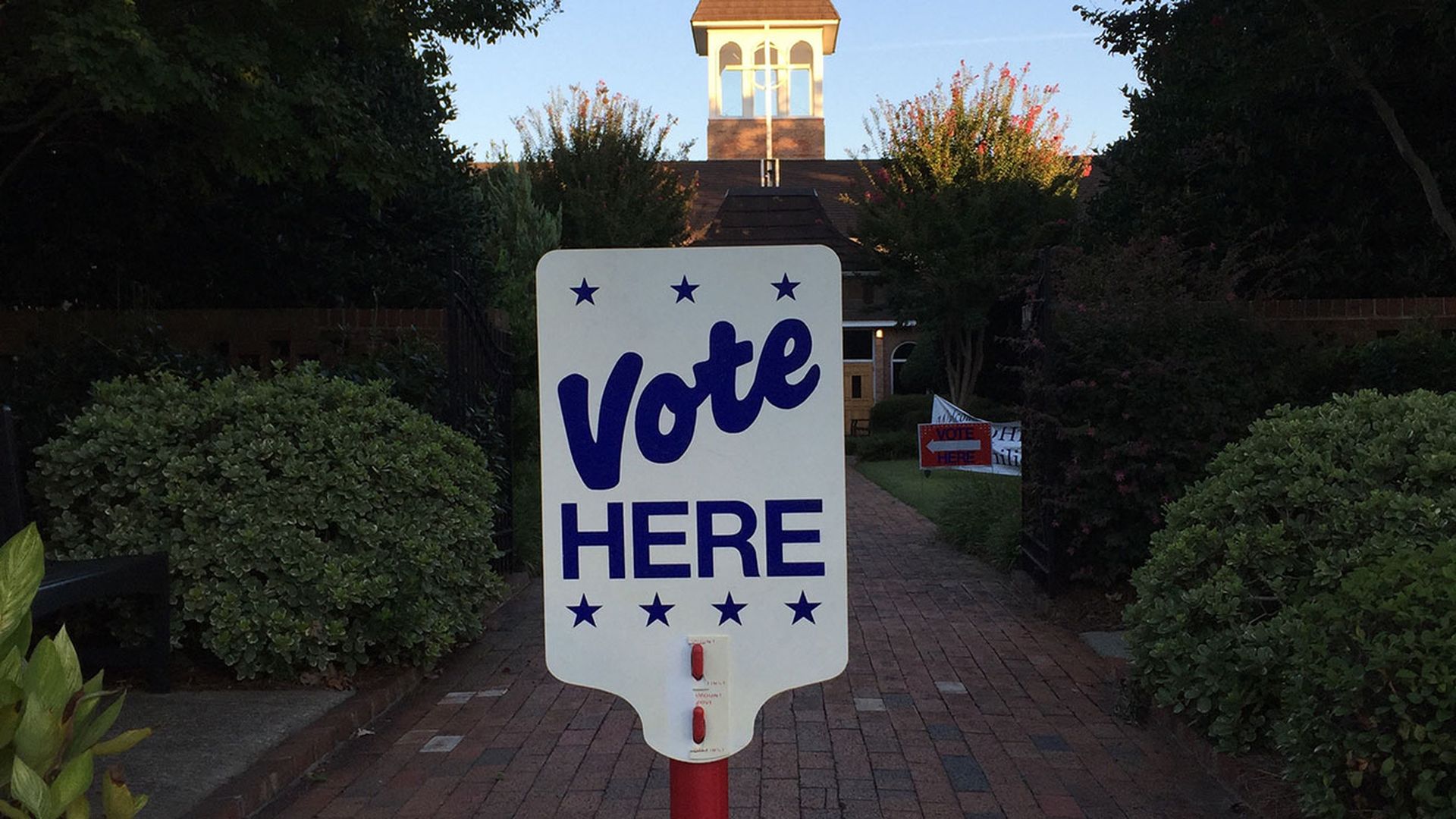
When you go to vote, you’re going to be looking at a ballot that’s six pages long. By the time you get to the end of it, you’ll be far beyond names that you recognize.
That’s where we come in. We’ve pored over every office in this year’s election, and have tried to break it down for you.
The point here is not to tell you who to vote for. The point is to help you make the best decision based on your political beliefs.
We’ll take these in the order they’ll appear on your ballot.
President
I’m not going to get into much detail on Hillary Clinton and Donald Trump. You know who they are, you’ve probably seen the debates.
If you’re considering voting for a third-party candidate, here’s the scoop: Only one of them will be on your ballot. That’s Libertarian candidate Gary Johnson. Sorry, no Jill Stein.
U.S. Senate
This race pits two-term Sen. Richard Burr, a Republican, against Democrat Deborah Ross.
The case for Burr: Stability. Fun fact — the 60-year-old Burr is the only U.S. senator from North Carolina to get re-elected since Jesse Helms stepped down in 2002. Burr’s seat had been a revolving door since the 1970s, with Terry Sanford, Lauch Faircloth and John Edwards all losing re-election campaigns or retiring after a single term. Helms’s former seat has been highly contested too, with Elizabeth Dole and Kay Hagan losing after one term before Thom Tillis won the job in 2014 (jury’s still out on him).
Burr has become a leader among Senate Republicans and is the chairman of the Senate Select Committee on Intelligence. He’s in the middle of the Republican pack ideologically, according to GovTrack.
The case for Ross: The Raleigh attorney had a long career in the state House and has major liberal cred from being the head of the North Carolina ACLU. She’s campaigned on issues like raising the minimum wage and ensuring equal pay for men and women. Ross is also benefiting from Burr’s close association with Donald Trump.
U.S. House of Representatives
You’ll be voting in one of two races, depending on what part of the Mecklenburg County you’re in. Neither one of them will be competitive due to the demographics of the district. There’s a whole backstory here on these new districts, created because the court system said North Carolina’s previous congressional districts were illegal.
Here are the new ones.
/2024/01/06/1704557727050.jpg)
District 12
Rep. Alma Adams (D) vs. Leon Threatt (R): Adams, the incumbent and a Greensboro native, emerged from a super crowded primary that drew several Charlotte political heavyweights. She is finishing up her first term, and has yet to make a big name for herself on Capitol Hill. She previously had a long career in the state House.
Threatt is a Charlotte pastor and split with Adams along party lines on issues like Obamacare (Threatt hates it), the presidential race (Threatt backs Trump) and House Bill 2 (Threatt defends it). So this is a pretty clear choice depending on your political persuasion.
District 9
Rep. Robert Pittenger (R) vs. Christian Cano (D): Similarly, Pittenger survived a tough primary battle in the redrawn district against Charlotte pastor Mark Harris. It even went to a recount. He’s a heavy favorite in the primarily Republican district. He is outspoken about fighting terrorism and supporting small businesses.
Cano has no political experience but garnered The Charlotte Observer’s endorsement mainly because of questions about Pittenger’s ethics (there was an FBI probe into Pittenger’s business dealings). Pittenger is also a strong Trump supporter and House Bill 2 backer.
N.C. governor
You’ve probably heard a lot about this one, too. Former Charlotte mayor and Gov. Pat McCrory faces a brutal re-election fight against N.C. Attorney General Roy Cooper.
/2024/01/06/1704557727323.jpg)
The case for McCrory: The “Carolina Comeback” that McCrory talks about is real. Politifact rated McCrory’s April statement that the state has “one of the fastest growing populations as well as the fastest growing economy in the country” as true. The unemployment rate and income tax rate have fallen as well. Under McCrory, the state has also significantly raised entry-level teacher pay.
/2024/01/06/1704557727613.jpg)
The case for Cooper: Roy Cooper is the man the N.C. Democratic Party has been counting on as its savior for years. He’s been called to run for Senate pretty much every cycle, and is jumping in to a close race here. He boasts a solid resume as a state legislator and has statewide political experience as attorney general. He made a national reputation for himself as a consumer advocate, as well. He’s been a strong opponent of House Bill 2, even refusing to defend the state in court battles over it.
Photo by Roy Cooper via Facebook
N.C. lieutenant governor
This office doesn’t have many formal duties, but it is seen as a stepping stone to running for governor (you may recall former Lt. Gov. Walter Dalton running as the Democratic nominee four years ago).
Dan Forest (R) vs. Linda Coleman (D): Forest is a staunch social conservative and won his current office in his first political campaign. Coleman is a mainstay of the state Democratic Party and narrowly lost to Forest four years ago.
Vote for Forest if you fall along conservative lines on social issues and would support a Tea Party-aligned candidate for governor in 2020 (Forest has said he will run). Vote Coleman if you’re voting for Roy Cooper.
N.C. attorney general
Buck Newton (R) vs. Josh Stein (D): The race to replace Roy Cooper has one of his former top lieutenants, Stein, vying for the job. Both Stein and Newton are N.C. senators. Newton was a key author of House Bill 2, and his latest campaign ad criticizes Stein for helping pass the Racial Justice Act, which he says lets “cold-blooded murderers escape death row for unrelated statistical data.”
N.C. auditor
Beth Wood (D) vs. Chuck Stuber (R): Wood is the incumbent and a CPA. She points to millions of dollars of taxpayer money her audits have saved. Stuber has a background as an FBI investigator, and he investigated prominent Democratic political figures like Gov. Mike Easley (who pleaded to a violation of campaign finance law). The position has a base salary of $124,676.
N.C. Commissioner of Agriculture
This role is responsible for about 2,000 employees, oversees animal welfare, supports the state’s agriculture industry and regulates gas stations.
Steve Troxler (R) vs. Walter Smith (D). Troxler is looking for this third term and has been widely uncontroversial and effective in this lower-profile post (salary is $125,676). He’s a State grad and Guilford County farmer, and has made a name for himself nationally. He’s a past president of the National Association of State Departments of Agriculture.
Smith is well qualified for the position, having been raised on a farm and retired from the U.S. Department of Agriculture. The main differentiating issue he’s campaigned on is marketing — he believes the Ag department should do a better job finding buyers for local produce.
N.C. Commissioner of Insurance
This position oversees what rates insurance companies charge and serves as state fire marshal.
Wayne Goodwin (D) vs. Mike Causey (R). This is another rematch of four years ago. Goodwin is the incumbent and has done a solid job. Causey is a retired insurance agent and has pushed for more deregulation.
N.C. Commissioner of Labor
Cherie Berry (R) vs. Charles Meeker (D): You might know Berry as the “Elevator Queen” because her face appears in all of the state’s elevators. She’s been in the role for a decade and a half, and has billed herself as business-friendly and against “job-killing” regulations. Meeker is the former Raleigh mayor and says the labor department needs to do more the ensure workplace safety. He’s also promised not to use his photo in elevators if elected.
N.C. Secretary of State
This role is in charge of corporations, charitable campaigns and lobbying.
Elaine Marshall (D) vs. Michael LaPaglia (R): Marshall has been in this job since 1997, when she beat Richard Petty (yes, that Richard Petty). She’s gotten more name recognition statewide by running for U.S. Senate a few years back, losing to Richard Burr in the general election. Both candidates have campaigned on making it easier to do business in North Carolina. LaPaglia has pledged to bring a more conservative approach to the job.
N.C. Superintendent of Public Instruction
June Atkinson (D) vs. Mark Johnson (R): Atkinson has served three terms so far, and points to steady improvements in N.C. public school graduation rates and test scores. Johnson is a Teach For America alum and a consultant and says the Department of Public Instruction needs to be rebooted and that students are over-tested.
N.C. treasurer
This job oversees state investments, pensions and health plans.
Dan Blue III (D) vs. Dale Folwell (R): This race is replace well-regarded outgoing treasurer Janet Cowell, a Democrat. Both have worked in the finance industry, Blue at Bear Stearns as an investment banker and Folwell as a financial consultant. Folwell has said the state pension plan is underperforming and criticized the fees that the state pays to investment firms to manage money. Blue has cautioned against sweeping change and speaks of protecting the state’s AAA bond rating.
If you liked Cowell, vote Blue. If you want change, vote Folwell.
N.C. Senate and House races
The next two races on the ballot will be your state House and state Senate elections. There are five Senate seats in Mecklenburg County and 12 House races.
The case for Republicans: State government has been under Republican control for six years now, and they’ve quickly instituted their own vision of government. They’ve cut taxes, raised average teacher pay by about 10 percent since 2012, made tuition rates predictable for state college students and presided over a growing economy. They’ve supported private and charter schools.
The case for Democrats: The case for Democrats also rests on things the Republicans in Raleigh have done. They’ve also passed a widely criticized slate of election law changes that institute voter ID and make it harder to vote early — a law that a federal appeals court said was surgically targeting African-Americans. Republicans have made it harder to have an abortion and passed House Bill 2. Democrats have disagreed with state policies encouraging charter schools and providing vouchers for low-income students to go to private school. They’ve also said the state should expand Medicaid under the provision in the Affordable Care Act and have supported a minimum wage increase to $12/hour.
Here’s who you’ll be voting for. Incumbents are listed first.
N.C. Sen. Jeff Jackson (D) vs. Bob Diamond (R): Jackson is one of the most visible political leaders in Charlotte and a de facto spokesman for the Democratic Party locally.
N.C. Sen. Joel Ford (D) vs. Richard Rivette (R)
N.C. Sen. Dan Bishop (R) vs. Lloyd Scher (D): Bishop was one of the primary champions of House Bill 2 and has otherwise been a leader on social issues for Republicans.
N.C. Sen. Joyce Waddell (D) vs. Marguerite Cooke (R)
N.C. Sen. Jeff Tarte (R) vs. Jonathan Hudson (D)
…
N.C. Rep. Rob Bryan (R) vs. Mary Belk (D): Bryan has been a leader of Republicans’ efforts in education and a member of the Charlotte Business Journal 40 Under 40. Belk has been a PTA leader and board member of the Dilworth Community Development Association.
Chaz Beasley (D) vs. Beth Danae Caulfield (R): Beasley is a financial industry attorney who lives in Steele Creek. Caulfield is a former Huntersville commissioner.
N.C. Rep. John R. Bradford III (R) vs. Jane Campbell (D)
N.C. Rep. Beverly Miller Earle (D) vs. Justin Dunn (R)
N.C. Rep. Bill Brawley (R) vs. Rochelle Rivas (D)
Andy Dulin (R) vs. Peter Noris (D): Dulin is a former Charlotte city councilman.
N.C. Rep. Scott Stone (R) vs. Connie Green-Johnson (D): Stone has been a regular mayoral candidate, defeated last year in the primary by Edwin Peacock. He was appointed to his current position in May when Jacqueline Schaffer stepped down.
Note: N.C. Reps. Rodney Moore, Becky Carney, Kelly Alexander and Carla Cunningham, and Charlotte councilman John Autry (all Democrats) are running unopposed for their House seats.
County commissioners
There’s very little likely to change in this race. The three incumbent at-large commissioners — Pat Cotham, Trevor Fuller and Ella Scarborough — face one challenger, Republican Jeremy Brasch.
Brasch works in IT at Compass Group and does not have a campaign website or Facebook page.
The only district race that has competition this year is Republican Matthew Ridenhour, seeking to keep his seat against Democrat challenger Marc Friedland. Ridenhour has been nominated for the Charlotte Chamber’s Young Professionals Awards and has broken new ground in his campaign in his use of Facebook Live. Friedland has focused on economic disparities in his campaign.
N.C. Supreme Court Associate Justice
Bob Edmunds vs. Mike Morgan. Edmunds has served on the court since 2001 and has the backing of the Republican Party, though this is a nonpartisan race. Morgan is a Wake County Superior Court judge and is backed by Democrats.
N.C. Court of Appeals judges
Linda Stephens (D) vs. Phil Berger, Jr. (R): Stephens has held this seat for 11 years. Berger ran unsuccessfully for Congress in 2014, losing in the Republican primary. His father is the powerful State Senate President Pro Tem.
Hunter Murphy (R) vs. Margaret Eagles (D): Eagles is a district court judge and a former assistant attorney general. Murphy is a trial lawyer.
Bob Hunter (R) vs. Abe Jones (D): Hunter is the incumbent. Jones is a former former Wake County Superior Court judge.
Richard Dietz (R) vs. Vince Rozier (D): Dietz is the incumbent, appointed in 2014. Rozier is a Wake County District Court judge.
Valerie Zachary (R) vs. Rickye McKoy-Mitchell (D): Zachary was just appointed to the position this summer. McKoy-Mitchell is a Mecklenburg County District Court judge.
N.C. District Court judges
Tracy Hewett vs. Aretha Blake: Blake is a former dean at Charlotte School of Law. Hewett is a supervising attorney at the public defender’s office and former guardian ad litem. Hewett has a slightly higher rating from the N.C. Bar Association (see here, page 36).
Christy Mann vs. George Bell: Mann is the incumbent (11 years service) and a senior family court judge. She has a significantly higher score from the N.C. Bar Association.
David Strickland vs. Ben Thalheimer: Strickland is the incumbent and has a much, much higher score from the N.C. Bar Association.
Soil & Water Conservation District Supervisor
/2024/01/06/1704557728082.jpg)
This position is one of a five-person panel that oversees natural resource concerns like stream erosion and soil loss. Usually you vote for these with county officials, but Brad Johnson was just appointed to fill a vacancy, so he’s on the ballot against four challengers.
Johnson is a Davidson College professor. Vonnie Brown is a Sierra Club volunteer. Lisa Carol Rudisill ran for county commissioner in the past. The other candidates are Doug Hans and Eric Erickson.
City bonds
There are three different bond packages on the ballot as a citywide referendum. Combined, they represent a $218.4 million investment in the city’s infrastructure. The city is already planning to pay the debt service out of the city budget, so no tax increase would be required.
Some of the highlights include funding for:
- The Cross-Charlotte Trail, a 26-mile greenway corridor that would stretch from Pineville to Cabarrus County
- A new pedestrian path across the light rail line by the Publix in South End
- New mixed-income housing developments
- Sidewalk and bikeway improvements along the Independence corridor
- Improvements along Monroe Road
- A bridge over I-85 to connect key areas of University City
- 10 to 12 miles of new sidewalks