This is who we are: A reflection from an African-American, Gen Xer on policing and the Charlotte protests

Add Axios as your preferred source to
see more of our stories on Google.
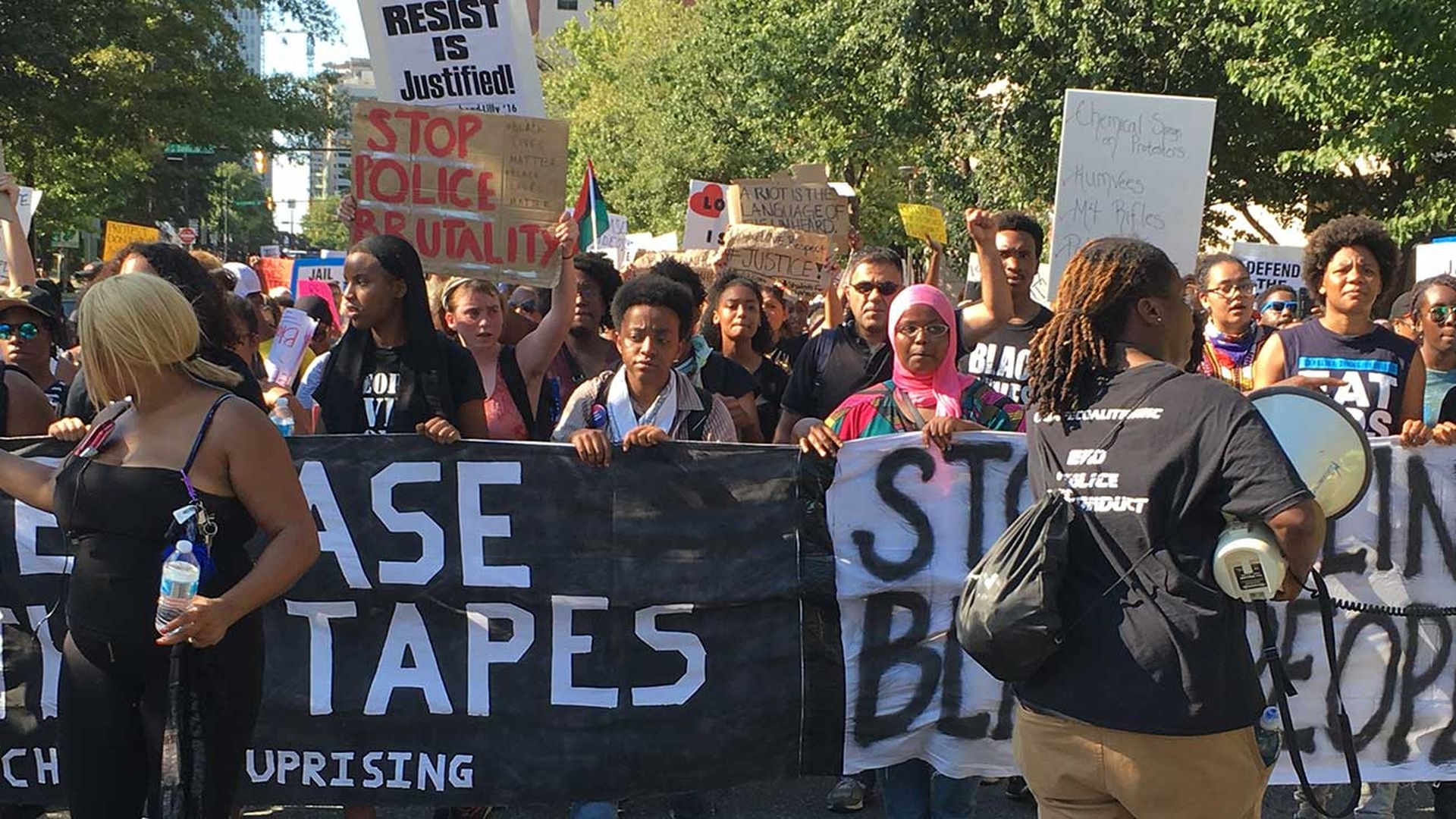
protest-marching-charlotte
When the protests first began in the aftermath of Keith Lamont Scott’s death from an a police officer involved shooting, I was trying to get my baby daughter ready for bed, before meeting up with a group of friends at the Bad Boy Family Reunion concert on that Tuesday night. My wife was out of town on business and my mother-in-law was the only reason I was afforded the opportunity to experience some great music and the nostalgia of 1990s hip-hop and r&b culture.
As the only GenXer in a group of Millennials, I explained that this particular era and genre was the soundtrack of my college experience, and that of my peers, especially (although not definitely not exclusively) those of us who are African-American.
But, the 1990s were not all good.
Even in the midst of a growing economy due in large part to leaps forward in technological evolution, exemplified by the birth of the internet, there were on-going socio-economic disparities, deteriorating urban cities plagued with crime and poverty, and deep racial tensions between black and brown communities and law enforcement, due to an overzealous war on drugs that targeted young people of color.
Discrepancies in sentencing for those who sold crack-cocaine versus those who peddled cocaine in powder form contributed to the high incarceration rates of African-American and Latin American men and women that are still disproportionately represented in prison today.
My first experience with the inequity of the criminal justice system came when I was a junior in college.
Campus police signaled with flashing lights for me to pull my car over for an expired registration tag not far from my on-campus apartment building. Although, I was agitated by the stop I was respectful and complied without protest. There were two officers and one came to collect my driver’s license and registration. After several minutes waiting for them to run the customary background checks, the officers came up to my car guns drawn and told me to get out of the vehicle and put my hands on top of the car. Absolutely bewildered, I wondered how an expired tag escalated to this level.
As the handcuffs were being put on my wrists I was told that there was a warrant for my arrest.
The officers took me to the police car and had me sit in the back seat. At that point I said in a calm, but forceful tone, “If you take me to jail I’m going to sue your entire department.”
I let them know in no uncertain terms that they had the wrong person. It was clear that the officers knew they needed to double-check their facts. After a few moments of looking over their database, they decided to release me, because they were indeed about to make a false arrest.
The officers offered an obligatory apology and simply said it was a case of mistaken identity.
I was outraged and filed a complaint with the campus police department, which lead to a meeting with the university police chief. He said that the suspect in question was a woman who had my same last name, and a first name that started with “R” (he said the actual name, but it would not be appropriate to share that here).
The chief did not say that the woman was black, but I wondered what other factor could have caused me – an African-American man without a criminal record – to be confused with a female suspect who was wanted for drug-trafficking? A more formal apology was given, but it did not quell the anger and sense of degradation that I felt. It was the beginning of an involuntary, growing distrust of police officers.
The officers and chief were white, but artists such as KRS-One in his song “Black Cop” and the iconic film “Boyz N the Hood” chronicled the racial profiling and misconduct that African-American cops sometimes participated in as well.
/2024/01/06/1704558435180.jpg)
That incident was compounded by an encounter with a South Carolina state trooper on the way to Myrtle Beach with my oldest daughter’s mother one summer while still in college.
On this particular occasion I was speeding and the officer had every right to engage me. However, I had a California driver’s license (because my family lived there at the time) and he claimed he was unable to run a background check on me in that state for whatever reason. This officer proceeded to tell me I had two choices. I could either pay him $80 right there on the spot or he was going to take me to jail. Getting issued a ticket was not an option. It was either pay up or get taken to a police station in rural South Carolina. Thank God I had a lot of cash on me (#SandraBland).
My story is one of millions, many of which have much worse outcomes, as we know.
During the Jim Crow era of segregation, there were countless African-Americans who were lynched, with the permission and participation, of law enforcement officials or killed in American jails without due process of law. Too many innocent black people and others have died in encounters with police during the period between the culmination of the Civil Rights movement in the 1960s and the age of social media and citizen journalism in which live now, that makes it possible for such occurrences to be documented and publicized.
To understand the unrest that took place in Charlotte after the death of Keith Scott you have to understand, not just the magnitude of the collective memory and emotional pain that has accumulated over generations since the founding of our nation. Although the majority of police officers conduct their jobs with a high-level of professionalism and respect for those they serve, the fatal shootings of black people (men in particular), by officers under questionable circumstances has been tolerated for far too long.
/2024/01/06/1704558435429.jpg)
I went to college in Charlotte and have spent most of my adult life here.
Though not a native, I am a Charlottean. I have one daughter who was raised here and another who is just getting started. Most of my professional and personal life has been spent advocating for diversity, inclusion and equity within organizations and the community. Having interacted with the myriad segments of Charlotte-Mecklenburg, I understand that the aspiration of one, unified community and the current reality are two very different things.
I applaud the protestors from all generations, and especially the young people, who made their voices heard for equality and justice this week. And while I believe it was counterproductive for a segment of individuals to express their anger and frustration through looting and vandalism, I understand that they are the products of the very inequity and injustice that have been brought to the forefront. This is why I do not use the hashtags #WeAreNotThis and #ThisIsNotUs.
While, I still believe that our city and region has many great qualities, part of our problem is that we tend to focus on who we want to be at the expense of who we are right now.
This week Charlotte was a place of peaceful protest and disruptive rioting. It was a dichotomy of harmony and conflict. We were/are a nexus of opportunity for some and despair for others.
If we do not truly acknowledge and wrestle with these tensions, then the deaths of Jonathan Ferrell, Keith Scott, Justin Carr and all of the other lives taken from us too soon through violence, will have been lost in vain.