Why more millennials don’t run for political office

Add Axios as your preferred source to
see more of our stories on Google.
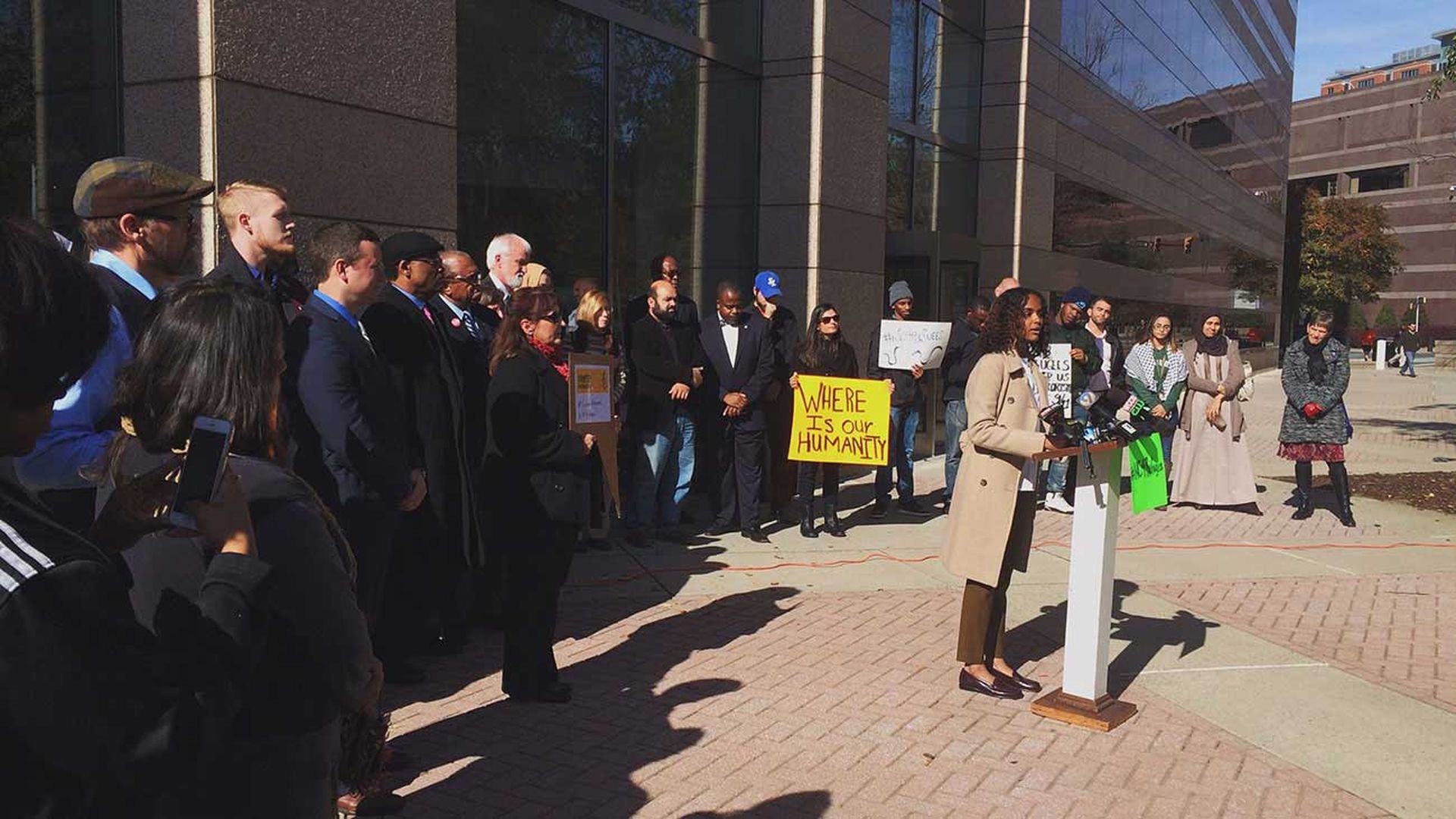
Lula-Dualeh-speech
It’s no secret that young people have accomplished great feats when we look at history and continue to astound us by pushing boundaries in all fields and aspects.
Malala Yousafzai, human rights and women’s education advocate and author, is the youngest Nobel Laureate ever at the age of 17 years old. A group of black student activists and 30 football players at the University of Missouri rallied together to protest on-campus racial incidences and ousted then President Tim Wolfe. One thing all of these students have in common – they’re all under the age of 25.
Millennials’ fearlessness and ambition know no boundaries, so why hasn’t that drive translated into the world of politics?
/2024/01/06/1704560736588.jpg)
As a 28-year-old woman who ran for Mecklenburg Board of County Commissioners, I’m used to having people’s jaws drop when I talk about my campaign. Although people of all ages express amazement over my former candidacy, I realize for many young people that amazement is an underlying curiosity and excitement to learn more about politics.
I quickly noticed a newfound enthusiasm among young people through my campaign. I understood, not only did I have the platform to highlight issues that affect my community and share my ideas and solutions to those problems but I also had an opportunity to share that platform with millennials who were left out of the political process.
Since then, I had time to process why more millennials don’t throw their hat in the political ring. Here are the three main reasons I’ve narrowed it down to…
The misconception of politics
Let’s face facts, politics can be intimidating. As a community organizer, I viewed politics as a “good ol’ boys’ club” reserved for a particular demographic who belonged to a specific tax bracket.
It wasn’t too long into organizing that I realized that the social issues I’m most passionate about would stay just that – issues, without political influence to help create solutions. Once I connected those dots, more millennials needed a seat at the table to make sure our voices were heard, so I jumped in head first.
That realization led me down a path to demystifying the illusion of politics and who can actually run for office. Actually having a career in politics has not been presented to us as a career path as much as becoming a doctor or lawyer has been.
Whether due to experience or know-how, millennials have accepted the false impression that we are incapable of running for office because that is what we were taught to believe. Outside of certain qualifications in order to become a candidate such as an age requirement for certain offices such as the North Carolina Council of State, anyone is qualified to run for office. As a member of this community, city, and state, your voice is valued and should be heard. If you’re interested in running, do it.
/2024/01/06/1704560736774.jpg)
The outsider effect
Although Charlotte is a budding city and a political ground zero concerning hot topic issues such as HB2, the local political community is almost impenetrable.
Granted, I was a political newcomer who never ran for office before; however I wasn’t new to the political sphere. I previously held an executive role in the Mecklenburg County Democratic Party, and I worked hand-in-hand with nonprofit organizations and local and state politicians as a community organizer — as well as being a precinct chair and regional field director hiring over 200 canvassers for then Sen. Kay Hagan with ForwardNC.
Despite that, the amazement I was greeted with from the local establishment left me in shock and disbelief. I ran for office because I realized representation matters, and we are sorely underrepresented with young voices within leadership. However, many viewed my candidacy as an attack against the local establishment.
/2024/01/06/1704560737001.jpg)
When presented with the idea of running for office, millennials are motivated by becoming change agents providing creative and modern solutions to decades old issues. In order to continue towards a more progressive Charlotte, we must welcome change with open arms and pass the baton of power to those who are ready and willing to carry on the fight towards equality.
Political processing
To many, politics is presented as an impossibly complex notion that is beyond the grasp of the average citizen, especially millennials, however that could not be further from the truth. Since President Obama’s initial run for president in 2008, we have seen a groundswell of millennial involvement with politics like never before.
With an unprecedented voter turnout among millennials, we proved to be the new voting bloc that held power to sway an election. With President Obama’s campaign and now a re-emergence of millennial buzz surrounding Sen. Bernie Sanders’ campaign, we continue to be a determining factor in elections, locally, statewide, and nationally.
Although we are now valued as voters in the political process, there needs to be a similar shift in perception that we can also be valued as candidates. The misconception that millennials are apathetic towards politics is a lie that has been accepted as the truth due to the political culture that celebrates our unknowingness of the political process.
Truth is, I didn’t wait for confirmation from others in order to run for office. I was well-aware that I wasn’t privy to the full spectrum of politics, however the concerns of my community was greater than my unfamiliarity. Like the journey of life, politics is a never-ending learning process with many obstacles but also great reward, so get started.
Simply put, millennials should no longer accept the role of understudy when we are powerful and capable enough to the lead in the play for political authority in Charlotte.
Is the deck stacked against us as young emerging leaders going up against the local establishment? Yes. Will it be difficult to prepare and run for office? Yes. However, the list of reward of running for office as a millennial has more pros then cons. By deciding to run for office, you are challenging the status quo of what it means to be candidate. If we are valued as voters, we can and will be valued as candidates.