Here’s the deal with the projected image on the UNC Charlotte Center City building

Add Axios as your preferred source to
see more of our stories on Google.
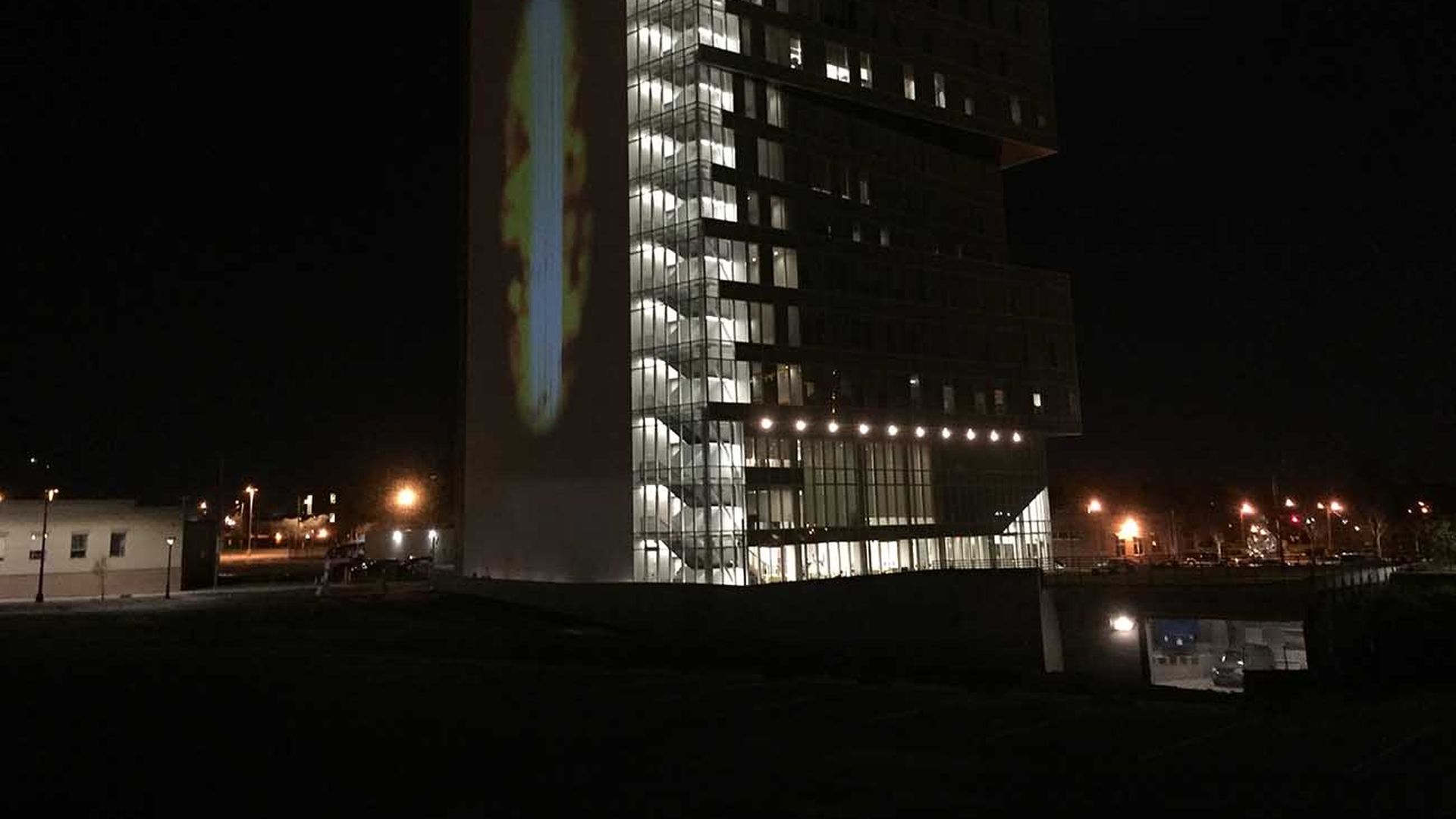
km particle falls uncc center city
A week or so ago, I was walking to First Ward Park and stopped dead in my tracks to ask out loud what the weird projection on the side of the textbook building was.
In a very honest way of speaking, the black and yellow orbs all floating around one long solid line of orange made me think immediately of Lord of the Rings.
But that is definitely not what it is.
It’s called Particle Falls and it serves as a real-time indicator of air quality.
The projection begins as a long blue line (rather than orange) meant to look like a waterfall that becomes overrun with brightly colored orbs as the quality of the air around the building worsens.
The bright orange and yellow orbs symbolize fine particulate matter.
Explained simply, particulate matter is a mixture of solid particles and liquid droplets that are formed from things like dust, dirt and smoke. Because they’re small enough to be inhaled into the lungs, absorbed into the bloodstream and cross the blood brain barrier, breathing in these tiny little particles has huge consequences — they’ve been linked to serious health issues.
The scary thing is that we can’t get away from them, as they’re often caused by everyday things such as cars, buses and construction equipment.
/2024/01/06/1704562552747.jpg)
How does it work?
A nephelometer (a tool that takes air samples) is used to gather data and the data it picks up is animated using computer software. When the nephelometer senses particle pollution, the brightly colored orbs start to move over the original blue light. The more orbs, the more particles. And it’s all in real time.
Why should you care? Because Charlotte ranks higher than the national average of this type of pollution.
And this art installation — and the fact that most of us have never seen it blue, like in this photo of the installation in Pittsburgh — reminds us of that.
/2024/01/06/1704562553027.jpg)
“People need to understand the importance of air pollution,” said creator Andrea Polli, who is both an artist and a scientist. “Particle Falls makes the invisible visible in an extraordinary way.”
Terry Lansdell, Clean Air Carolina Program Director, agrees. “It is an attempt to make real what we take for granted. We struggle to test and clean the air we breathe. We ignore its impacts until it is too late. Particle Falls forces us in a most beautiful way to see the air we breathe and to make the connection to the life we live.”