The world’s most visited traveling exhibition opens this weekend in Charlotte

Add Axios as your preferred source to
see more of our stories on Google.
Body Worlds Charlotte
Jamie Decker was in high school when she saw Gunther von Hagens’ Body Worlds exhibit at Discovery Place in 2007. The human anatomy exhibit shattered the museum’s attendance records that year and changed the trajectory of her professional life.
Although she’d always been interested in mortuary science and anatomy, the exhibit introduced Decker to plastination, Dr. von Hagens’ patented body preservation technique. She went on to study funeral service and mortuary science at Piedmont Technical College, eventually meeting von Hagens at the International Conference on Plastination. He invited her to intern at The Plastinarium in Guben, Germany, which is the dissection lab for all Body Worlds specimens.
Back by popular demand, Body Worlds, the most visited traveling exhibition in the world, will reopen in Charlotte again on Saturday, November 21. More than 11,000 tickets have already been sold and Jamie Decker is back where it all began working as a project specialist assisting with the programming and education of the exhibit. We got a sneak peek on Thursday.
/2024/01/06/1704518244063.jpg)
/2024/01/06/1704518244364.jpg)
I might be the only person on earth who thought I was going to see plastic models of human bodies but these are in fact real human specimens donated to science by individuals who indicated in their wills that their bodies could be used for educational purposes in the exhibit. There are nearly 16,000 people registered as body donors to the Institute of Plastination; 25 are from North Carolina and 6 live here in Charlotte.
/2024/01/06/1704518244597.jpg)
Although you could certainly learn about anatomy with a plastic model or computer program, viewing real human specimens adds an emotional layer that the exhibit’s creative and conceptual designer Dr. Angela Whalley says is more impactful. “You see people deep in thought, in awe, in self reflection,” she said. “The value of Body Worlds is that it makes people change their minds about themselves and their lifestyles.”
And that, she says, can have a measurable impact on lifestyle choices that affect our health. A survey of people who attended the exhibit found that 9 percent stopped smoking, 33 percent started eating healthier foods and 25 percent engaged in more physical activity.
/2024/01/06/1704518244970.jpg)
/2024/01/06/1704518245347.jpg)
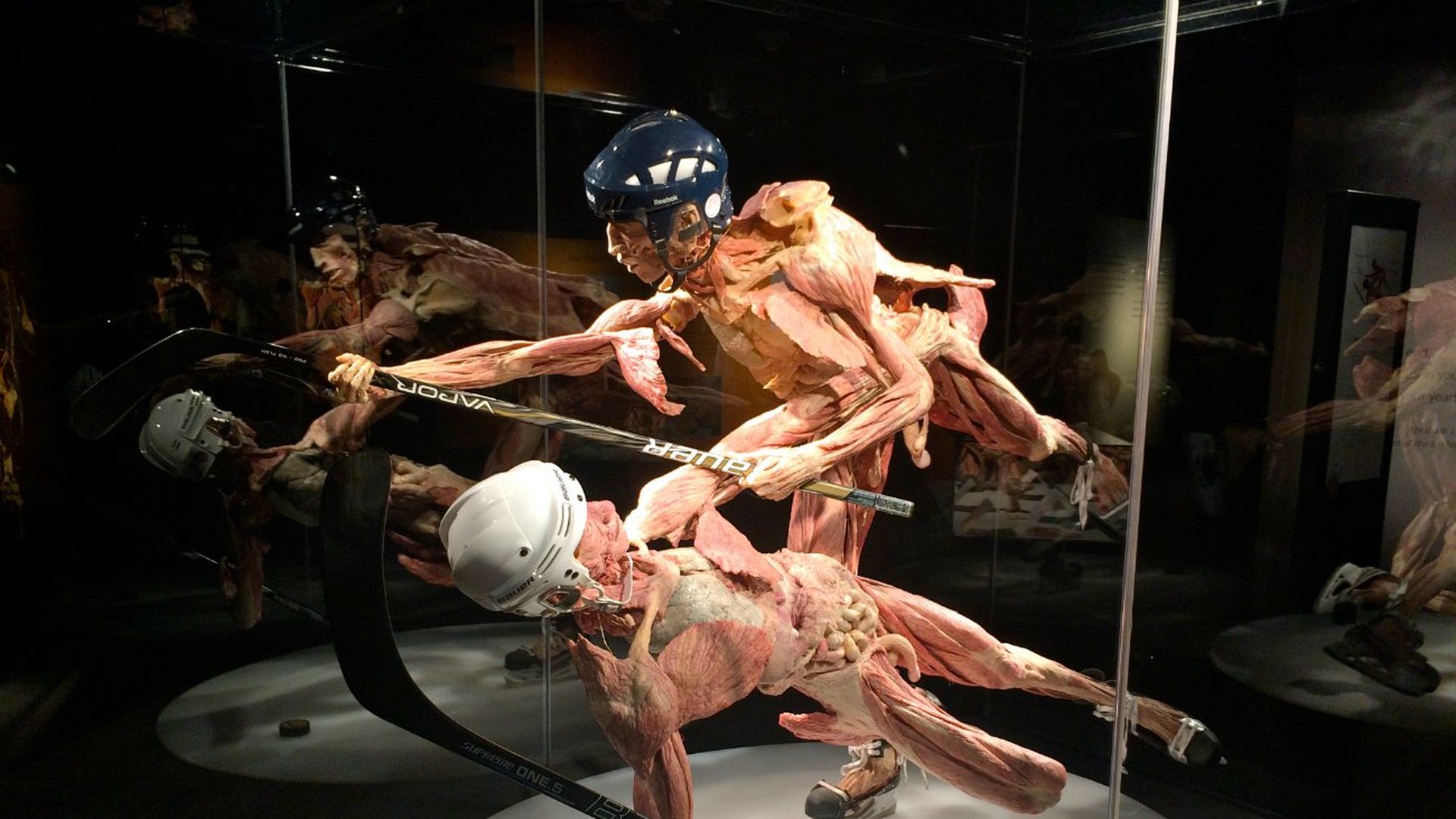
Part of the inspiration to live a healthier life no doubt comes from seeing sick and diseased specimens on display – a smoker’s black lung, a cross section of an obese body, skin cancer. But it might also come from the dymaic athletic poses of the bodies. That, according to Dr. Whalley, is done on purpose.
/2024/01/06/1704518245571.jpg)
One of the primary complaints from their inaugural exhibit in Japan in 1995 was that the bodies, displayed mostly in stiff anatomical positions, looked “so dead.” So they decided to pose them in action, making them more lifelike to appeal to people who have hesitations or have never seen a cadaver before.
Bodies undergo an intricate manual plastination process for preservation. It takes about 1,500 hours to prepare one body and they even processed an entire elephant one time that took three years to complete.
I didn’t think this exhibit would get to me but it’s worth noting that I had a negative physical reaction to the sight of human bodies peeled open for display. I didn’t pass out or throw up (although I’ve been told people have), but I did leave feeling pretty queasy and opted to skip lunch.
Whether you react physically, connect emotionally or, like Jamie Decker, change your career path, this exhibit will get to you. “Questions about life and death, who we are and what we’re made of, these questions are most profound to us,” said Dr. Whalley.
Body Worlds is at Discovery Place from Saturday, November 21 until May 1, 2016. See exhibition hours and ticket prices here.