That time I participated in a geopolitical forecasting project but hadn’t voted in the Charlotte Mayoral election

Add Axios as your preferred source to
see more of our stories on Google.
good-judgement-project
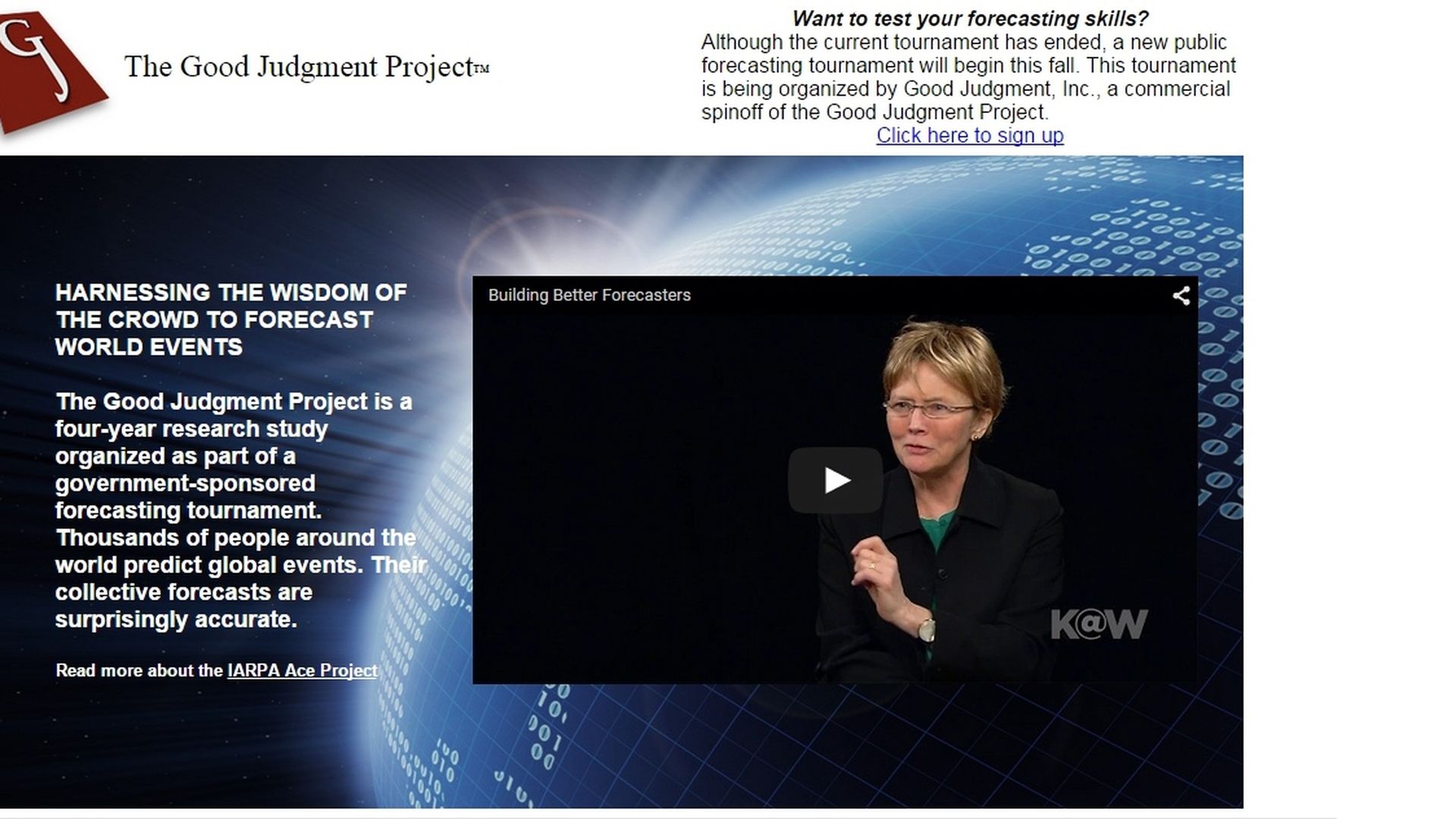
In spring of 2014, as I was driving the home-school-home jitney, I caught a story on NPR called “So You Think You’re Smarter Than a CIA Agent?” Alix Spiegel reported for approximately 7 minutes on an experiment called the Good Judgment Project (GJP) and it blew my relatively dormant, suburban mind.
Facts about the Good Judgment Project:
(The scale of this experiment is large and far more complicated than I can summarize in bullet points for this piece, but here’s an idea. If you want more information, visit the GJP website.)
- Lab Rats. An experiment pulled together by well-known psychologists at UC Berkeley and University of Pennsylvania and members of the U.S. national intelligence community.
- Wisdom of the Crowds Theory. The predictions of a large crowd of people with access to different information will be better than that of one person, no matter how well informed that one person is. Participants include approximately 3,000 average people.
- Forecasting. Participants make predictions on global events and concerns by assigning probability estimates. Though the GJP provides a news feed for questions, participants are responsible for conducting their own research.
- It’s a Tournament. When an actual event is realized, participants are assigned a score based on their predictions, and their cumulative score is ranked against other participants in their group.
- Yes, You Are Smarter Than a CIA Agent. Predictions made by the Good Judgment Project are often better than those made by intelligence analysts who have access to classified information.
In under 7 minutes, I was hooked.
It’s nerdy and fascinating, my favorite combination. (Don’t get me wrong, I can still name every housewife on Bravo there ever was.) Plus, in my daily myopic world of running the home-school-home jitney, I was intrigued by the opportunity to learn more about world events. I wanted a piece of this and after an application process that included some forms, test, and training, I was accepted into the fourth and final year of the tournament, starting in August 2014.
There were 127 questions released throughout the project year, we weren’t required to answer all of them. I’m not completely clear on confidentiality requirements, so here is a sampling of some of the more innocuous questions (I don’t feel like picking a fight with the intelligence community today, or ever.)
- When will the closing spot price of gold fall to $1,150.00 or below?
- What percentage of those voting in the Scottish independence referendum will vote for independence?
- When will the World Health Organization next report any *confirmed cases of Ebola in a European Union member state?
- When will OPEC next agree to cut its oil output?
- When will Israeli Prime Minister Netanyahu next speak before the U.S. Congress?
As I’ve been reflecting on this experience and simultaneously following local political events with the upcoming Mayoral election, it dawned on me that I didn’t vote in the 2013 Mayoral election.
I don’t remember why, but I surmise it’s because we had recently moved to Charlotte and a Mayoral election didn’t register on my radar of importance. The irony of participating in a geopolitical forecasting competition but not voting in my city’s own election is not lost on me.
Clearly, I wasn’t the only one to skip the vote because in 2013, only 18 percent of registered voters participated in the Mayoral election.
And the numbers for the 2013 primary were worse, turnout was 6.7%.
The Charlotte Mayoral primary is Sept. 15, and the general election on Nov. 3. We have 8 candidates (6 Democrats, 2 Republicans), you can see the full list here in our highly scientific poll. Edwin Peacock won with 44% of the vote, a whopping 103 votes. If I remember algebra correctly, that’s a total of 234 people who voted. 234. Voting in this poll could not have required less energy.
If there’s one thing I learned from the GJP is that wisdom of the crowds is a real thing and it can be applied not only to forecasting world events, but actually determining local events like Mayoral elections as well.
The more of us that do our research and vote in the primary AND election, the better our chances of electing the best candidate to serve as Mayor of Charlotte. And let’s face it Charlotte, we’ve made some bad decisions before.
/2024/01/06/1704521225199.jpg)
This year’s GJP project wrapped up in June, and my mean score was better than 99% of my cohort.
The project opened up my eyes to a lot of world topics I didn’t know existed. And while it was fascinating, there are many issues and concerns here in Charlotte as well that I’m not all too familiar with. And over the next few months, as 8 passionate Mayoral candidates try and earn our votes, these issues and concerns will be at the forefront.
We’ll work hard to report on the Mayoral race, but we can’t make you read our stories or make you vote.
If you read Axios Charlotte, you’re obviously interested and invested in our city. The biggest investment you can make in Charlotte is with your vote. And the more of us that vote, the bigger the mandate for our leaders to continue making Charlotte a better city for all of its residents.
Knowing who has the best brunch in Charlotte is important and understanding the political landscape of our city is important. You can have both, just like watching Real Housewives while forecasting geopolitical events.