Extreme weather defined Earth's hottest month

Add Axios as your preferred source to
see more of our stories on Google.
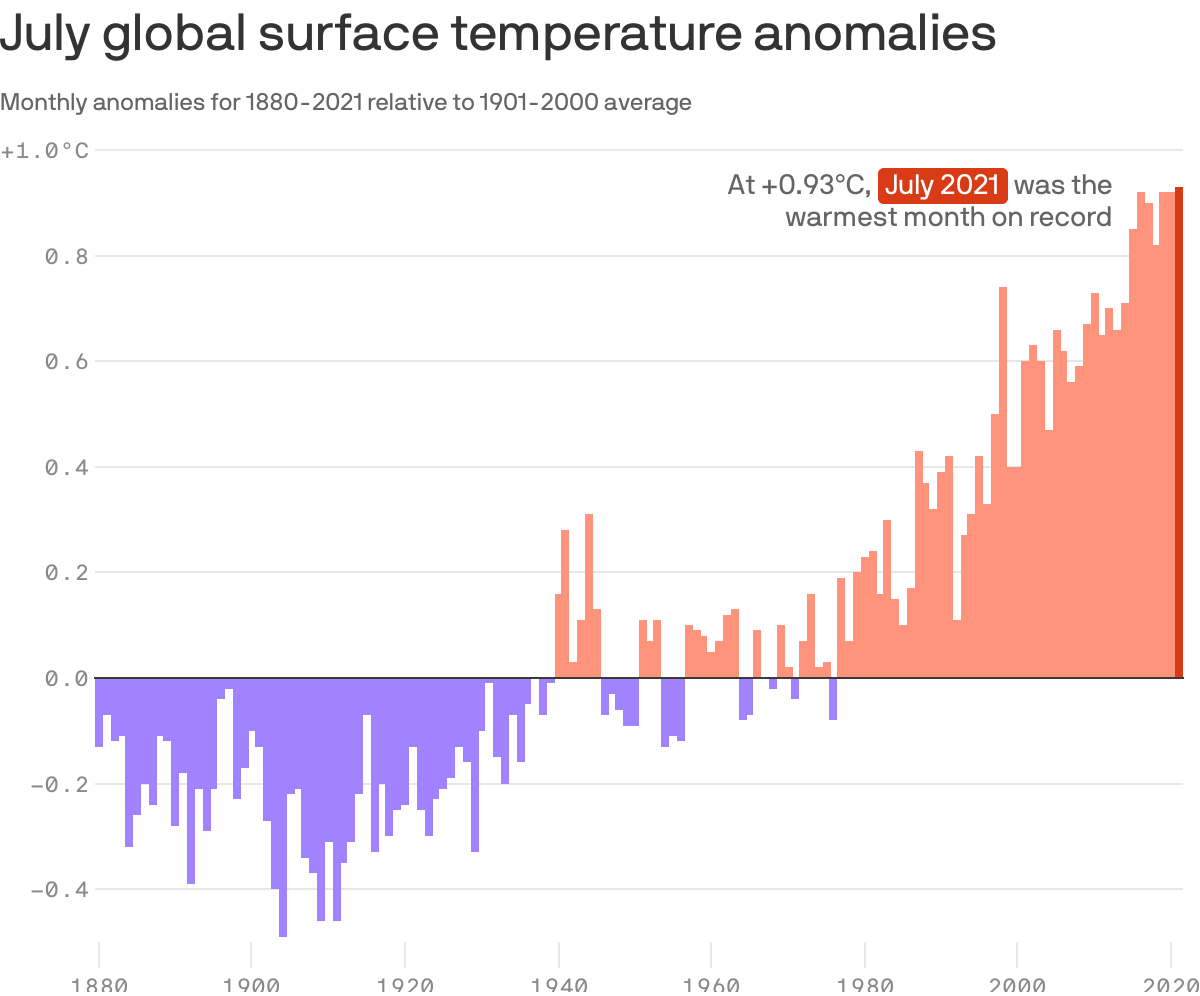
July was the hottest month on record worldwide, according to the National Oceanic and Atmospheric Administration (NOAA).
Why it matters: When it comes to establishing new climate milestones, the Earth is on a roll, thanks in large part to the burning of fossil fuels for energy, as well as deforestation.
- The monthly temperature record news dropped in the same week as the dire climate report from the U.N. Intergovernmental Panel on Climate Change.
- That report makes clear that global warming can no longer be viewed as a problem simply for future generations — its effects are already here.
- The report was the climate science equivalent of the horror movie trope: "The phone call is coming from inside the house."
Details: The Northern Hemisphere land-surface temperature was the highest ever recorded for July, at an unprecedented 2.77°F (1.54°C) above average, NOAA found.
- The month was the hottest month on record for Asia and second-hottest for Europe.
During July:
- California saw a spate of wildfires worsen, as did Oregon, Montana and other Western states. One of the fires that began in July, known as the Dixie Fire, is now California's second-largest blaze on record.
- Brutal heat waves hit Europe and Asia, and vast stretches of Siberia went up in flames, choking population centers with smoke and haze.
- Turkey set record highs, which helped set the stage for wildfires that broke out in August. Parts of Japan broke temperature records, and Northern Ireland broke its all-time heat record two days in a row.
Yes, but: Climate scientists don't pay very close attention to individual calendar months, but rather to long-term, 30-year-plus trends. But in both cases, the trend lines are clear: The world is getting warmer, quickly, as greenhouse gas concentrations in the air climb.
- It is nearly certain that 2021 will rank among the top 10 warmest years on record, most likely at No. 6 or 7 on NOAA's list. That is despite the presence of a La Niña event in the tropical Pacific Ocean that helped keep global average temperatures lower for a time.
What they're saying: “This new record adds to the disturbing and disruptive path that climate change has set for the globe,” said NOAA administrator Rick Spinrad.
