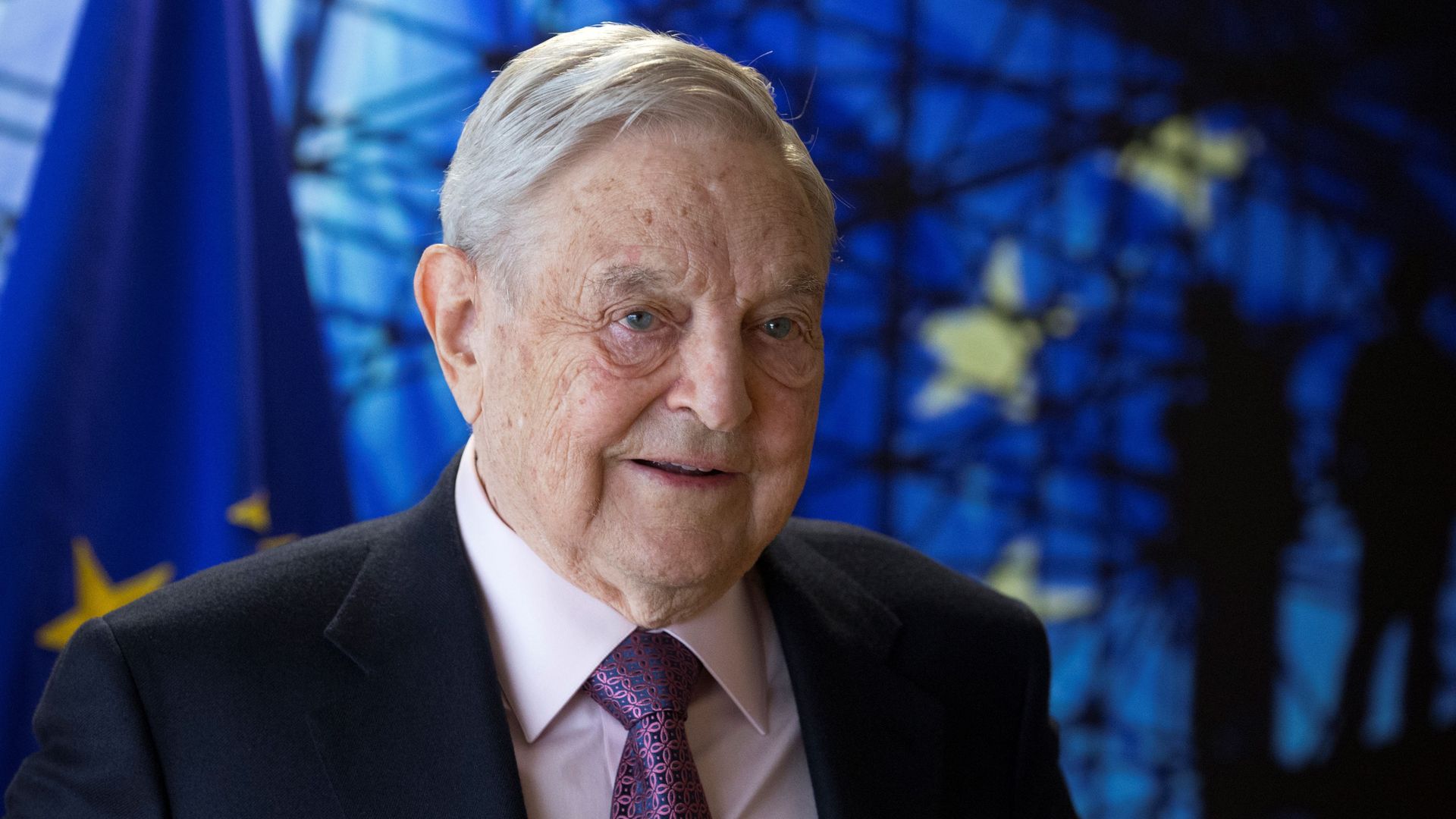
Billionaire George Soros. Photo: OLIVIER HOSLET/AFP/Getty Images
Billionaire investor George Soros launched a brutal attack on big online platform companies at this year’s World Economic Forum meeting in Davos. Now, his influential organization is "certainly examining new ways" to tackle the growing power of tech giants, according to an official at his influential philanthropy.
Why it matters: Soros may put his money where his mouth is. With a global reach and an annual budget of more than a billion dollars, the Open Society Foundations has the ability to significantly shape the growing debate over the power of Big Tech.
What they’re saying: “The Open Society Foundations has long worked on issues involving the free and democratic flow of information and the ways in which a concentration of power can affect knowledge and communication,” Open Society Foundations acting Co-Director of U.S. Programs Laleh Ispahani said in a statement to Axios. “Mr. Soros’s speech reflected rising concern about the effects of a handful of giant internet platforms having so much influence, and we’re certainly examining new ways we might address those concerns in ongoing conversations not just in the U.S. but among our foundation colleagues globally.”
Soros has been on a tear against the web platforms lately. "The rise and monopolistic behavior of the giant American Internet platform companies is contributing mightily to the US government’s impotence," he wrote in a recent op-ed that predicted that regulatory action in the European Union will be their "undoing."
What they’re doing: The organization didn’t provide details of their current conversations. A spokesman said that it provided a $180,000 two-year grant to the Open Markets Institute last fall for work around web platforms.
The organization's interest in platforms has been building for some time. It gave the group Data & Society $250,000 in 2016 for "reimagining pathways for algorithmic accountability of platforms and organizations that produce and distribute content, such as search and recommendation engines and social media."
Open Society Foundations has weighed in on issues like net neutrality and surveillance.
Go deeper: Interest in this topic is rising among wealthy individuals who can use their philanthropic organizations to influence the conversation.
President Trump arrives yesterday with First Lady Melania Trump and Vice President Pence at the funeral of the Rev. Billy Graham in Charlotte, N.C. Photo: Jim Watson / AFP / Getty Images
There's a contagion of Washington coverage that isn't worthy of your time. The stories sound dramatic but tell you little, if anything.
Be smart: Jonathan Swan emails me: "The very important collective impact of this reporting is that it could make Trump more angry than ever about the probe."
See if you can spot the pattern:
"Source: Mueller looking into what Hicks knows." (CNN)
"Mueller asking if Trump knew about hacked Democratic emails before release." (NBC)
"Mueller asking about Trump's Russia business deals and Miss Universe pageant." (Newsweek)
"Mueller team asks about Trump's Russian business dealings as he weighed a run for president." (CNN)
"Mueller looking at Ivanka Trump's interaction with Russian lawyer at Trump Tower." (The Hill)
Why it doesn't matter: All we know is what yappy witnesses tell reporters they were asked about.
News flash: Mueller is looking at everything.
That's his job. When he was named, he was empowered/instructed to look into the "FBI investigation of Russian government efforts to influence the 2016 presidential election and related matters." That there is a broad mandate.
This gives us literally zero insight into what the special counsel is actually doing and thinking.
These kernelsaren't from Mueller's office: We've seen time and again (and again) that his office is one of Washington's few leak-free zones.
Yes, it looks bad. Based on conversations with White House insiders, I can tell you they're more bearish than ever about the outcome. But we're all guessing.
The bottom line: Here's one headline that's true: "Expect more ‘surprises’ from Mueller probe, former crusading prosecutor says."
And expect plenty more "scoops" about what Mueller is asking gabby witnesses.
North Korea says it will "counter" any U.S. military exercises
A man watches a television news broadcast showing Kim Jong-Un. Photo: Jung Yeon-Je / AFP / Getty Images
North Korea said on Saturday that it would "counter the U.S." if military exercises were conducted, and the U.S. will "own all responsibilities for the ensuing consequences," Reuters reports.
“If the U.S. finally holds joint military exercises while keeping sanctions on the DPRK, the DPRK will counter the U.S. by its own mode of counteraction and the U.S. will be made to own all responsibilities for the ensuing consequences."
— North Korea's news agency KCNA
Why it matters: Per Reuters, the U.S. and South Korea plan to start joint exercises in April. North Korea said through KCNA that drills "would harm reconciliation efforts," and that the regime will not "beg for dialogue" with the U.S.
Secret Service responded to man shooting himself near the White House
The Secret Service responded after a man shot himself near the north fence line of the White House on Saturday afternoon. Per their Twitter, no other injuries were reported and medical personnel responded.
President Trump is not at the residence, but was briefed on the situation. White House personnel were instructed to shelter in place, according to radio station WTOP.
NRA President Wayne LaPierre at the NRA Leadership Forum. Photo: Jim Watson / AFP / Getty Images
The NRA has gotten something right: it's extremely effective in pushing its message onto as many platforms, and in front of as many people, as possible.
How they do it: They aren't using traditional tactics, like knocking on doors or making cold calls to get their message across. The NRA's official app, NRA-ILA, is used by tens of thousands of people. Through push notifications and in-app reminders, users (who aren't necessarily NRA members) are encouraged to call their representatives, post on social media, and donate. Thomas Peters, the founder of uCampaign which created the app, told Axios it's a "tremendous success."
On one side: Jordan Birnholtz, co-founder of political engagement start-up the Tuesday Company, told Axios the NRA app is "indicative of where a lot of prospective online activism is going."
The Tuesday Company created Team, which is used to organize volunteering for Democratic and progressive campaigns and causes. While not identical, the two share a similar goal of organizing online activism.
"It's really unique to see an advocacy group finding ways to coordinate and track how effective their mobilization of volunteers online is. To one extent, that's the work that Team...does for Democrats and progressive causes."
— Jordan Birnholtz
Peters says the app isn't justfor taking action — although there have been millions of "real-life actions" taken since its creation. NRA-ILA is also a community:
"People will jump on the app on July 4th and post messages like 'God Bless America.' They're very patriotic, and they love their guns and they love their religion...and they've found a community of other people like them."
The app is also used as a "parallel news structure that people go to when they're trying to figure out what the facts are, because they typically don't trust a lot of the Facebook algorithms and gate keepers," Peters said.
President Trump tweeted on Saturday afternoon that if the European Union increases tariffs on U.S. companies, the U.S. will apply "a Tax on their Cars which freely pour into the U.S."
Why it matters: This is what you'd call a trade war. This has been the primary concern since Trump announced new tariffs on steel and aluminum this week. But per Axios' Mike Allen and Jonathan Swan, tariffs are what Trump has wanted and now he's feeling like a man of steel.
South Africa votes to transfer land from white to black farmers
South Africa's new president Cyril Ramaphosa. Photo: Mike Hutchings / AFP / Getty Images
South Africa's parliament voted 241-83 on a motion that would allow land to be transferred from white to black land owners without financial compensation, the Independent reports.
"This original sin that was committed when our country was colonised must be resolved in a way that will take South Africa forward."
— President Cyril Ramaphosa
Why it matters: Ramaphosa, said he wanted to resolve racial disparities in land ownership "once and for all," per the Independent. The motion was opposed by the Democratic Alliance party, which argues this will "undermine property rights and scare off potential investors."
"Can Venezuela Be Saved? As a nation unwinds, Leopoldo López, the opposition’s most prominent leader, sits under house arrest and contemplates what might still be possible," by Wil S. Hylton.
Why he matters: "[H]e has become the most prominent political prisoner in Latin America, if not the world. His case has been championed by just about every human rights organization on earth."
"López was arrested in February 2014 after leading a public protest that turned violent. ... Before his arrest, he was among the most prominent and popular opposition leaders in Venezuela. Polling suggested that he could defeat President Nicolás Maduro, the unpopular successor to Hugo Chávez."
"The Venezuelan government routinely disparages him as a right-wing reactionary from the ruling class who wants to reverse the social progress of chavismo and restore the landed aristocracy; the Venezuelan right, meanwhile, considers López a neo-Marxist, whose proposal to distribute the country’s oil wealth among the people would only deepen the chavista agenda."
Update: "Since the publication of this article, armed guards from the Venezuelan intelligence service have raided and occupied the residence of Leopoldo López. Members of the Venezuelan National Assembly gathered in front of the house, along with local media and citizens, to protest the invasion and threats by the Venezuelan government that López will be returned to military prison."
Q-Tip performs at the Kennedy Center on Oct. 6. Jati Lindsay / Kennedy Center via AP
The Kennedy Center, trying to shed an image of white elitism in a largely black city, is embracing hip-hop culture in a major way, AP's Ashraf Khalil reports:
"The center has gradually introduced rap music into its programming, with rappers like Nas and Kendrick Lamar performing with the National Symphony Orchestra."
"Q-Tip from A Tribe Called Quest has been named artistic director for hip-hop culture. Last year, LL Cool J became the first rapper inducted into the elite ranks of Kennedy Center Honors recipients."
A full-time staffer, Simone Eccleston, is director of the new hip-hop culture department.
As far back as 2008, rapper Mos Def performed at the Kennedy Center, sneaking in as part of the jazz programing.
"Inside the building, staffers refer to the traditional programming staples by the acronym SOB: symphony, opera and ballet. President Deborah Rutter acknowledged that the shift has sparked some concern among what she called 'the dyed-in-the-wool, I only want to hear "La Traviata"' audience."
Pianist Jason Moran, the center's artistic director for jazz, laughingly recalls a moment before Lamar's 2015 performance when a member of Lamar's team asked, 'Who's coming to this thing, man?'"
Roy Moore is asking for financial help to fight accuser in court
Roy Moore. Photo: Jim Watson / AFP / Getty Images
Roy Moore, former U.S. Senate candidate in Alabama, is asking for help to pay his legal bills as he fights Leigh Corfman in court, a woman who claims she was molested by Moore when she was 14.
"Please help me fight this battle for the heart and soul of this Nation. Your financial contribution to my legal defense fund is crucial...My resources have been depleted and I have struggled to make ends meet."
Why it matters: Moore's loss in Alabama was a historic one — a Democrat took a senate seat in a deeply red state, after nine women accused Roy Moore of sexual misconduct. Moore has raised $32,000 of a requested $250,000, the AP reports.