Sign up for our daily briefing

Make your busy days simpler with the Axios AM and PM newsletters. Catch up on what's new and why it matters in just 5 minutes.

Please enter a valid email.

Please enter a valid email.

Subscription failed
Thank you for subscribing!

Catch up on the day's biggest business stories

Subscribe to the Axios Closer newsletter for insights into the day’s business news and trends and why they matter.

Please enter a valid email.

Please enter a valid email.

Subscription failed
Thank you for subscribing!

Sign up for Axios Pro Rata

Dive into the world of dealmakers across VC, PE and M&A with Axios Pro Rata. Delivered daily to your inbox by Dan Primack and Kia Kokalitcheva.

Please enter a valid email.

Please enter a valid email.

Subscription failed
Thank you for subscribing!

Sports news worthy of your time

Binge on the stats and stories that drive the sports world with the Axios Sports newsletter. Sign up for free.

Please enter a valid email.

Please enter a valid email.

Subscription failed
Thank you for subscribing!

Tech news worthy of your time

Get our smart take on technology from the Valley and D.C. with Axios Login. Sign up for free.

Please enter a valid email.

Please enter a valid email.

Subscription failed
Thank you for subscribing!

Get the inside stories

Get an insider's guide to the new White House with Axios Sneak Peek. Sign up for free.

Please enter a valid email.

Please enter a valid email.

Subscription failed
Thank you for subscribing!

Catch up on coronavirus stories and special reports, curated by Mike Allen everyday

Catch up on coronavirus stories and special reports, curated by Mike Allen everyday

Please enter a valid email.

Please enter a valid email.

Subscription failed
Thank you for subscribing!

Want a daily digest of the top Denver news?

Get a daily digest of the most important stories affecting your hometown with Axios Denver

Please enter a valid email.

Please enter a valid email.

Subscription failed
Thank you for subscribing!

Want a daily digest of the top Des Moines news?

Get a daily digest of the most important stories affecting your hometown with the Axios Des Moines newsletter.

Please enter a valid email.

Please enter a valid email.

Subscription failed
Thank you for subscribing!

Want a daily digest of the top Twin Cities news?

Get a daily digest of the most important stories affecting your hometown with Axios Twin Cities

Please enter a valid email.

Please enter a valid email.

Subscription failed
Thank you for subscribing!

Want a daily digest of the top Tampa Bay news?

Get a daily digest of the most important stories affecting your hometown with the Axios Tampa Bay newsletter.

Please enter a valid email.

Please enter a valid email.

Subscription failed
Thank you for subscribing!

Want a daily digest of the top Charlotte news?

Get a daily digest of the most important stories affecting your hometown with Axios Charlotte

Please enter a valid email.

Please enter a valid email.

Subscription failed
Thank you for subscribing!

Want a daily digest of the top Nashville news?

Get a daily digest of the most important stories affecting your hometown with the Axios Nashville newsletter.

Please enter a valid email.

Please enter a valid email.

Subscription failed
Thank you for subscribing!

Want a daily digest of the top Columbus news?

Get a daily digest of the most important stories affecting your hometown with the Axios Columbus newsletter.

Please enter a valid email.

Please enter a valid email.

Subscription failed
Thank you for subscribing!

Want a daily digest of the top Dallas news?

Get a daily digest of the most important stories affecting your hometown with the Axios Dallas newsletter.

Please enter a valid email.

Please enter a valid email.

Subscription failed
Thank you for subscribing!

Want a daily digest of the top Austin news?

Get a daily digest of the most important stories affecting your hometown with the Axios Austin newsletter.

Please enter a valid email.

Please enter a valid email.

Subscription failed
Thank you for subscribing!

Want a daily digest of the top Atlanta news?

Get a daily digest of the most important stories affecting your hometown with the Axios Atlanta newsletter.

Please enter a valid email.

Please enter a valid email.

Subscription failed
Thank you for subscribing!

Want a daily digest of the top Philadelphia news?

Get a daily digest of the most important stories affecting your hometown with the Axios Philadelphia newsletter.

Please enter a valid email.

Please enter a valid email.

Subscription failed
Thank you for subscribing!

Want a daily digest of the top Chicago news?

Get a daily digest of the most important stories affecting your hometown with the Axios Chicago newsletter.

Please enter a valid email.

Please enter a valid email.

Subscription failed
Thank you for subscribing!

Sign up for Axios NW Arkansas

Stay up-to-date on the most important and interesting stories affecting NW Arkansas, authored by local reporters

Please enter a valid email.

Please enter a valid email.

Subscription failed
Thank you for subscribing!

Want a daily digest of the top DC news?

Get a daily digest of the most important stories affecting your hometown with the Axios DC newsletter.

Please enter a valid email.

Please enter a valid email.

Subscription failed
Thank you for subscribing!

Please enter a valid email.

Please enter a valid email.

Subscription failed
Thank you for subscribing!

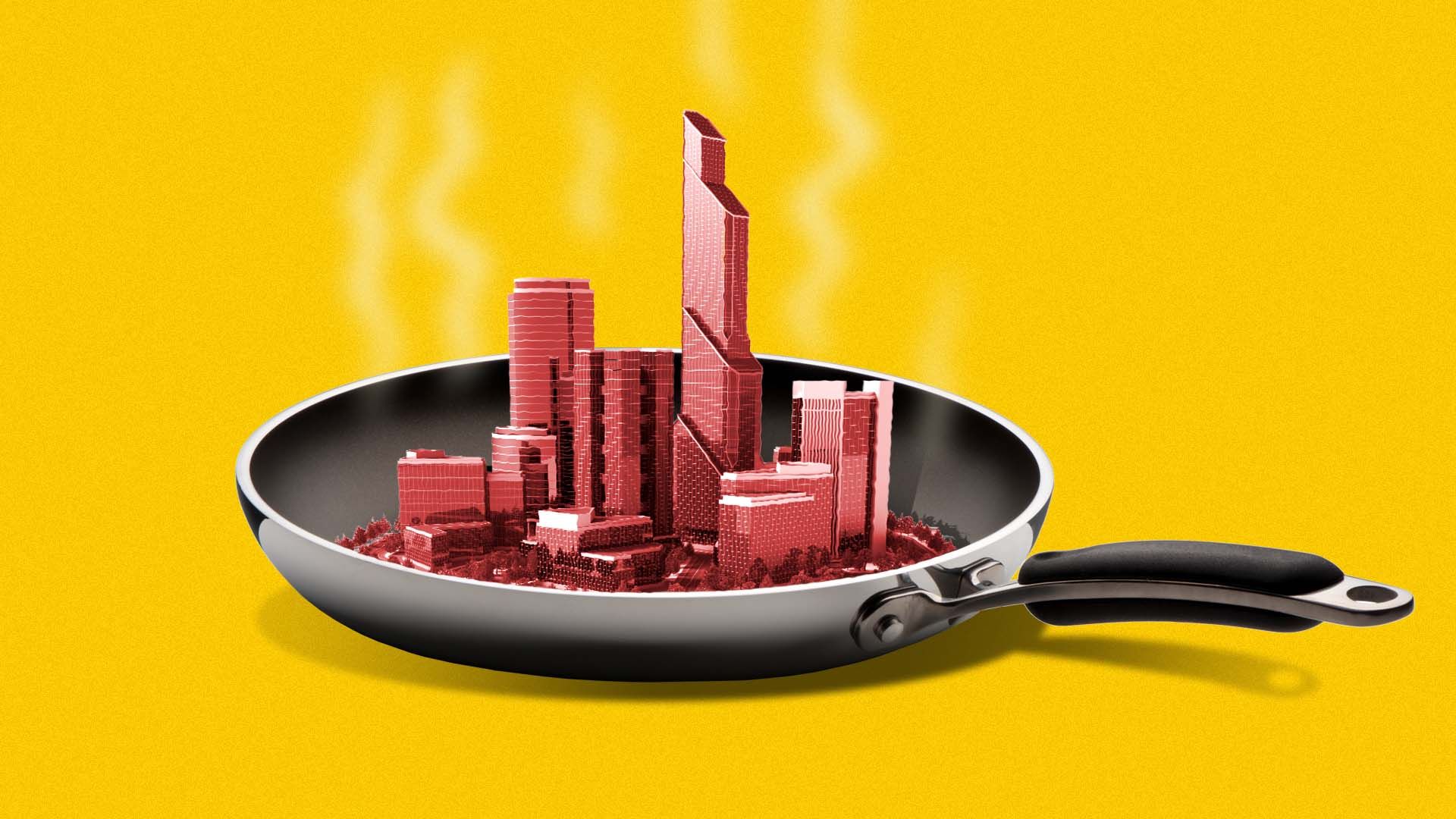
Illustration: Sarah Grillo/Axios

Most U.S. cities are at risk of experiencing extreme heat thanks to the "urban heat island effect" that's causing cities to warm as much as 50% faster than the rest of the country.

Why it matters: July was the hottest month ever recorded globally, and it was especially brutal for major metros.

"The extreme heat we’re seeing right now is the result of both climate change and urban development patterns. Cities have to think about the long-term implications of the changing environment."
— Katharine Burgess, vice president of urban resilience at the Urban Land Institute

The big picture: Severe heat wreaks havoc on cities' infrastructure, like electric grids, and presents serious public health risks.

City planners and developers are rethinking urban design to keep buildings and people cool as temperatures rise, according to a new report by the Urban Land Institute first shared with Axios.

  • Extreme heat may be a material risk: Moody's, Fitch Ratings and S&P Global warned that credit ratings could take into account cities' strategies for dealing with climate change. That could significantly impact cities' ability to raise capital and finance projects.
  • Midsized U.S. cities can expect about a 1% GDP loss by 2050 due to increased expenses and reduced growth associated with rising temperatures.

By the numbers: On average, cities are 2°F to 6°F warmer than their surroundings. Because they are covered with sun-absorbing pavement and rooftops, cities can be up to 22 degrees hotter than surrounding areas.

  • Today, cities have on average 10 more extreme heat events per year than they did in the mid-1950s.
  • Heat islands cause about 20% of the formation of urban smog, which then traps even more hot air in a city.

What's happening: From an economic perspective, cities that plan for super-hot futures may have a competitive advantage as consumers' preferences change with the weather.

  • In Houston, a midtown throughway was narrowed to make room for 175 large trees to provide shade cover along the corridor, resulting in a 20-degree temperature reduction in shaded areas.
  • In Scottsdale, a mixed-use development placed clustered buildings at specific angles to provide shade to each other and to pedestrian walkways. A giant custom shade was installed above the central plaza.
  • In New York City, parking lots are being turned into green spaces and "cool roofs" are installed throughout the city.
  • In Toronto, all buildings of a certain size are required by law to install vegetation on rooftops to reduce ambient temperatures. Greening 5% of the city's rooftop areas is estimated to lower citywide temperatures by about 1 degree.
  • In Los Angeles, where 40% of the city is covered with pavement, roofing materials must meet new sun-reflecting standards, and some city roads are coated with light-colored, reflective coating.

The catch: Heat mitigation measures are expensive, especially for large-scale projects. In the near-term, increasing air conditioning will likely be the go-to cooling method, even though they give off heat that may increase local temperatures and, through emissions, worsen climate change.

The most intense daytime urban heat islands are Las Vegas, Albuquerque, Denver, Portland, Louisville, Washington, D.C., Kansas City, Columbus, Minneapolis and Seattle.

Threat level: The impacts of extreme heat are felt disproportionately by a city's most vulnerable populations — the homeless, elderly, young and those living in poverty. Low-income communities are also less likely to have air conditioning or access to pools or cooling centers.

The bottom line: Severe heat will force cities, especially those in already-warm climates, to find long-term cooling strategies to protect their people, infrastructure and economy.

Go deeper

Biden science adviser Eric Lander resigns after violating workplace policy

Eric Lander, who became President Biden's science adviser, speaks on Jan. 16, 2021, at the Queen Theater in Wilmington, Delaware. Photo: Alex Wong via Getty Images

Biden science adviser Eric Lander resigned from his position on Monday after an investigation found that he violated the Biden administration's workplace policy, the White House confirmed.

Why it matters: An investigation found that Lander violated the White House's workplace policy and "corrective action" was taken, according to an Office of Science and Technology Policy spokesperson. Investigation recordings and documents obtained by Politico show that Lander bullied his former general counsel, among others.

Updated 1 hour ago - Politics & Policy

Omicron dashboard

Illustration: Shoshana Gordon/Axios

  1. Health: Pharmacies feel stiffed on pill payments — Long COVID is contributing to America's labor shortage — U.S. death toll hits 900,000.
  2. Vaccines: The kids' vaccine dilemma — Pfizer asks FDA to authorize vaccine for kids under 5 — Pentagon tells governors National Guard must be vaccinated.
  3. Politics: Blue states move to drop mask mandates — Virginia Supreme Court dismisses parents' lawsuit against Youngkin's school mask order — Delaware to end to mask mandates for schools, indoor settings.
  4. Business: COVID pushes teachers to pivot careers
  5. World: Australia to reopen to double-vaccinated travelers — Protests against restrictions spread across Canada — 3 European countries ending restrictions.
  6. Variant tracker
Updated 2 hours ago - Health

Blue states move to drop mask mandates

New Jersey Gov. Phil Murphy in Trenton today. Photo: Tanya Breen/The Record via USA Today Network

America's blue states are increasingly chasing normalcy, especially when it comes to face mask rules meant to slow the spread of COVID-19.

The big picture: "We are not going to manage COVID to zero," tweeted Gov. Phil Murphy. The New Jersey Democrat announced today that his state is unwinding school mask mandates that have been in place for the entire pandemic.