Exclusive: Trump privately talks up executing all big drug dealers
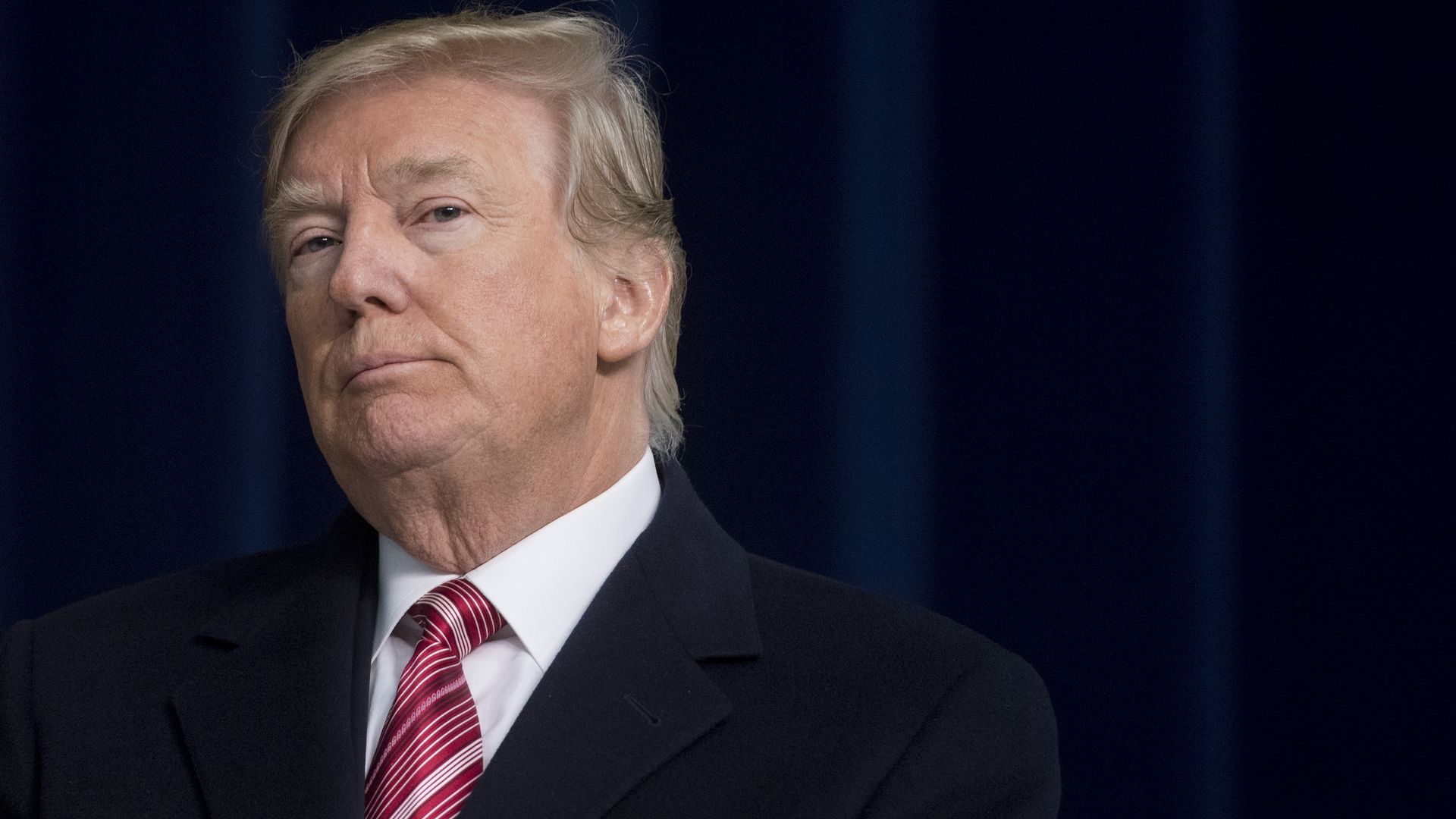
Photo: Saul Loeb / AFP via Getty Images
In Singapore, the death penalty is mandatory for drug trafficking offenses. And President Trump loves it. He’s been telling friends for months that the country’s policy to execute drug traffickers is the reason its drug consumption rates are so low.
"He says that a lot," said a source who's spoken to Trump at length about the subject. "He says, 'When I ask the prime minister of Singapore do they have a drug problem [the prime minister replies,] 'No. Death penalty'."
He often jokes about killing drug dealers... He’ll say, 'You know the Chinese and Filipinos don’t have a drug problem. They just kill them.'
— A senior administration official to Axios
But the president doesn't just joke about it. According to five sources who've spoken with Trump about the subject, he often leaps into a passionate speech about how drug dealers are as bad as serial killers and should all get the death penalty.
Trump tells confidants a softer approach to drug reform — the kind where you show sympathy to the offenders and give them more lenient sentences — will never work.
He tells friends and associates the government has got to teach children that they'll die if they take drugs and they've got to make drug dealers fear for their lives.
Trump has said he would love to have a law to execute all drug dealers here in America, though he's privately admitted it would probably be impossible to get a law this harsh passed under the American system.
Kellyanne Conway, who leads the White House's anti-drug efforts, argues Trump's position is more nuanced, saying the president is talking about high-volume dealers who are killing thousands of people. The point he's making, she says, is that some states execute criminals for killing one person but a dealer who brings a tiny quantity of fentanyl into a community can cause mass death in just one weekend, often with impunity.
The substance: Trump may back legislation requiring a five-year mandatory minimum sentence for traffickers who deal as little as two grams of fentanyl. Currently, you have to deal forty grams to trigger the mandatory five-year sentence. (The DEA estimates that as little as two milligrams is enough to kill people.)
Fentanyl is a synthetic opioid, and much of it is manufactured in Chinese labs. It can be lethal in extremely small doses. Of the 64,000 people who died of drug overdoses in 2016, more than 20,000 overdosed on synthetic opioids like fentanyl, according to the National Institute for Drug Abuse.
Between the lines: Conway told me this kind of policy would have widespread support. “There is an appetite among many law enforcement, health professionals and grieving families that we must toughen up our criminal and sentencing statutes to match the new reality of drugs like fentanyl, which are so lethal in such small doses,” she said.
"The president makes a distinction between those that are languishing in prison for low-level drug offenses and the kingpins hauling thousands of lethal doses of fentanyl into communities, that are responsible for many casualties in a single weekend."
What's next: Trump wants to get tough on drug traffickers and pharmaceutical companies. Stay tuned for policy announcements in the not-too-distant future.
Trump and some of his advisers are discussing whether they might adopt other aspects of Singapore's "zero tolerance" drug policies, like bringing more anti-drug education into schools.
Both Conway and the First Lady Melania Trump, who has taken a strong interest in the administration's anti-drug policies, support getting better drug education and prevention into schools.
Get more stories like this by signing up for our weekly political lookahead newsletter, Axios Sneak Peek.
President Trump boards Air Force One on a windy day at Andrews Air Force Base yesterday. (Nicholas Kamm / AFP / Getty Images)
With his announcement yesterday that he's considering $100 billion more tariffs on Chinese goods, President Trump created confusion within his administration and abroad because of a negotiating style you could call "governing by bluffing."
This is how he has lived his whole life: promising big things, and creating on-the-edge, "Apprentice"-style drama — then changing his mind.
He threatened to veto a spending bill that conservatives hate, then signed it.
He announced stiff tariffs on imports of steel and aluminum, then the administration started negotiating tons of carve-outs.
He talks of war with North Korea, then agrees to meet with Kim Jong-un.
He muses openly of replacing top aides, including White House Chief of Staff John Kelly, then lets them stay.
How Trump views negotiating, based on conversations by Jonathan Swan and me:
Unlike most politicians, he sees the “announcement” not as the rollout of a policy, but as the starting point for negotiations.
The word Trump uses all the time privately, and sometimes publicly, is “flexible.” Everything is up for negotiation. Everything is zero sum.
And he always needs a scorecard, to know minute-by-minute who is “winning.” With foreign countries like China, his scorecard is the trade deficit.
So the bluff is really just his extreme, gambler’s negotiating style: Make a maximalist ask, frame the debate around that, and go from there, improvising all the way.
It worked sometimes in his business career but it also failed a bunch, most spectacularly in Atlantic City when his casinos went bust and he temporarily gave his life over to his creditors.
It’s too early in his presidency to tell definitively whether his negotiating tactics will work in international relations.
As Eurasia Group's Ian Bremmer points out, Trump has already gotten some concessions out of the Chinese and South Koreans, so the approach hasn't been a total failure.
A source close to Trump tells us: "Being a 'bluffer' only works when you have a history of actually following through. Trump has followed through on his threats enough that it's impossible to determine what he's really thinking."
Be smart: Trump is right that his wild unpredictability gives him leverage and keeps people guessing. But his style stirs wild uncertainty and market volatility daily.
Donald Trump thought Japan was taking advantage of the U.S. in the 1980s, but now it's his closest partner in confronting a new rival: China.
The bottom line: The U.S. and Japan agree on the threat posed by an increasingly ambitious China. But Japan wants to counter China through international partnerships, while, under Trump, the U.S. is actively retreating from those alliances in favor of going after Beijing alone.
The backstory
Yuki Tatsumi, director of the Japan Program at the Stimson Center, says Japan "was the first to recognize China's disruption of the existing world order."
At the height of its economic bubble in the 1990s, Japan's economic capacity mirrored that of China today. And Tokyo can offer valuable lessons to Beijing on how to deal with an aging society. But the relationship between the countries is defined by their differences.
Values matter when it comes to dealing with China, because values are the major difference between Japan and China.
— A Japanese diplomat
Now the U.S., India and Australia have joined Japan in its apprehension about China's widening influence, in part because China is starting to infiltrate their own neighborhoods. Chinese cash has reached Latin America's shores, and its ships are appearing in the Indian Ocean.
Japan's plan
Here's how it wants to counter China:
Partner up: Japan sees the Trans-Pacific Partnership as its key tool, says Dan Sneider, a Stanford expert on the region.
The TPP's diplomatic and economic prowess was weakened when Trump pulled the U.S. out of it, but the remaining 11 countries have since reached a new deal.
And it's still a powerful tool for setting international trade standards, says Sneider. The TPP includes guidelines on intellectual property theft and state-run enterprises — two areas where China is bending the rules.
Be the alternative: The Japanese have been competing with Beijing for infrastructure projects in Indonesia, Burma and Vietnam, hoping to offer those countries a second option for development.
Use the private sector: This year, Japanese companies could beat their Chinese counterparts in securing overseas deals for the first time since 2012, per Bloomberg.
But these are the roadblocks:
Changes in leadership: Prime Minister Shinzo Abe, a conservative leader, has taken an especially strong stance against China, but it's not clear whether his successor — whenever power changes hands — will make countering Beijing a top priority.
Courting the U.S.: Japan can't afford to go head-to-head with Chinese foreign investment. Only the U.S. can do that. But, as the U.S. actively retreats from international trade deals under "America First," Washington isn't competing with Chinese dollars in the developing world.
The Trump factor
The big issue: Trump is complicating Japan's plan. "The Japanese say that Trump is kind of stuck in the 80s" in terms of his view of Tokyo, Sneider says. Japan was surprised when it wasn't exempted from Trump's steep tariffs on steel and aluminum.
But the U.S. is an irreplaceable partner for Japan, especially when it comes to protecting the East China Sea, and Japanese government officials know that whatever the president does, "they have to live with it," he says.
And Japan is also "banking on this administration’s very suspicious, very hostile attitude toward China," says Tatsumi. It's in Tokyo's interest for Trump to keep doubting Chinese intentions.