Climate scientists refute 12-year deadline to curb global warming

Add Axios as your preferred source to
see more of our stories on Google.
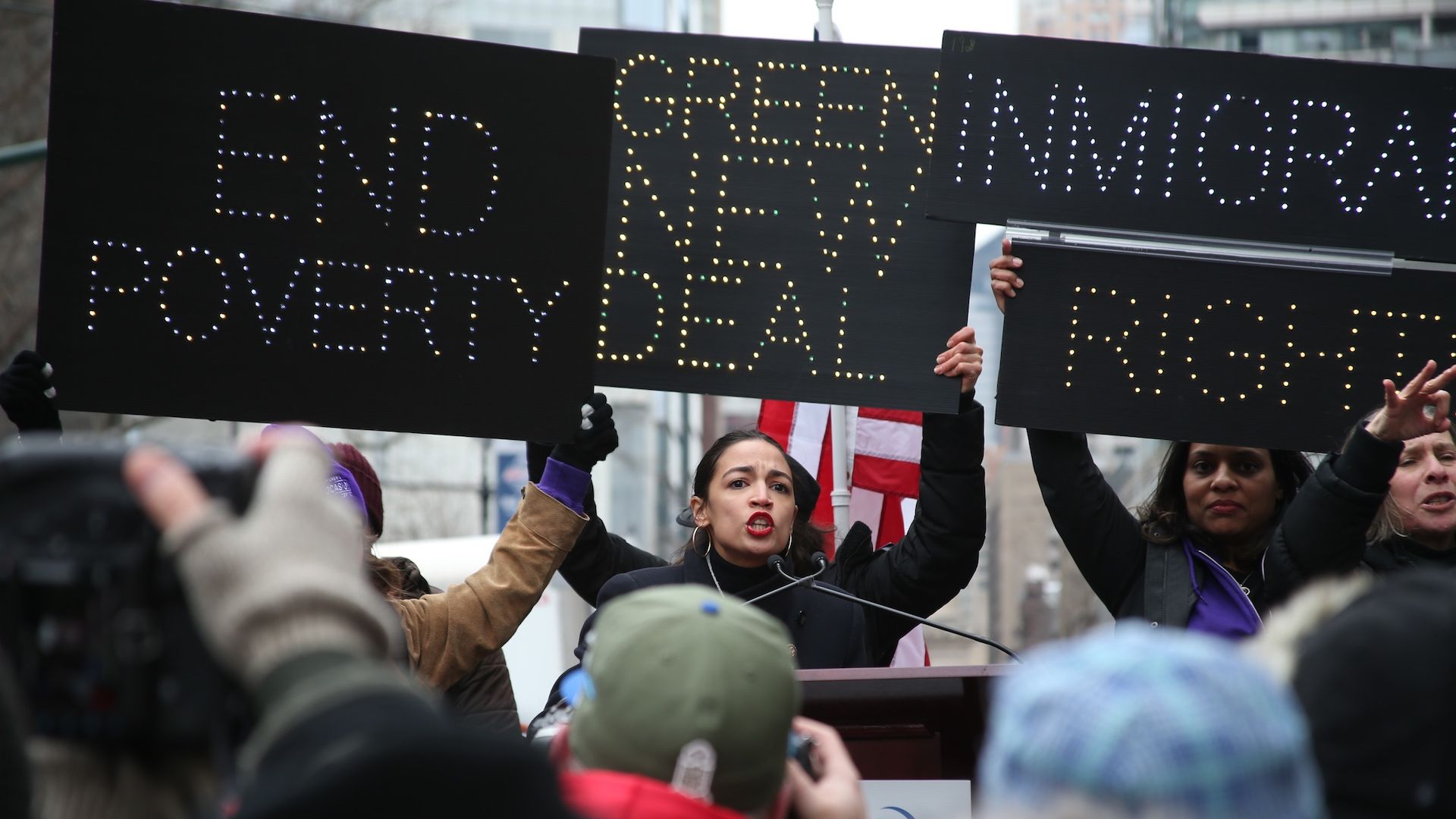
Rep. Alexandria Ocasio-Cortez attends the Women's March on Jan. 19 in New York City. Photo: Rob Kim/Getty Images.
Prominent climate scientists are pushing back against the view, promoted by media coverage of recent science reports as well as climate advocates, that we have only 12 years to act on global warming or face an existential threat to humanity.
Why it matters: This do-or-die framing has found a powerful advocate in Democratic freshman Rep. Alexandria Ocasio-Cortez, who said on Monday that millennials understand that we only have 12 years or "the world is going to end." She is pushing a broad policy proposal to address climate change, known as the Green New Deal.
The big picture: During the past year, several scientific reports have been released that underscore the urgency of slashing emissions of greenhouse gases to avoid facing severe consequences from global warming.
A particularly influential report was published by the UN Intergovernmental Panel on Climate Change (IPCC) in October 2018. It found that global warming could still be held to 1.5°C, or 2.7°F, of warming relative to preindustrial levels, especially if:
- Net human-caused carbon dioxide emissions decline by 45% by 2030 compared to 2010 levels, and reach "net zero" by roughly mid-century.
The catch: While there were only 12 years left till 2030 when the IPCC report came out, the reality is that we have a diverse array of choices before us in terms of how soon to make emissions cuts and how significant and costly they are, top climate scientists told Axios. Their comments were about the framing of a rigid 12-year timetable in general, not specifically in reaction to Ocasio-Cortez's remarks.
What we're hearing: "12 years isn't a deadline, and climate change isn't a cliff we fall off — it's a slope we slide down," said Kate Marvel, a climate scientist at NASA. "We don't have 12 years to prevent climate change — we have no time. It's already here. And even under a business-as-usual scenario, the world isn't going to end in exactly twelve years."
- In reference to Ocasio-Cortez's comments, Marvel said: "She's right that decisions we make in the next decade will determine how bad climate change gets — we can't prevent bad things, but we have the power to avoid the worst-case scenario."
Katharine Hayhoe, a climate scientist at Texas Tech University, told Axios that the idea that there is only a finite amount of time to fix climate change is the wrong way to look at the problem. She summed up the IPCC's 1.5-degree report this way: "Every action matters. Every bit of warming matters. Every year matters. Every choice matters."
- Hayhoe says she worries that deadlines will make people treat climate change more cavalierly to start, since 12 years can seem like a long time.
The rhetoric used by Ocasio-Cortez and many others in favor of bold action suggests that either scientists or the media, or both, got the IPCC report wrong.
Andrea Dutton, a paleoclimate researcher at the University of Florida, said the 12-year deadline became attractive for media headlines in spite a lack of support from the IPCC report itself:
"For some reason the media latched onto the 12 years (2030), presumably because they thought that it helped to get across the message of how quickly we are approaching this and hence how urgently we need action. Unfortunately, this has led to a complete mischaracterization of what the report said."
Reality check: "All the time-limited frames are bullshit," Gavin Schmidt, who leads NASA's Goddard Institute for Space Studies in New York, told Axios in an email. "Nothing special happens when the 'carbon budget' runs out or we pass whatever temperature target you care about, instead the costs of emissions steadily rise," he said. The IPCC report, for example, found the impacts worsen considerably beyond 1.5°C of warming.
- "The thing to push back against is the implicit framing that there is some magic global mean temperature or total emissions that separate 'fine' from 'catastrophic'. There just isn't," Schmidt said.
The bottom line: Even if hard deadlines are scientifically flawed, they can be effective when it comes to activism. The 12-year timeframe, in particular, has been widely adopted by proponents of climate action.
- "We can quibble about the phraseology, whether it's existential or cataclysmic" impacts that we'll face without taking action in the next 12 years, Ocasio-Cortez spokesman Corbin Trent told Axios. But, he says, the reality is: "We're seeing lots of [climate change-related] problems that are already impacting lives."
Go deeper:
