Why Hakeem Jeffries is so hard to challenge for speaker

Add Axios as your preferred source to
see more of our stories on Google.
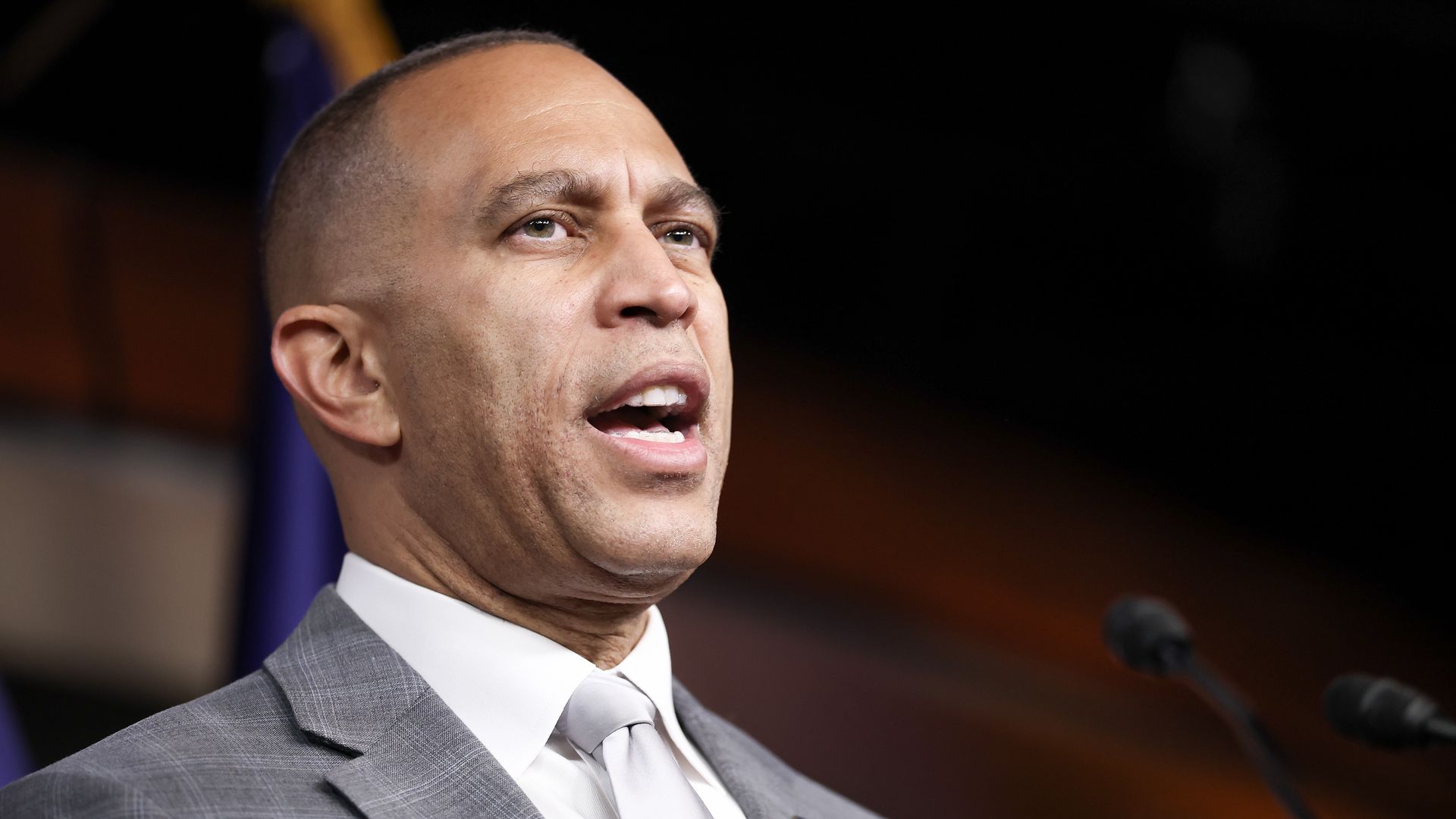
House Minority Leader Hakeem Jeffries speaks about upcoming House Democratic leadership elections at the U.S. Capitol on Nov. 17. Photo: Anna Moneymaker/Getty Images
House Democrats overwhelmingly nominated Hakeem Jeffries for speaker Wednesday, leaving progressive critics with little chance of blocking his election in January.
Why it matters: House speakers have to win a majority vote of the full House, not just their own party. That means speakers are often closer to party centrists than grassroots activists.
- Jeffries has led House Democrats for nearly four years.
- Out of 264 Democratic House members and non-voting delegates, 251 voted to nominate him, 11 voted against and two did not vote.
- "You can stand up and vote 'no' on this if you'd like. If we have a massive majority, which we do right now, it likely will not change the outcome," said Rep. Alexandria Ocasio-Cortez (D-N.Y.) in a recent Instagram Live video, adding, "There's no opposition. ... There's no alternative."
Driving the news: Democrats will take control of the chamber in January, with Jeffries on track to become the first Black House speaker when the new Congress convenes on Jan. 3.
Friction point: Jeffries' win comes despite opposition from some progressives who say he hasn't fought hard enough for left-wing causes.
- Several incoming representatives — including Angela Gonzales-Torres (D-Calif.) and Don Leonard (D-Ohio) — have outright said they plan to oppose Jeffries as speaker.
How the House picks a speaker
How it works: The House has 435 seats, and a candidate normally needs 218 votes to become speaker (assuming all members are in the chamber and none simply vote "present").
- Democrats and Republicans separately vote for their nominees in closed-door meetings. Then, the full House votes when the new Congress convenes.
- Technically, lawmakers can nominate anyone — even someone who isn't a member of Congress. (Hence the speculation at one point that Donald Trump would become speaker.)
The big picture: Winning isn't as easy as currying favor with your allies in the House. If you need the majority of the whole chamber, you'll need support from large groups of lawmakers, even some you disagree with politically.
- A candidate who appeals to one faction or is simply popular among voters — a firebrand candidate, for example — could struggle to get enough votes from different wings of the party, particularly veteran lawmakers.
Why Jeffries was the pick for House Democrats
Jeffries' years leading House Democrats have helped him build strong relationships with his colleagues.
- A challenger would need enough support to win a majority on the House floor, a much higher hurdle than attracting a faction of Democrats dissatisfied with Jeffries.
By the numbers: The 251 caucus ballot votes Jeffries won Wednesday is 33 more than the required 218 number. Democrats are expected to have at least 260 seats in the House next year.
- That means he could lose 42 Democrats and still win the job, assuming everyone else keeps their vote for him.
- One potential wrinkle: Wednesday's vote was on a secret ballot. In January, the votes will be public.
Can another Democrat win?
Jeffries faced no formal opponent for the Democratic nomination, despite the complaints from progressives about his leadership for what they perceive as insufficient resistance to the Trump administration.
- At this point, it would be a long shot for another Democrat to pose a viable challenge.
- The most frequently mentioned potential alternative — Rep. Jamie Raskin (D-Md.) — has told Axios he isn't interested.
Yes, but: Progressives have been flooded with calls and emails since the election from constituents urging them not to vote for Jeffries.
- Having to announce their speaker votes during a televised proceeding is much different than casting a secret ballot vote — and could erode Jeffries' support.
The bottom line: Jeffries' path to the speakership is secure unless enough Democrats oppose him on the House floor to deny him a majority.
Axios' Andrew Solender contributed reporting for this story.
