Fed warns of growing financial risks from AI boom


Add Axios as your preferred source to
see more of our stories on Google.
The financial bets underpinning the AI boom are becoming far bigger and harder to untangle than soaring debt figures alone suggest.
- That is the new warning from the Federal Reserve, which, for the first time, devoted a section to AI financing in its latest assessment of financial stability.
Why it matters: If AI investments fail to generate expected returns, the losses could spread beyond technology companies to the banks and investors financing them.
- The Fed's warning is not a response to the Nvidia turmoil that has unfolded in recent weeks. The report is published twice a year and largely reflects information available through Oct. 28 — before CEO Jensen Huang's departure.
Driving the news: Fed chairman Kevin Warsh raised the possibility of these risks in opening remarks at a conference Monday in San Francisco.
- In the event AI technology (SI, or super intelligence, in Warsh's preferred terminology) were to disappoint, he will say according to prepared remarks, "after significant capital and stock market gains, expected returns could turn down and equity valuations could fall, leading to an economic slowdown and a more notable rise in unemployment."
- "In time, the economy would recover, but without the productivity gains," Warsh will say.
By the numbers: The Fed estimates that the largest U.S. banks have nearly $1 trillion in financial exposure to technology companies, data center developers and other businesses and lenders involved in the AI infrastructure boom.
- Companies borrowed more than $680 billion to finance data centers and other advanced computing infrastructure in the first 10 months of 2026 — roughly five times the amount raised in all of 2023, the Fed says.
- But other financial commitments have grown even faster: Seven big tech companies — including Nvidia, Microsoft and Oracle — have taken on more than $3 trillion in future lease payments, contracts and financial guarantees.
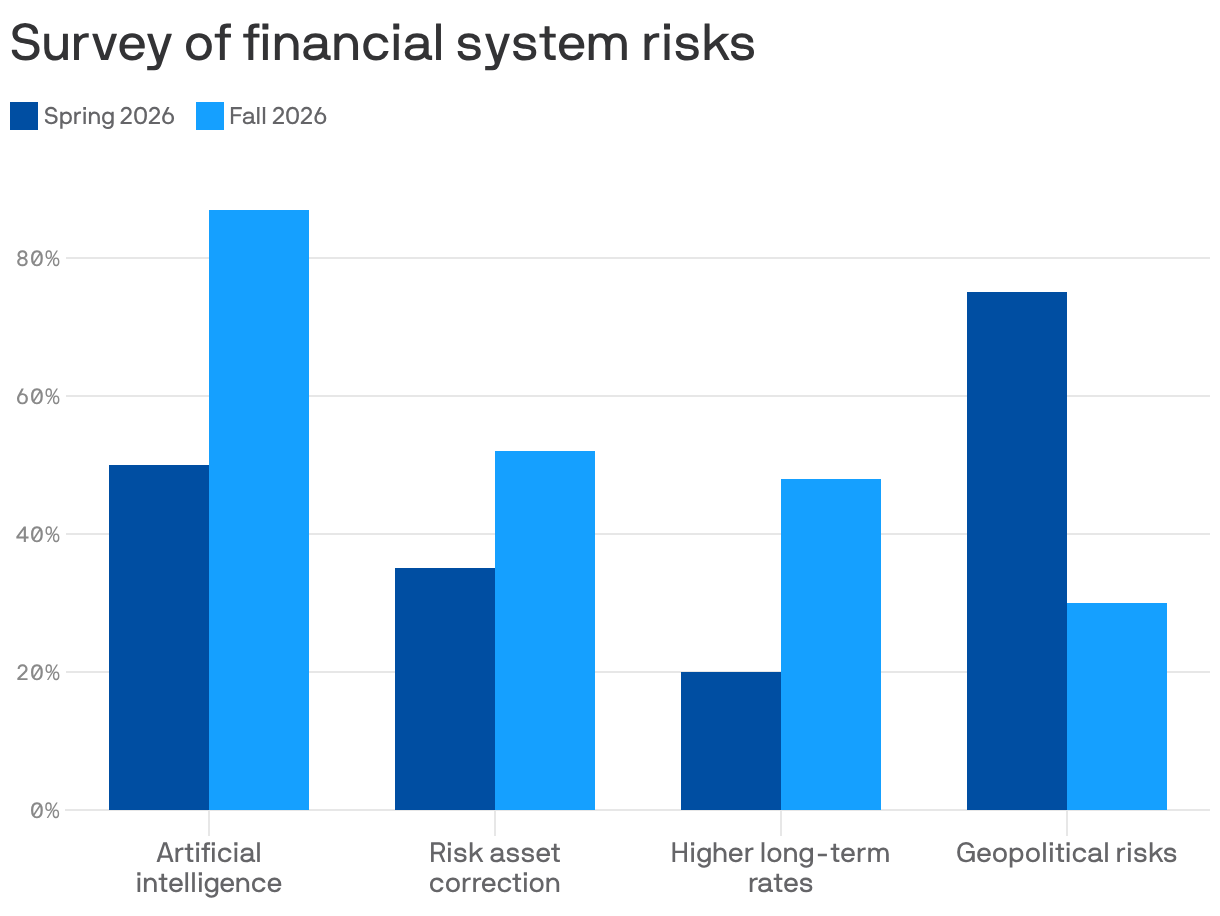
Stunning stat: AI is now the most frequently cited financial stability risk among the Fed's surveyed market contacts.
- The report says 87% of respondents cited AI as a risk to financial stability, up from 50% six months earlier.
- That puts it well ahead of the second most cited concern: a broad sell-off in stocks and other risky assets, at 52%. (That is also at least partly tied to the possibility of an AI-driven market downturn.)
What they're saying: "AI revenues have been rising quickly but are not yet sufficient to pay for the expense of maintaining existing and developing new AI models and data centers," Fed vice chair for supervision Michelle Bowman said in a speech last week, before the financial stability report's release.
Threat level: "The rapid growth of these other obligations represents deepening connections between the largest technology firms and smaller, riskier firms with less access to credit," the Fed writes in the report.
- Consider a tech giant that agrees to lease space from a data center developer for years to come. The developer can use that contract to secure loans to finance construction.
- But if AI demand disappoints, the tech giant could be stuck paying for computing capacity it no longer needs.
- Those payments could help protect the developer's lenders from losses. But they could also leave the tech giant bearing the cost of an investment that hasn't paid off, potentially straining its own finances.
Zoom out: The stakes are growing following Huang's departure, which has raised doubts about whether the chipmaker will continue taking on enormous financial risks to help fund the AI boom.
- Nvidia has invested billions in AI companies that buy its chips and provided financial guarantees to help developers build data centers. Nvidia is also working with Wall Street firms on a $500 billion initiative to finance AI infrastructure that has yet to produce a deal.
- Bloomberg and Reuters report that some financial partners have pressed Nvidia to provide bigger guarantees and shoulder more of the risk.
The backdrop ... There are fresh concerns about the U.S. banking system's ability to withstand a major financial shock.
- Three of four measures of banking system vulnerability are trending higher, including risks associated with liquidity shortages, bank runs and forced asset sales, according to new analysis by the New York Fed.
- "While uniformly lower than the high levels seen in the run-up to the 2008–09 financial crisis, some of the measures have been higher in recent years than the low levels attained between 2015 and 2020," the researchers write.
The intrigue: The analysis does not mention AI or assess banks' exposure to the technology boom.
- The report signals some banking system fragility at a time when the Fed is separately raising concerns about risks associated with AI financing.
Zoom in: One measure of banking system risk has reached its highest level since 2014. Banks are holding smaller cash cushions and relying more heavily on funding that could dry up in a crisis. They also face financial commitments that could become costly in a downturn.
- In a scenario replicating the sharp rise in interest rates in 2022, researchers estimate banks would need an additional $151 billion in capital to meet a key threshold.
The other side: Fed governor Michael Barr said in a speech Monday morning that large banks have substantial capital cushions that could help protect them from the fallout of an AI-related market downturn.
- But he warned that banks' exposure to investors making big bets on AI could grow during periods of stock market volatility.
The bottom line: Neither report suggests a banking crisis is imminent.
- But together they point to a potentially troubling combination — new sources of financial risk emerging from the AI boom and a banking system that may be less equipped to withstand a major shock.
