Democrats seize states' overlooked levers of power

Add Axios as your preferred source to
see more of our stories on Google.
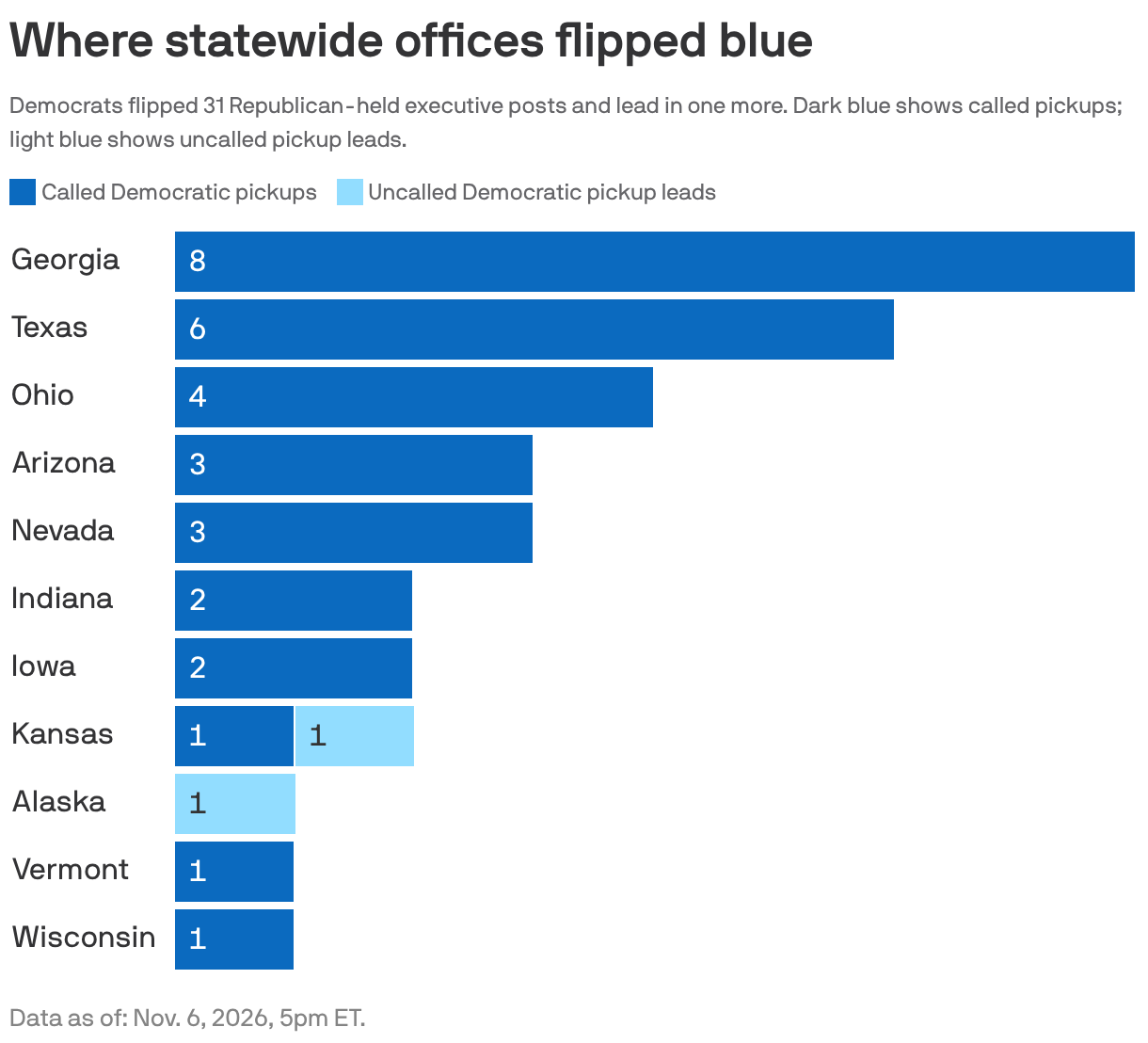
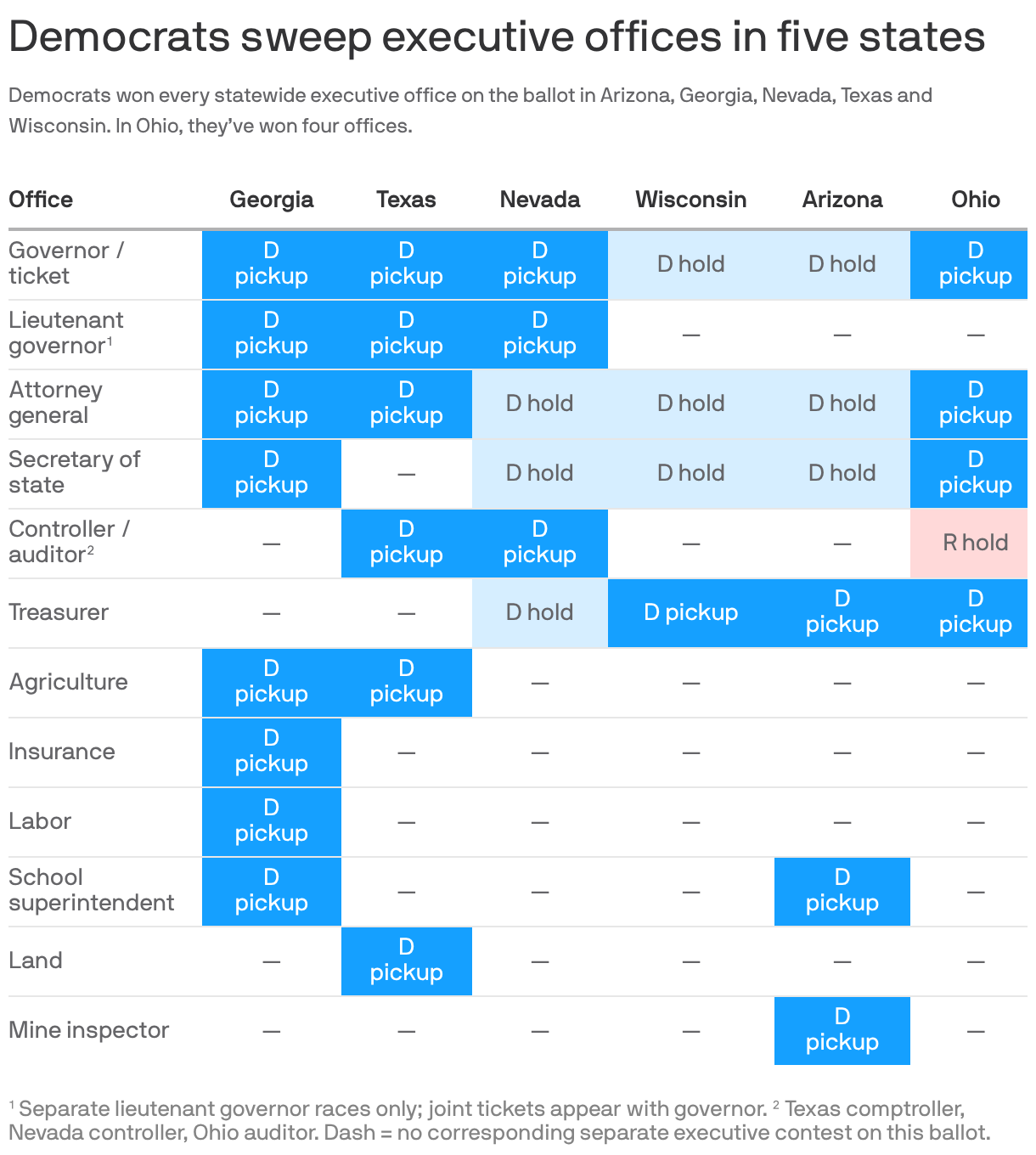
Democrats' midterm gains extended deep into the machinery of state government: They swept every statewide executive office on the ballot in Texas, Georgia, Nevada, Wisconsin and Arizona.
Why it matters: These low-profile victories will shape what millions of Americans pay for electricity, what their kids read in class and which party runs the 2028 presidential election in key states.
The big picture: Democrats captured five Republican governorships, in Texas, Georgia, Ohio, Iowa and Nevada. But the scale of their gains becomes clearer farther down the ballot.
- Georgia: Democrats wrested all eight statewide executive offices on the ballot, including governor, attorney general, secretary of state and school superintendent.
- Texas: They flipped all six posts, defeating Gov. Greg Abbott and Lt. Gov. Dan Patrick in a state that hadn't elected a Democrat to statewide office in 32 years.
- Nevada: Democrats won all six executive offices, flipping governor, lieutenant governor and controller.
- Wisconsin: Democrats completed their Badger State domination, picking up the office of treasurer, the sole statewide office still held by a Republican.
- Arizona: Democrats held governor, attorney general and secretary of state. They lead in the three other executive races: treasurer, school superintendent and mine inspector.
Between the lines: The Democratic gains reach offices that decide which policies advance, which don't and which get challenged in court.
- Attorneys general: Nathan Johnson in Texas and Tanya Miller in Georgia will decide when their states sue the Trump administration and what corporations they investigate.
- Secretaries of state: Democrats flipped these offices in Georgia, Ohio and Indiana, putting new officials in charge of running the 2028 presidential election there.
- Texas' lieutenant governor: Vikki Goodwin will preside over the Senate, where the lieutenant governor picks committee chairs and decides which bills get a hearing.
The intrigue: Some offices are hyper-specific and rarely command national attention, but they have a big influence on the issues Democrats championed this election.
- Utility bills: Shelia Edwards' victory and Peter Hubbard's reelection give Democrats a 3–2 majority on Georgia's Public Service Commission, which sets utility rates and approves long-term electricity plans, putting Democrats in charge of decisions that affect the climate and affordability.
- Oil and gas: Jon Rosenthal's victory breaks Republicans' monopoly on Texas' three-member Railroad Commission, which, despite its name, regulates oil and gas production and pipeline safety.
Classrooms: Democrats won three Republican-held Texas State Board of Education seats and lead in a fourth that would change the majority.
- Publishers have historically tailored the nation's textbooks to the Texas board's conservative curriculum standards. It recently adopted social studies changes that Muslim advocacy groups criticized as discriminatory.
The courts: Democrats won all four Texas Supreme Court seats on the ballot, cutting an all-Republican court to a 5-4 GOP majority.
- They also swept Texas' 15th Court of Appeals, which hears appeals involving state government.
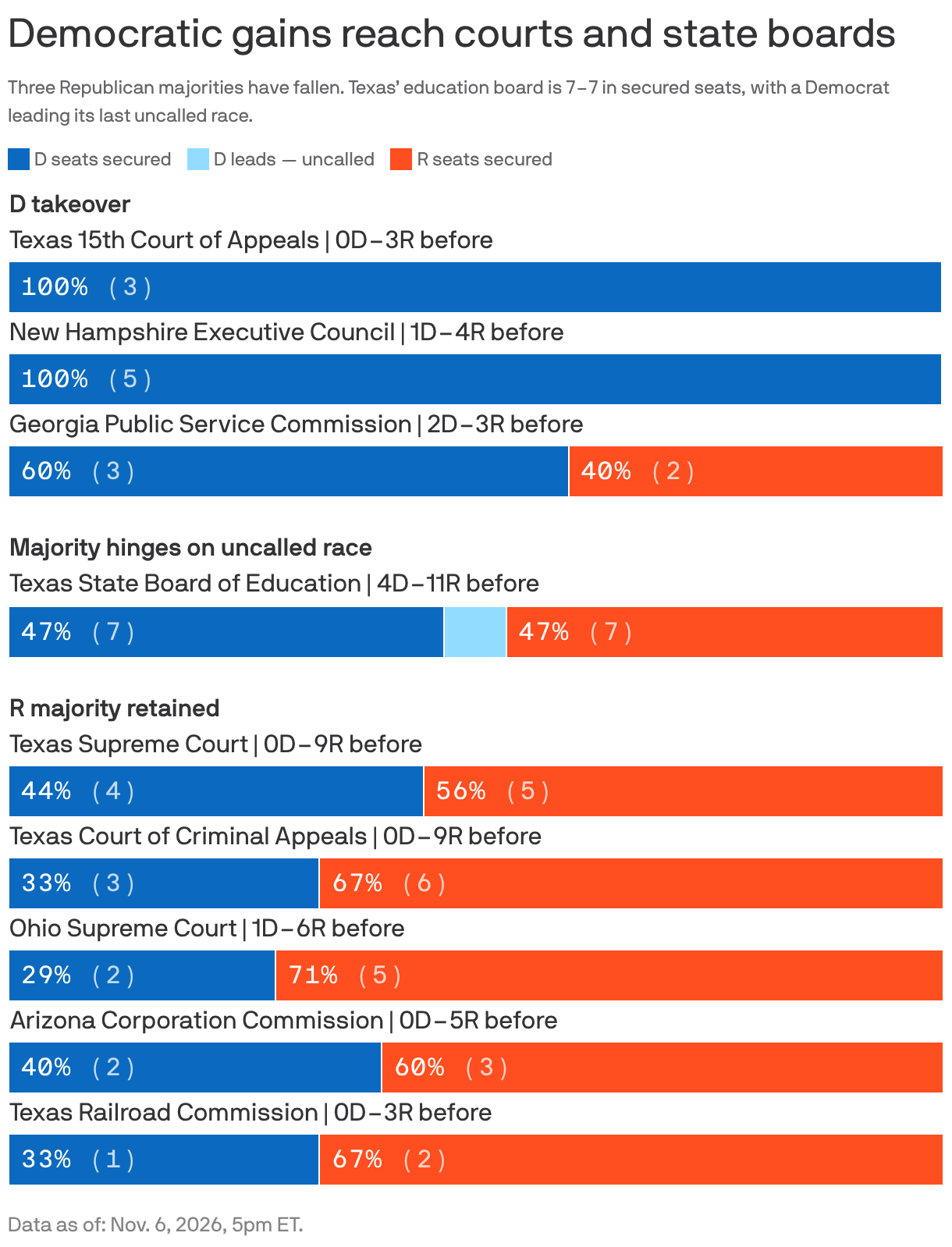
Case in point: Democrats flipped New Hampshire's Executive Council, giving them veto power over Republican Gov. Kelly Ayotte's nominees and major state contracts.
- Republican councillors repeatedly rejected family-planning contracts with Planned Parenthood. A Democratic majority could force compromises.
The bottom line: Many voters couldn't name the officials they just put in charge of their power bills, textbooks and ballots. But they'll soon feel their decisions.
