Nation's largest Indigenous tribe elects its first woman president

Add Axios as your preferred source to
see more of our stories on Google.
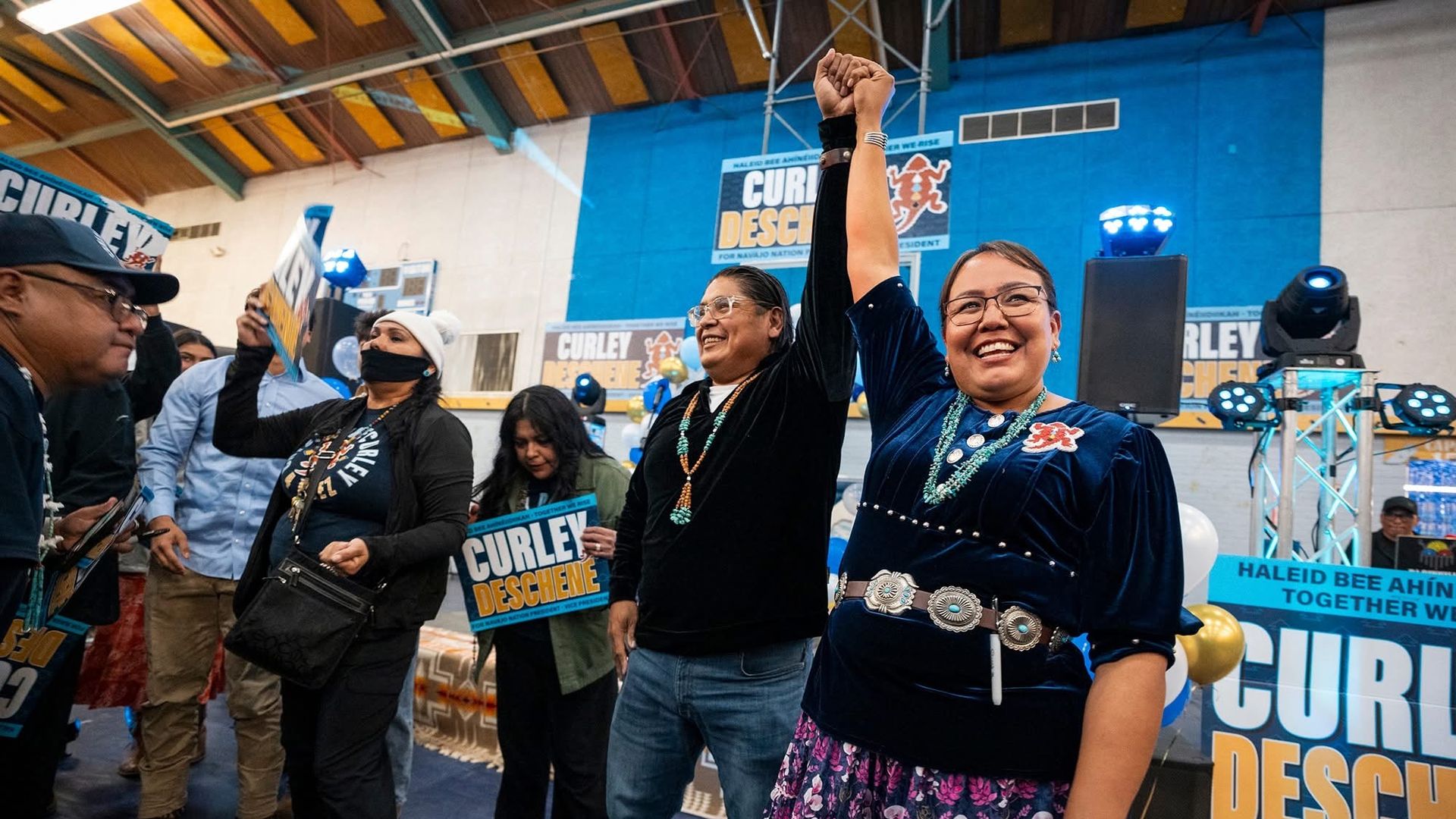
Navajo Nation President-elect and Vice President-elect Crystalyne Curley and Chris Deschene celebrate their win to lead the nation's largest Indigenous tribe in Window Rock, Ariz. Photo: Courtesy of the Curley campaign
Navajo Nation voters made history this week by choosing their first woman president, handing Crystalyne Curley a groundbreaking victory — and a political fight before she even takes office.
Why it matters: Curley's victory breaks a barrier in the Navajo Nation, where women hold deep cultural influence, but men have long dominated the presidency.
Driving the news: Curley, 40, and running mate Chris Deschene defeated Justin Jones and Emily Ellison in the Nov. 3 election, according to unofficial Navajo Election Administration results.
- Curley won 50.88% to Jones' 49.12% — a margin of just 1,115 votes across the Nation's 110 chapters.
- She will succeed President Buu Nygren, whose turbulent bid for a second term ended with a third-place finish in July's primary.
- Her running mate, former Arizona legislator and energy attorney Chris Deschene, returns to tribal leadership politics 12 years after a Navajo-language qualification dispute derailed his presidential campaign.
- The Navajo Nation, the country's largest Native American reservation, spans more than 27,000 square miles across Arizona, New Mexico and Utah and has nearly 430,000 enrolled members, according to June 2026 tribal figures.
Yes, but: Jones refuses to concede and has threatened a legal challenge, alleging irregularities in the vote count. The Navajo Times reported he initially offered no specific discrepancies.
- Tribal election law prevents certification until at least 10 days after the election, leaving time for challenges, according to the site.
Zoom in: Curley now faces a tougher challenge: tackling poverty, delivering basic services and healing a government fractured by years of infighting.
- About 35.2% of residents of the Navajo Nation Reservation live below the poverty line, compared with 12.5% nationally, according to 2024 American Community Survey five-year estimates.
- Between 30% and 40% of Navajo families lack running water at home, according to an April 2026 statement from the outgoing administration.
- An estimated 10,000 families still lack electrical service, according to the American Public Power Association.
What they're saying: "This could not have been possible without the Navajo People. This is your victory. We worked hard because we said we wanted a positive direction," Curley said in a statement.
- "Thank you for believing in this team. This is a new direction for our people."
What's next: Curley faces a high-stakes battle over drilling near sacred sites in the Southwest.
- The Trump administration is reviewing whether to reverse federal protections covering roughly 336,400 acres around Chaco Culture National Historical Park in New Mexico, potentially reopening federal lands to new oil and gas leasing.
- Curley joined Nygren in 2023 in criticizing the 10-mile drilling buffer created by then-Interior Secretary Deb Haaland. (Haaland was herself elected governor of New Mexico this week.)
- Navajo leaders raised concerns over sovereignty and the economic interests of individual Navajo landowners, while other Indigenous advocates backed stronger protections.
- The federal restrictions do not directly prohibit drilling on Navajo allotted lands.
